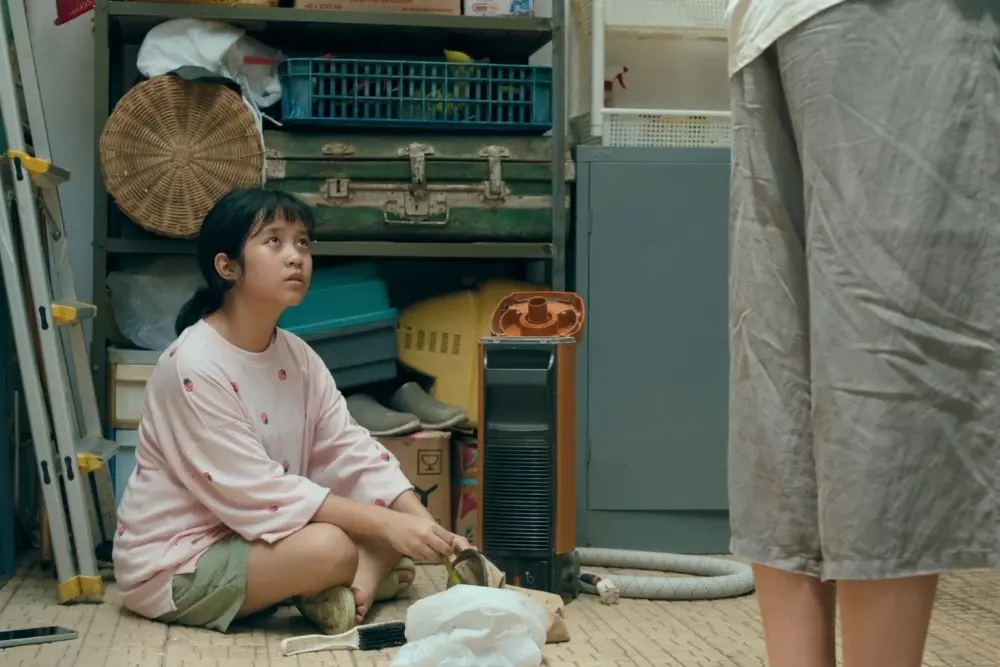
After a decade-long hiatus from the director’s chair, Indonesian filmmaker Ariani Darmawan has made a poignant return to the craft with her first feature, "Jani Be Good." Currently competing in the Asian Future section of the Tokyo International Film Festival, the film serves as a deeply personal exploration of the complexities inherent in womanhood, motherhood, and the often-unspoken dynamics that define the household. For Darmawan, who stepped away from professional filmmaking to focus on raising her child, this project is more than just a return to work; it is an examination of the invisible labor and emotional currents that bridge three generations of women.
"I stopped making films for over 10 years because I was having a kid and looking after my family, so getting back to it was all I really wanted," Darmawan reflects in an interview with Variety. The transition from full-time caregiver to director was a deliberate reclamation of her identity, one that allowed her to channel her personal experiences into a narrative that feels both intimate and expansive.
Set against the backdrop of four days in December leading up to Christmas, "Jani Be Good" centers on the life of 13-year-old Jani. The family’s delicate stability is shattered when Jani overhears a heated argument between her 18-year-old sister, Julia, and their mother, Winnie. The confrontation leads to Julia’s departure from home, a catalyst that forces the remaining women to navigate a sudden void. Winnie, a single mother balancing a career as an accountant with the labor-intensive side-hustle of fulfilling fruit hamper orders, becomes increasingly short-tempered with the daughter who stayed. Meanwhile, Jani finds solace in secret communication with her sister and leans on her grandmother, "Oma," who spends her days meticulously preparing spring rolls to sell, quietly saving money for her own future funeral. The household, rooted in a Chinese-Catholic background, serves as a microcosm for the tensions and silent sacrifices shared by many families.
The ensemble cast features Chempa Puteri, Sigi Wimala, Tutie Kirana, and Hyori Mika. The screenplay, co-written by Darmawan and Cyntha Hariadi, was brought to life by producers Taurisia and Muhammad Zaidy of the Jakarta-based Palari Films. Founded in 2016, Palari Films has scheduled a theatrical release for the project in Indonesia on December 10.
The inception of the film dates back to 2022, when Taurisia, a longtime friend of the director, approached Darmawan with an offer to helm a family drama—a genre for which Darmawan harbors a genuine passion. As a working mother, Darmawan found herself uniquely attuned to the unseen, daily care work that sustains a family—a reality she had previously overlooked. The process of becoming a mother fundamentally altered her perspective on her own upbringing and her relationship with her mother.
"As a kid, I watched her keep the family running, rummaging through things at her desk, making phone calls, cooking dinner, but I never wondered how she felt," Darmawan says. "It took having my own family, in my late thirties, to understand how exhausting and all-consuming it is."
Darmawan notes that her position as the youngest child in her own family, while often resulting in being underestimated or treated as the one who understood the least, provided her with a distinct vantage point. "That’s exactly what gave me the freedom to watch things from a distance," she explains. "You could say you can only see the constellation when you’re standing outside it."
In the film, the character of Jani is frequently urged to "be good," an ironic instruction given that she is already a dutiful child. As the narrative progresses, the audience—alongside Jani—begins to perceive her mother, sister, and grandmother not as archetypes of maternal roles, but as individuals with their own distinct desires, frustrations, and human failings. A common misconception, Darmawan notes, is that an all-female household is inherently more harmonious. She challenges this, asserting that familial conflict is universal, regardless of the gender composition of the family.
"Communication can break down between women too, especially because of the power dynamics in a family, where the mother, especially if she’s the breadwinner, feels she has the most right to speak the loudest," she observes.
Darmawan highlights a cultural trend in many Asian families where silence is preferred over confrontation to avoid causing pain to a relative. "But that ends up hurting us even more," she argues. "If it keeps getting held in and never confronted, it stays a wound and gets passed down to the next generation." This cycle of silence is a central theme in the film, which subtly depicts how the women protect themselves behind locked gates and barred windows, a visual metaphor for the emotional walls erected within the home.
Despite the friction, Darmawan was adamant that Winnie should not be portrayed as a villain. "I think I understand Winnie because I’m a mother too," she explains. "I know how easy it is to feel like the one who has the right to speak the loudest. So I didn’t want to judge her." This empathetic approach was shared by the co-writers and producers, who drew heavily on their personal lives as daughters and mothers to ensure the characters remained nuanced.
The transition to co-writing with Hariadi presented a significant creative hurdle for Darmawan, who had primarily authored her previous projects solo. The task involved adapting Hariadi’s prose into scenes that maintained the structural requirements of a feature film without stripping away the writer’s unique voice.
Darmawan’s background in short films and documentaries—including "Sugiharti Halim," which competed at Clermont-Ferrand and screened at Rotterdam and Busan, and "Silenced," which also played at Rotterdam—provided the essential training ground for her debut feature. She describes those early projects as "homebound and DIY," emphasizing her ability to observe quietly and allow spaces and characters to carry the weight of a scene. Taurisia, who had followed Darmawan’s career since the early 2000s, notes that it was the maturity of Darmawan’s vision regarding womanhood that convinced Palari Films to move forward with the project.
The production itself was a compact, highly focused affair. Filmed over just 13 days in a house in Bandung—a record-short shoot for Palari—the team prioritized preparation. Two months before filming, the director, writers, and the four leads gathered at the location to read the script, followed by rehearsals in Jakarta and a final two-week prep period at the location with cinematographer Teoh Gay Hian and production designer Suherina. Because the actors were unfamiliar with one another, the casting process was heavily centered on chemistry tests designed around Puteri.
Taurisia’s role in the production was one of supportive trust, allowing the director full autonomy. "I sat in on the whole process, but when it comes to the final call, I like to leave it to the director," Taurisia says. "She’s the chef, and she knows her ingredients best."
For Palari Films, which achieved international acclaim with the Golden Leopard-winning "Vengeance Is Mine, All Others Pay Cash" and has produced a diverse array of content including "Posesif," "Aruna and Her Palate," and the Netflix original "Borderless Fog," "Jani Be Good" represents a commitment to supporting artistic voices despite the lack of international development funding. Taurisia acknowledges the difficulty of balancing festival prestige with commercial viability in the Indonesian market, where films are often judged by their performance in the first few days of release.
To mitigate these risks and foster a more sustainable model, Palari launched the "Kelas Komunitas Palari" (Palari Community Class) this year. This workshop series empowers regional film communities to organize their own screenings and watch parties, with "Jani Be Good" serving as the inaugural test case. "How can we build film careers, let alone sustainable ones?" Taurisia asks, pointing to the structural gaps in the Indonesian film value chain.
The company continues to cultivate a slate that balances veteran directors like Edwin with rising talents such as Aditya Ahmad and Khozy Rizal. For Darmawan, the future remains tied to the organic intersection of her family life and her creative pursuits, including her work at the independent library and bookstore Kineruku. As she looks forward to future projects, she remains guided by a simple, enduring interest. "As for themes, I’m open to anything, as long as it has sad and sweet relationships between people," she says. "That’s where things get complicated and interesting."