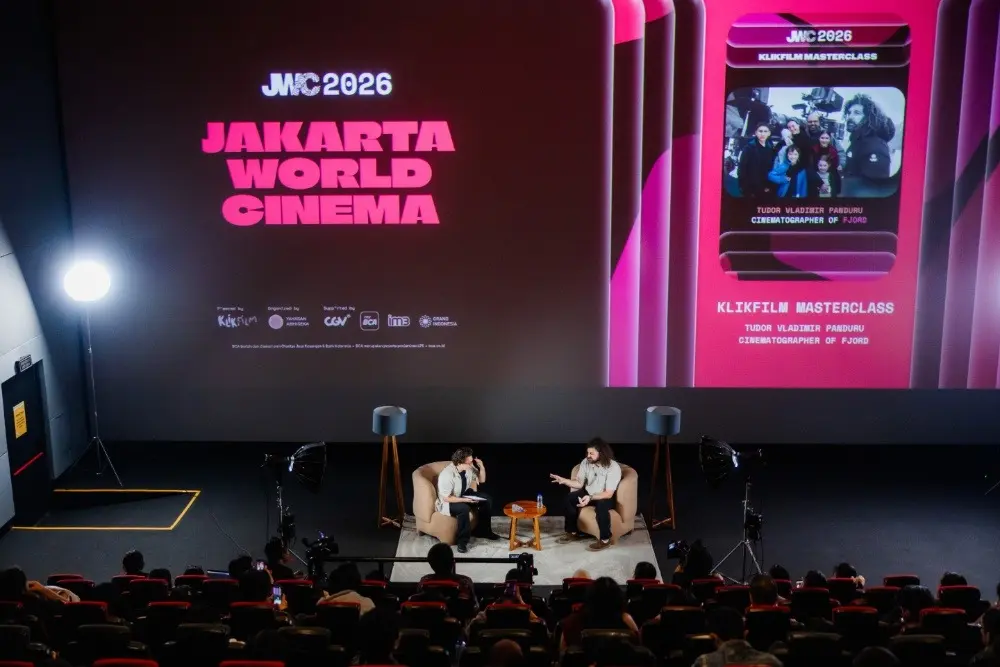
At the recent Jakarta World Cinema festival, the spotlight turned toward the meticulous and disciplined world of European auteur cinema, specifically through the lens of acclaimed cinematographer Tudor Vladimir Panduru. Known for his profound and long-standing creative partnership with Romanian director Cristian Mungiu, Panduru sat down for an extensive masterclass that offered a rare, behind-the-scenes look at the technical rigor and philosophical depth required to bring some of modern cinema’s most striking images to life.
The session was moderated by Benh Zeitlin, the Oscar-nominated director of Beasts of the Southern Wild. Setting the stage for the discussion, Zeitlin expressed a personal admiration for the cinematographer’s work, revealing that he had requested to moderate the session with the hope of a future collaboration. Zeitlin praised Panduru’s unique ability to elevate a director’s vision, describing him as a rare talent who can "bring a dimension to your work that is beyond your personal imagination."
The masterclass served as a chronological retrospective of Panduru’s career, beginning with an exploration of his breakthrough work on Mungiu’s Graduation. Panduru’s journey into the upper echelons of global cinema began early; he cut his teeth training under Oleg Mutu, the veteran cinematographer responsible for the visual identity of Mungiu’s Palme d’Or-winning masterpiece, 4 Months, 3 Weeks and 2 Days. Having been introduced to Mungiu during his formative years as a trainee, Panduru eventually stepped into the role of cinematographer, with Graduation serving as his second major feature—the project that would ultimately secure his reputation on the international stage.
Throughout the session, Panduru emphasized a core tenet of his work with Mungiu: the camera is intended to remain low-profile. The goal is never to manipulate the audience or force their gaze toward specific narrative cues, but rather to allow the scene to breathe. Panduru maintains a firm belief in the intelligence of the viewer, arguing that audiences are "smart enough to understand what’s going on there" without needing the camera to act as a heavy-handed narrator.
A significant portion of the masterclass was dedicated to the grueling, yet rewarding, nature of the plan-séquence—the long, uninterrupted take. Mungiu’s signature style relies heavily on these long shots, often capturing entire scenes in a single take without a single edit. For a cinematographer, this approach presents a unique set of obstacles. "There is no editing, no cuts," Panduru explained. "From a cinematographer’s point of view, things can be quite difficult because we end up shooting a lot of takes, and the performance comes as somehow the most important thing on set. We end up shooting 20, 30, 40 takes sometimes to reach the best outcome."
While the repetition of dozens of takes might sound exhausting or monotonous to an outsider, Panduru painted a different picture of the set environment. He noted that Mungiu possesses a unique ability to keep the cast and crew fresh and engaged, regardless of how many times a scene is repeated. The responsibility for maintaining that creative spark, Panduru suggested, is communal. He views the act of filming as a shared experience of living in the moment, rather than a robotic process of hitting marks.
"It’s also a matter of trust," Panduru reflected. "When you get to work in this kind of style, everybody gives a bit of himself into that process, so there’s a moment of synchronicity. We don’t shoot 30 takes because the takes are not good. [The one that works] needs to have all the elements get together so you have the best outcome of everything."
Zeitlin steered the conversation toward the thematic core of Mungiu’s filmography, noting that the director’s work is characterized by an unwavering commitment to "directness and truthfulness," often serving as a sharp critique of "hypocrisy and dishonesty" in society. Panduru was quick to agree, highlighting that Romanian cinema has long been anchored in the exploration of complex social issues. He views his role not as a passive observer, but as a facilitator of Mungiu’s mission, stating simply, "I’m just trying to help him tell that."
When asked about his process for selecting projects, Panduru emphasized the importance of alignment. He believes that artists should prioritize collaborations based on shared values. While he has been fortunate enough to choose the stories that resonate with him, he is selective about the genres he engages with. For example, he expressed little interest in standard action films, noting that he would only consider such a project if it were grounded in a strong social drama. "Everything relates to affinities," he explained.
To illustrate his technical evolution, the masterclass featured screenings of defining scenes from his filmography, followed by detailed breakdowns of the craft behind them. These included the complex 20-minute sequence in R.M.N., which features over 100 people in a town hall, a fluid long shot alongside a sailing boat in Iraqi director Hasan Hadi’s The President’s Cake, and excerpts from Mungiu’s latest project, Fjord.
The discussion on R.M.N. highlighted the deceptive nature of film lighting. Panduru revealed that the scene, which appears to take place during the day, was actually shot at night. The technical challenge was immense, particularly regarding the focus pulling. "You’re basically using the focus pulling as a way to edit and also reframe in the same shot without having the camera moving at all," he explained, noting the difficulty of keeping a room full of 100 people in sharp focus within a single, static frame.
Zeitlin, reflecting on the versatility shown in the clips, remarked that upon viewing The President’s Cake, he was struck by how different its aesthetic was from the gritty realism of Mungiu’s work, despite being shot by the same person. Panduru noted that the film, which functions as a children’s fairytale, necessitated a completely different visual language. The natural landscape provided a new canvas for his creativity, allowing him to utilize equipment like running jib arms and wheels—techniques that he would later incorporate into the aesthetic of Fjord.
Lighting remained a focal point as the discussion turned toward Fjord. A clip of a family gathering, which appeared to be bathed in the soft, golden light of "magic hour," prompted Panduru to explain the tactical use of artificial barriers. By blocking out the natural light from the outside, he was able to extend the shooting window, giving the actors more time to refine their performances without the sun shifting positions and ruining the continuity of the light.
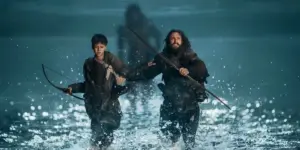
The masterclass concluded with a look at one of the most ambitious long takes in Fjord, in which the camera tracks the film’s lead, Renate Reinsve, as she transitions from searching on the ground to jumping into the sea. For Panduru, the importance of the shot lay in capturing the entire emotional arc of the character without interruption. "It was really important to have the entire arc of the scene of the emotional trajectory of the characters, [so] it was really important for Cristian not to cut in this moment," he said.
The technical execution of the scene involved Panduru physically jumping into the freezing water alongside Reinsve. While he initially thought the shot would be straightforward, the reality of the environment—and the pressure of the long take—made it one of his most challenging moments. He laughed as he recalled the difficulty of synchronizing his movement with the actor during the jump, acknowledging that the success of the sequence was entirely dependent on his team. "I had a really great team of grips who were supporting me in the water and also outside the water," he concluded, highlighting the collaborative spirit that defines his approach to cinematography.