Most creators are fortunate if they manage to produce even one genuinely revolutionary piece of work in their lifetime. Steven Spielberg, however, has built a career defined by at least half a dozen masterworks that completely altered the cinematic landscape.
While he has experienced his share of misfires and critical stumbles along the way, Spielberg’s broader filmography has fundamentally reshaped multiple genres and the medium of filmmaking as a whole. Many of his movies have become permanent fixtures of global culture. A wide range of cinematic trends and revivals can be traced directly back to his creative vision—from the faux-serial period action of the Indiana Jones franchise and the gritty, modern-war realism of Saving Private Ryan, to virtually every high-concept monster movie released in the wake of 1975’s Jaws.
In retrospect, however, there is one particular entertainment subgenre that audiences and critics alike may not give Spielberg enough credit for pioneering: the modern alien conspiracy thriller. Released in 1977, Close Encounters of the Third Kind served as Spielberg’s monumental follow-up to the box-office phenomenon of Jaws. While it may not occupy the exact same tier of ubiquitous pop-culture ubiquity as some of Spielberg’s subsequent family-adventure blockbusters, the influence of Close Encounters is undeniable. Its DNA can be felt across the entire landscape of alien-abduction films and television series that dominated the 1980s and 1990s.
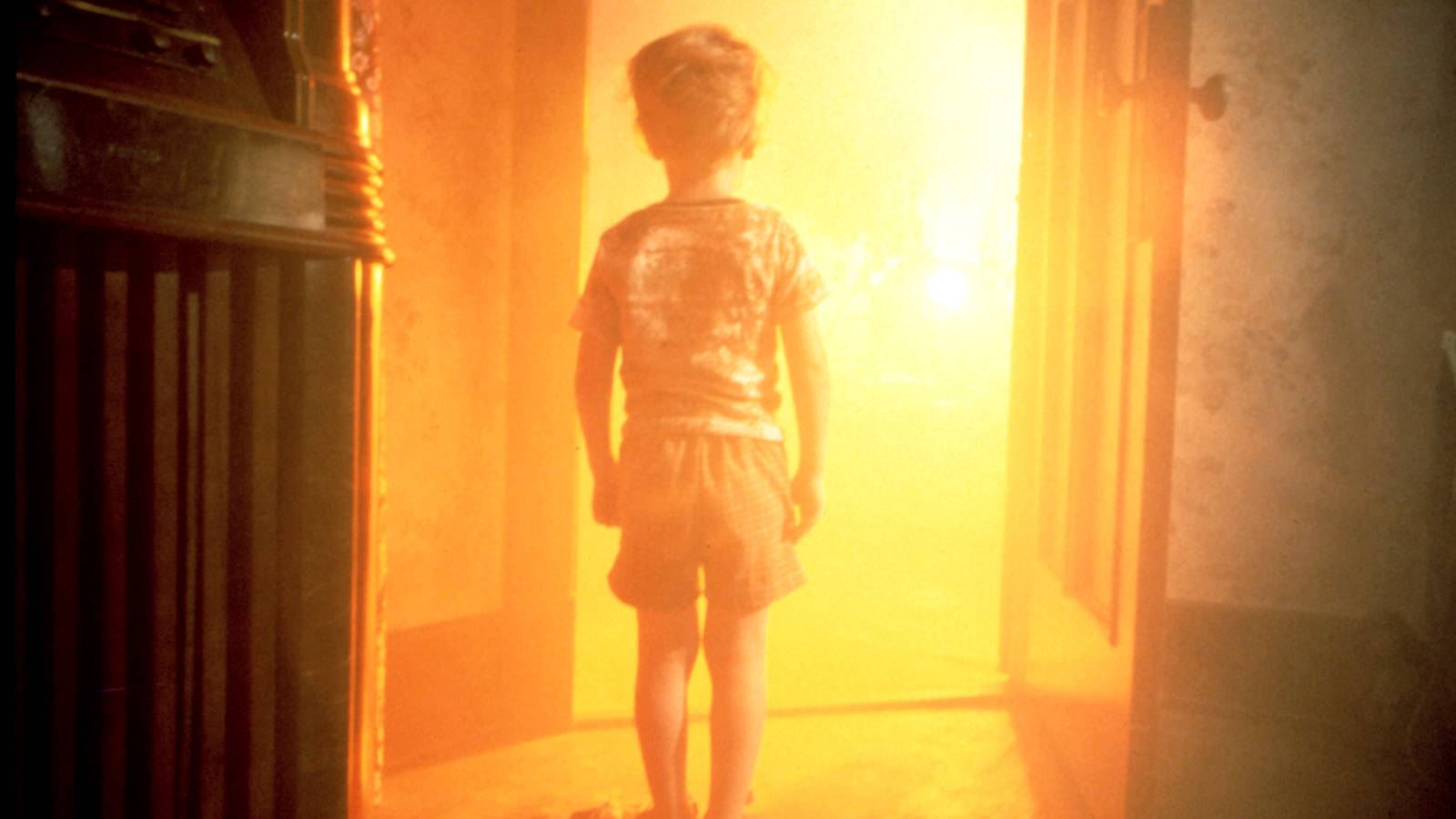
For film enthusiasts looking to revisit the classic—or experience it for the first time ahead of its approaching 50th anniversary—YouTube is currently streaming the film completely free of charge, with commercial breaks. Notably, the version available on the platform is not the theatrical release, but rather the definitive Director’s Cut endorsed by Spielberg in 1998. This particular cut successfully reverses several studio-mandated changes that had been introduced in the 1980 Special Edition, restoring the filmmaker’s original artistic intent.
The Origin of a Classification
To fully understand the cultural footprint of Close Encounters, it helps to look at the origins of its distinct title. For many viewers encountering the film for the first time, the title might mistakenly suggest a continuation of an ongoing franchise. In reality, the name was pulled directly from the 1972 book The UFO Experience: A Scientific Inquiry by J. Allen Hynek.
Hynek served as a vital scientific consultant on Spielberg’s production and even makes a brief cameo appearance in the film—viewers can spot him smoking a pipe near Devils Tower. In his seminal book, Hynek proposed a formal system of classification for UFO sightings. This scale ranged from category one, which denoted strange lights in the sky, all the way up to category six, which described encounters involving a UFO alongside an animated entity, such as a human pilot or an extraterrestrial being.
The final three tiers of Hynek’s scale were collectively labeled as "close encounters." The most significant of these—the "third kind"—referred to instances where both a UFO and its occupant were witnessed, providing the ultimate title for the film. In contemporary vernacular, this concept is more commonly understood as "first contact."
A Worldwide Phenomenon Meets a Personal Obsession
Close Encounters opens in 1977 with a baffling mystery: a collection of long-lost aircraft suddenly reappears in the middle of the California desert under inexplicable circumstances. As a multinational team of scientists scrambles to investigate the bizarre event, reports of unidentified flying objects begin to flood in from across the globe, signaling a coordinated global phenomenon.

Meanwhile, in Muncie, Indiana, a blue-collar electrical lineman named Roy Neary, played by Richard Dreyfuss, is dispatched to help resolve a widespread local power outage. While working in the field at night, Roy experiences a harrowing, blinding near-miss when a passing UFO sweeps directly over his truck, leaving half of his face severely sunburned.
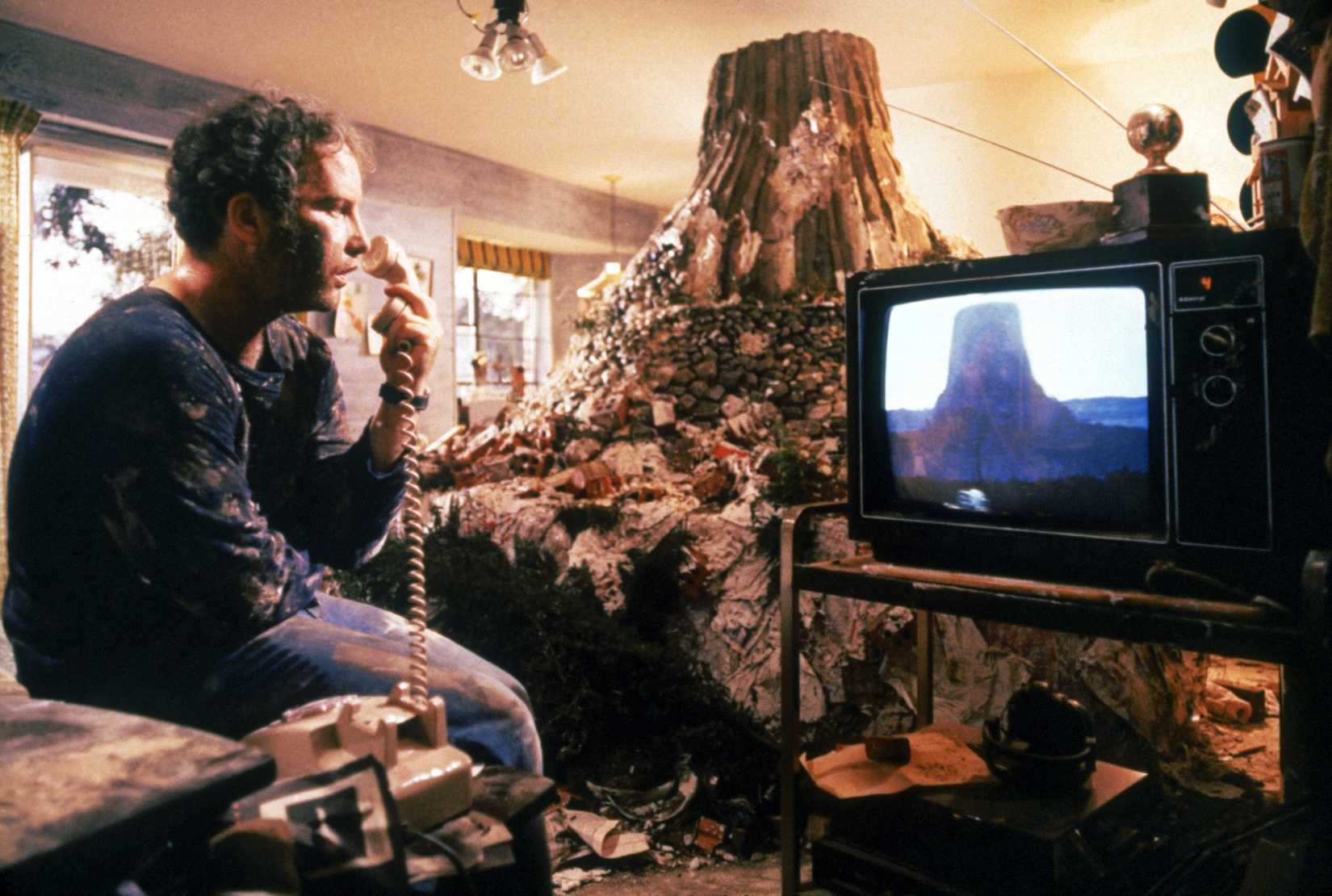
In the wake of this terrifying event, Roy’s life begins to unravel. He develops an intense, all-consuming obsession with UFOs and a mysterious, recurring mental image. This fixation rapidly strains his relationships with his wife, Ronnie, played by Teri Garr, and their young children. Driven by an irresistible internal compulsion he cannot comprehend, Roy begins furiously constructing three-dimensional models of a specific, unfamiliar mountain using whatever household materials are immediately available to him, ranging from common dirt and clay to a massive pile of mashed potatoes at the dinner table. Unbeknownst to Roy, his frantic domestic sculpting is slowly intersecting with a sweeping, top-secret government conspiracy.
The Psychological Toll of the Unknown
Portions of Close Encounters can prove to be a challenging viewing experience by design. While the audience is well aware that Roy’s erratic behavior is rooted in a profound, genuine contact event—largely because his experiences are contextualized by parallel scenes involving government scientists—Roy himself is kept entirely in the dark.
The second act of the film functions as a stark, unsettling portrait of psychological disintegration. Roy himself has no rational explanation for the drastic changes overtaking his mind and body. In one particularly striking sequence, he sits completely isolated in his ransacked living room, surrounded by chaotic stacks of newspaper clippings and crude handmade sculptures. This memorable scene serves as a direct narrative precursor to the countless conspiracy-board tropes that would later saturate popular culture, from The X-Files to the beloved internet meme featuring Charlie Day from It’s Always Sunny in Philadelphia. In hindsight, Richard Dreyfuss’s portrayal of Roy Neary established a definitive stock character in modern Western fiction: the frantic, obsessive conspiracy theorist driven to the brink of madness in pursuit of proof that will finally validate his truth.
This grounded, deeply internal focus may explain why Close Encounters has faded slightly from the forefront of public consciousness compared to Spielberg’s other watershed works. While it is undeniably a science fiction film, it deliberately avoids the fast-paced spectacle, high-octane action, or widespread excitement that characterized Spielberg’s later genre milestones. In fact, Spielberg himself would return to the subject of extraterrestrial visitation just five years later with E.T. the Extra-Terrestrial. That subsequent family-friendly blockbuster arguably eclipsed the cultural footprint of Close Encounters, leaving iconic cinematic moments like Richard Dreyfuss losing his grip at the family dinner table overshadowed by soaring bicycle chases across the moon.
Nearly five decades after its original theatrical release, Close Encounters of the Third Kind remains a towering achievement of American cinema. For viewers willing to approach it not as a fast-paced thriller, but as an atmospheric, slow-burn family drama about obsession and the unknown, it stands as an essential viewing experience. As long as audiences understand its deliberate pacing, the film reveals itself as an underrated and vital linchpin of modern science fiction history.
The Director’s Cut of Close Encounters of the Third Kind is currently available to stream for free on YouTube.