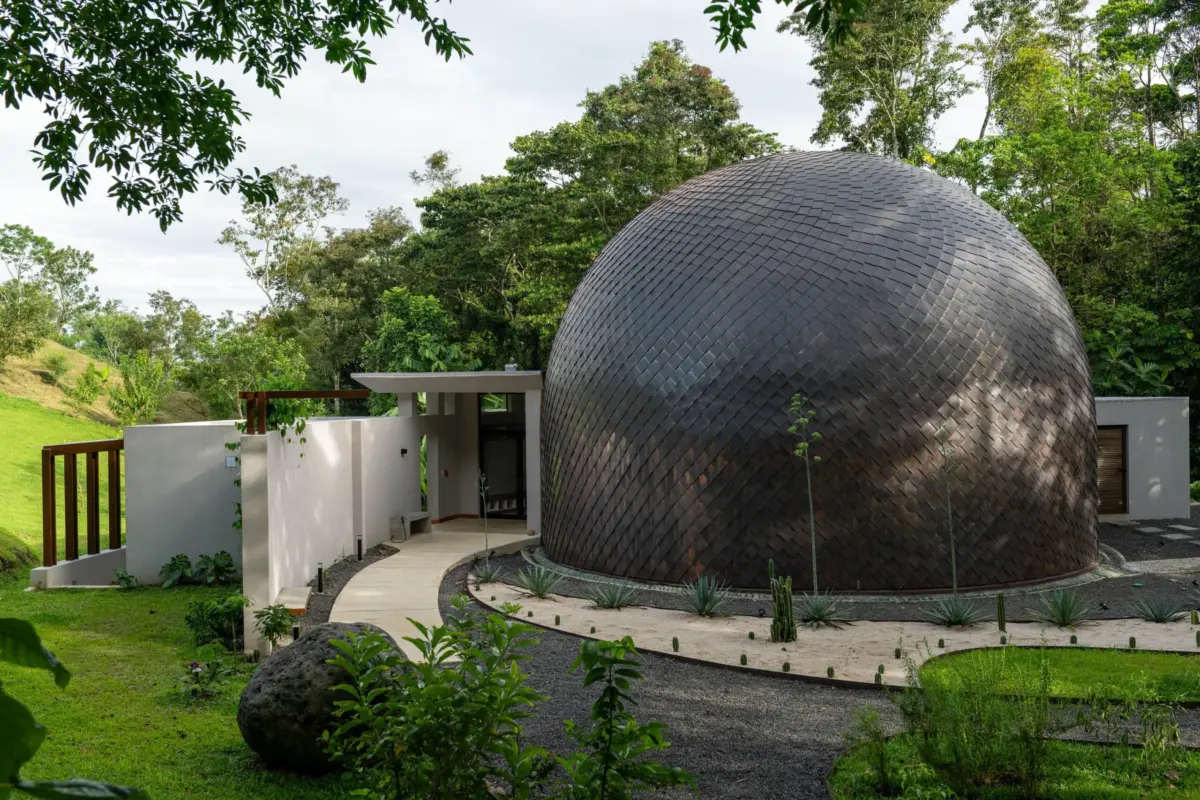
I’m not usually someone who seeks self-actualization through my travel itineraries, but I found myself at a juncture where the prospect of a wellness retreat in Costa Rica felt less like a luxury and more like a necessity. I was navigating a period of profound transition: the impending loss of my 11-year-old French Bulldog, Cooper; the sting of a recent breakup; and a persistent, low-level anxiety regarding the inevitability of aging. Whether one classifies this as a classic quarter-life crisis or the chaotic turbulence of a Saturn return, I was desperate for clarity. I convinced myself that if any environment could silence the mental noise accompanying my transition into my 30s, it would be the sonic vibrations within "The Frequency Dome" at a new, ambitious retreat center known as The Vessyl.
The Vessyl, which opened its doors this past August, markets itself as the "world’s first 4D sound resort." Nestled on 118 acres of lush rainforest at the base of the Arenal Volcano, the property serves as a boutique sanctuary, welcoming only 32 guests at a time. While the modern tech-adjacent branding and the "Burning Man-adjacent" aesthetic might suggest a certain brand of performative spirituality, I was drawn by something more tangible: a fatigue with the tired narrative of sauna-and-cold-plunge retreats that currently dominate the wellness industry. The Vessyl promised an immersive experience where sound isn’t just heard—it is engineered to be felt.

A Sanctuary Under the Volcano
The timing of this trip was fraught with emotional weight. My dog, Cooper, had been the silent witness to my entire 20s. He had been a graduation gift from my father—a calculated move to ensure my frequent returns home to New Jersey—and had remained a constant through the isolation of the COVID-19 pandemic, periods of unemployment, and the shifting tides of my romantic life. As his health declined due to a brain tumor, the decision to leave New York felt like a betrayal. Yet, there was a strange, hollow comfort in knowing he was being cared for by my parents, allowing me to travel to the northern highlands of La Fortuna with the hope that the Costa Rican rainforest would provide the container I needed to process my anticipatory grief.
Costa Rica has become a global epicenter for the wellness industry, which has seen a 58 percent market increase since 2019, according to data from the Global Wellness Institute. The local ethos of pura vida—a phrase that adorns everything from tourist trinkets to local conversations—feels particularly apt in a landscape defined by towering waterfalls and the imposing, mist-shrouded silhouette of the Arenal Volcano.

Upon arriving at The Vessyl’s open-air lobby, the volcano served as a dramatic backdrop to the resort’s infinity pool. My accommodation was a "Sky Tree House," a structure elevated on stilts that offered a panoramic view of the jungle and the resort’s centerpiece: the copper-scaled Frequency Dome. The architecture was striking, a sharp, glistening contrast to the organic chaos of the surrounding rainforest. I spent my first few hours exploring, including a descent into a darkened, burrow-like meditation space built into my treehouse. I had my doubts about my ability to actually meditate—I have never been particularly adept at quieting my mind—but I was prepared to surrender to the process.
The Science of Sound and Self
Chad Wittman, the resort’s chief operating officer, walked me through the Frequency Dome, a space developed in collaboration with Grammy Award-winning acoustician George Augspurger. The project was the culmination of over 11 years of research and engineering. The Dome features a custom floating floor embedded with 24 transducers—the same technology found in high-end theme park attractions—designed to facilitate a "nervous system reset." These transducers pulse with spatial audio and immersive visuals, turning sound waves into physical vibrations that resonate through the body.

Before entering the Dome for my first session, I underwent a "Bio-Well" scan facilitated by staff member Ashley Marie. Developed by Russian physicist Konstantin Korotov, the device uses Gas Discharge Visualization (GDV) to analyze stress levels, energy distribution, and overall regulation via a simple fingerprint scan. While I joked with Wittman about whether the facility was secretly planning to clone me, the results were startlingly accurate. The graphs, which tracked my physical, emotional, and intellectual biorhythms, mirrored the exact weeks I had spent at the veterinary neurologist with Cooper. It was a stark, data-driven validation of the exhaustion I had been carrying.
That evening, during a dinner of yuca gnocchi and octopus ceviche, I spoke with the founder of The Vessyl, Josh Stanley. Stanley is no stranger to pioneering unconventional paths; he and his brothers were instrumental in the development of Charlotte’s Web, the hemp strain that helped spark the global CBD movement a decade ago. Over dinner, the conversation turned to "human design," a complex, trending system that synthesizes elements of the Kabbalah, I Ching, numerology, the chakra system, and quantum physics. It was the next step in my journey at the resort: an attempt to map my internal landscape using my birth date, time, and location.
.png)
Integrating the Digital and the Physical
The following day, I returned to the Dome. With headphones on and a blanket wrapped around me, I lay on the vibrating floor as a projection of a continuous black-and-white spiral played on the ceiling. A voice, which I later learned was generated by AI based on my specific "bodygraph," began to speak to me, positioning itself as my "higher self."
While the experience was undeniably evocative, it also triggered a sense of skepticism. Was this just a more sophisticated, high-tech version of the self-optimization culture I was trying to escape? We are currently living in an era where the desire to "biohack" our way to success has led to an obsession with metrics—from Oura Rings to health scans—that can, at times, make us feel more like projects to be managed than human beings to be lived. I spent the session intellectualizing the process, struggling to reconcile the technology with the vulnerability of the experience.
.jpg)
However, the tone shifted during a one-on-one session with lead facilitator Svetlana Parmar. As we sat on an outdoor patio, the technicalities of the "bodygraph" fell away, replaced by a raw, human conversation about relationships, aging, and the fears that come with turning 30. It became clear that while the tools at The Vessyl were innovative, the real work was the process of articulating these long-held anxieties out loud.
Somatic Release and Natural Rhythms
I was further humbled during a session of somatic breathwork. I had arrived at the Dome expecting little more than a guided relaxation, but the facilitator, Dylan Baird, pushed us into a 40-minute cycle of intense, rhythmic breathing. The physiological result was profound: my hands went numb, the room seemed to shift, and I found myself experiencing a visceral, uncontrollable release of emotion. According to Dr. Diva Nagula, the resort’s chief medical officer, this occurs because active breathing temporarily alters blood pH and activates the nervous system, allowing the amygdala and hippocampus—the brain’s emotional and memory centers—to function in an altered state.

When I emerged from the session, the heavy, constant cloud cover over the Arenal Volcano had finally dispersed, revealing the mountain in its full, majestic glory. It felt like a deliberate, cinematic conclusion to the internal work I had been doing.
My final experience at The Vessyl involved a visit to a nearby stable, where I was paired with a horse named Rosa. The facilitator, a horse whisperer named Enrique Molina, explained that horses do not respond to our projections; they respond only to the energy we present in the moment. As I rode through the jungle, I realized the lesson was one of radical presence.

Just before we departed, I encountered a small Doberman that belonged to the stable owner’s son. The dog, much like the one I had left behind in New Jersey, bowed in an invitation to play. As we ran together in the sand, the grief I had been holding—the same grief I brought with me to the rainforest—finally found a place to land. I watched the dog move with the same clumsy, joyful spirit that Cooper had when he was a puppy, and for the first time, I didn’t try to analyze the emotion or reach for a metric to explain it. I simply let the tears fall, acknowledging that while the next chapters of my life will hold more weight than the ones before, they will also be defined by the ability to feel, to grieve, and to eventually move forward.