I am not typically the type of traveler who seeks self-actualization through a destination. I tend to prefer the concrete over the abstract, and the predictable over the transformative. Yet, I found myself standing at a crossroads, navigating a season of life defined by the weight of impending loss, the aftermath of a recent breakup, and a pervasive, low-level anxiety about the inevitable march toward turning 30. Some might label this a classic quarter-life crisis; others, perhaps more attuned to the celestial, might call it a Saturn return. Regardless of the nomenclature, I felt a desperate need to clear the mental fog, and when the opportunity arose to visit The Vessyl—a newly opened wellness retreat in Costa Rica—I found the promise of vibrational healing through their "Frequency Dome" to be a compelling, if unconventional, solution.
The Vessyl, which opened its doors this past August, positions itself as the "world’s first 4D sound resort." It is a concept that leans heavily into the modern tech-wellness zeitgeist, utilizing a name that follows the current trend of tech companies playing fast and loose with traditional vowels. While I was prepared to engage in high-concept discussions with the self-proclaimed spiritual elite often found in such settings, I was also deeply fatigued by the standard wellness narrative—the endless cycle of sauna-cold plunge protocols that have dominated the conversation among my peers. I was looking for something distinct, a "New-New Age" experience that might offer more than just physical discomfort masquerading as health.

Set against the dramatic backdrop of 118 acres of rainforest beneath the towering Arenal Volcano, The Vessyl operates on an intimate scale, welcoming just 32 guests at a time. The retreat is designed to serve as a conduit between the raw, untamed natural environment and the high-tech, engineered experiences housed within the Dome. By offering a curated menu of vibrational yoga sessions, fractal projections, energy alignments, and live performances, the resort aims to move beyond simple auditory reception, engineering its space to ensure guests can literally feel the sound.
Despite the intrigue of this experimental approach, my departure from New York was marked by a heavy heart. My 11-year-old French Bulldog, Cooper, had been struggling with a brain tumor, and his condition had recently worsened, breaking through his medication with an alarming uptick in seizures. I knew with the clarity of a grieving owner that I was witnessing his final days. Cooper had been a fixture of my life since I was 18, a graduation gift from my father—a man who, perhaps knowingly, used the dog to ensure I would frequently return home to New Jersey. Over the last decade, Cooper had been the silent witness to the entirety of my 20s: the isolation of the COVID-19 pandemic, periods of professional instability, and the emotional turbulence of various relationships. He was the constant who would cock his head and stare at me whenever I wept. Leaving him behind was an agonizing choice, but I clung to the hope that the retreat would provide the necessary isolation and professional guidance to process this looming grief.

My journey led me on a three-hour drive from San José to the northern highlands of La Fortuna, a region where the mist clings to the trees and the air feels charged with potential. It is little wonder that Costa Rica has become a global epicenter for those in search of soul-searching; the country’s wellness industry has seen a 58 percent market increase since 2019, according to data from the Global Wellness Institute. The local "pura vida" philosophy—a lifestyle mantra emphasizing simplicity and gratitude—seemed to permeate the atmosphere, offering a soft landing for my frazzled nerves.
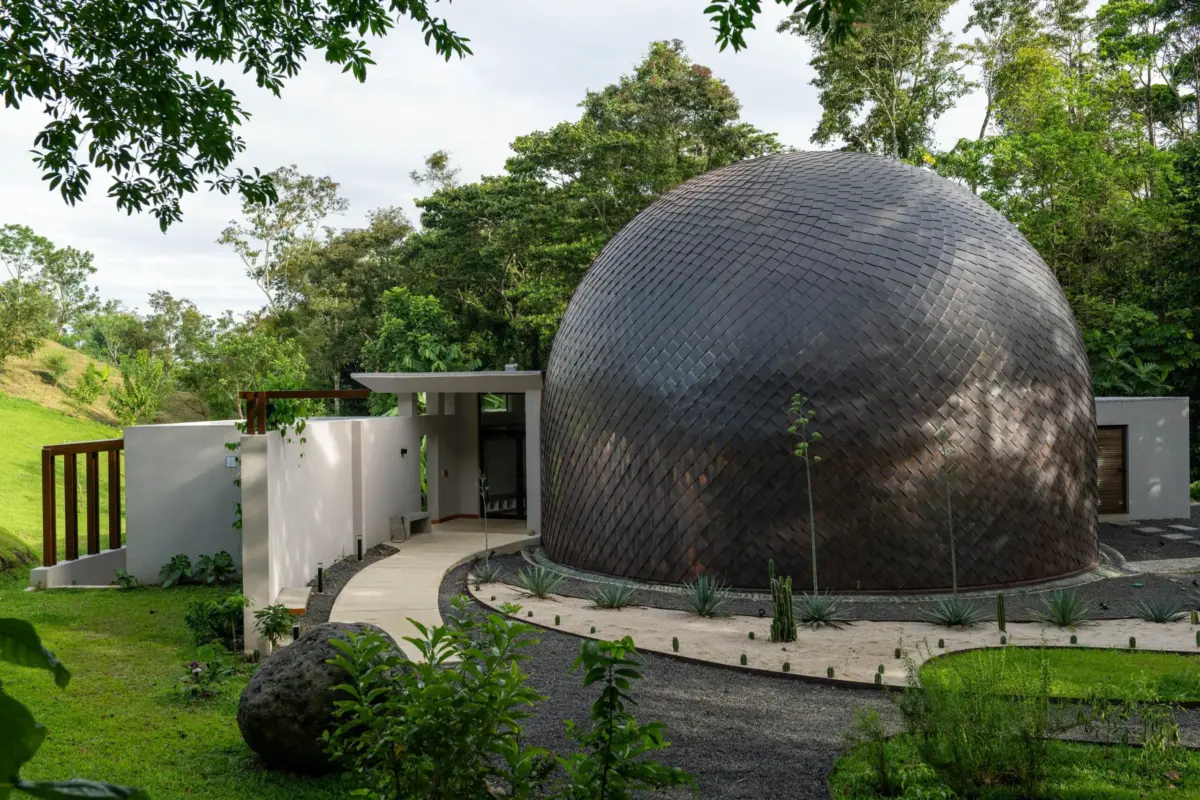
Upon arrival at the open-air lobby and restaurant, the sight of the Arenal Volcano—its peak occasionally emerging from a shroud of clouds—reflected in the edge of an infinity pool, was arresting. I was shown to my accommodation, the Sky Tree House, a wooden structure perched on stilts above the forest floor. From the panoramic terrace, I had a clear view of the Dome. It appeared as a copper-scaled anomaly in the middle of the jungle, a stark contrast to the verdant, chaotic landscape surrounding it. I was scheduled for a "Bio-Well" scan shortly after, though I felt a persistent skepticism. I have never been particularly gifted at quieting my mind, and I wondered if a high-tech dome could succeed where years of personal struggle had failed.

Inside the Dome, I met with Chad Wittman, the resort’s chief operating officer. He provided a tour of the space, which he noted was developed over eleven and a half years in collaboration with Grammy Award-winning acoustician George Augspurger. The structure is an engineering marvel, featuring a custom floating floor embedded with 24 transducers—the same technology often utilized in theme park rides at Disney and Universal to simulate movement and impact. These transducers work in tandem with spatial audio and immersive visuals, creating an environment meant to facilitate a profound nervous system reset.
My Bio-Well scan, conducted by facilitator Ashley Marie, felt like something out of a science fiction film. The device, developed by Russian physicist Konstantin Korotov, uses Gas Discharge Visualization to analyze stress levels, energy distribution, and overall balance based solely on a scan of my fingerprints. When I jokingly asked if they intended to clone me, Wittman’s denial was swift, though it didn’t entirely dispel the surreal nature of the experience. The resulting graphs—depicting my "biorhythms" and energetic state—provided a stark, data-driven visualization of my recent history. When I cross-referenced the troughs in the graphs with my calendar, the dates aligned perfectly with the days I had spent in the neurologist’s office with Cooper.
.png)
That evening, during a dinner featuring yuca gnocchi and octopus ceviche, I met the founder of The Vessyl, Josh Stanley. Stanley is no stranger to pioneering unconventional paths; he and his brothers are widely credited with the 2013 development of a specific hemp strain that helped save the life of a young girl named Charlotte Figi, a catalyst that eventually sparked the global CBD movement. Listening to him discuss the integration of technology and wellness, I began to hear frequent mentions of "human design." Initially, I dismissed it as a buzzword, but further conversation with lead facilitator Svetlana Parmar revealed it to be an intricate personal mapping system. Drawing from a diverse array of sources—including the Kabbalah, I Ching, numerology, the chakra system, and even quantum physics—human design uses birth data to generate a "bodygraph," a tool that has recently found significant traction on social media.
The following day, I returned to the Dome for a guided session. We were instructed to lie on the vibrating floor while wearing headphones, watching a continuous, black-and-white spiral projected onto the ceiling. A voice, identifying itself as my "higher self," began to speak. It was, in essence, a form of hypnosis. While some of the messaging regarding my tendency to turn mystery into intellectual certainty resonated, I couldn’t shake the feeling that I was witnessing the extreme edge of the self-optimization movement. The fact that an AI had synthesized the messaging based on my bodygraph only added to my sense of dissonance. I found myself trapped in the irony of the situation: I had come here to stop intellectualizing my life, yet I was currently sitting in a dome analyzing the ethics and efficacy of biohacking.
.jpg)
My one-on-one reading with Parmar, held on an outdoor patio under the flickering light of a citronella candle, proved more grounding. Despite the technical complexity of my bodygraph, our conversation drifted toward the universal: aging, the weight of our choices, and the nature of human curiosity. I realized then that the technical data was merely a scaffold; the true value lay in the reflection.
The most transformative moment, however, came during a session of somatic breathwork. Led by Dylan Baird, we were warned that the process could be as intense as a psychedelic experience. Lying in a circle with eye masks, we adopted a rhythmic, 40-minute breathing pattern. As the session progressed, my extremities went numb, and I felt a strange, cold intensity. During the subsequent integration period, I experienced a series of fleeting, dreamlike visions, followed by an unexpected, uncontrollable release of tears. It wasn’t prompted by a specific sad memory, but by a sense of total, overwhelming release. Afterward, I felt a level of calm that was entirely foreign to me. Dr. Diva Nagula, the retreat’s medical director, later explained this as a physiological shift: the rapid breathing temporarily alters blood pH and cerebral blood flow, momentarily deactivating the brain’s emotional regulation centers before allowing a deep, parasympathetic recovery.

Toward the end of my stay, a visit to a local stable reinforced the connection between the technological and the natural. Under the guidance of horse whisperer Enrique Molina, I was paired with a white horse named Rosa. Molina explained that horses react not to our internal narratives, but to the energy we present—hesitation, fear, or confidence. It was a lesson in radical honesty.
Just before the ride, I encountered a young dog belonging to the stable owner. As she bounded toward me, eager to play, I was struck by the contrast between her joy and the memory of Cooper. I wept again, but this time it was different. I was mourning the loss of a companion who had seen me through the trials of my 20s, and I was acknowledging the fear of the unknown that comes with entering my 30s. I left The Vessyl not with a neat, data-driven solution to my life, but with the realization that the work of healing is not a process to be optimized, but a reality to be lived. As I departed, the Arenal Volcano finally emerged fully from the clouds—a sight of quiet, enduring beauty that required no explanation.