As the days grow shorter and the crisp chill of winter settles over the five boroughs, the pulse of New York City’s cultural life remains as vibrant as ever. From the storied halls of Museum Mile to the intimate, avant-garde gallery spaces tucked away in the industrial corridors of Brooklyn, the city is currently playing host to a diverse array of exhibitions that challenge our perceptions of art, history, and the human experience. Whether you are seeking a deep dive into the evolution of urban landscapes, an exploration of surrealist philosophy, or a nostalgic journey through the neon-soaked dance floors of the 1970s, the current landscape offers something for every visitor.
New Museum: Examining History and the Black Experience
The New Museum, consistently at the forefront of contemporary discourse, is currently presenting two exhibitions that offer a profound look at the relationship between individuals and their environments. Spanning two floors, the museum is hosting Arthur Jafa: I Am Tony, a comprehensive retrospective of the American artist and cinematographer’s work over the past four decades. Jafa’s practice has long been centered on the complexities of the Black experience, and this exhibition serves as a powerful testament to that legacy. The centerpiece, an eight-minute video montage titled Love is the Message, the Message is Death, is a masterclass in visual storytelling. By sampling clips from music videos, historic newscasts, and iconic sporting events, Jafa weaves a tapestry that captures the full spectrum of Black life—its profound grief, its unbridled joy, and the persistent pain of systemic struggle. The exhibition is scheduled to run through January 3, 2027.

On the second floor, the museum shifts its focus to the very ground it stands on with Bowery: Devil’s Mile. This exhibition provides a sprawling historical survey of one of lower Manhattan’s most mythic thoroughfares. The Bowery has lived many lives: it began as a pre-colonial Lenape footpath, transformed into a 19th-century strip defined by raucous saloons and dance halls, and eventually became a sanctuary for Beatniks, punks, and post-rockers. While the "Skid Row" of the past has largely given way to a more polished, contemporary atmosphere, the exhibition resurrects the street’s gritty history through 19th-century sideshow flyers, Jacob Riis’s seminal photographs of the working class, and an array of artifacts that document its evolution. Bowery: Devil’s Mile remains on view through January 31, 2027.
Solomon R. Guggenheim Museum: Narratives of the Unseen
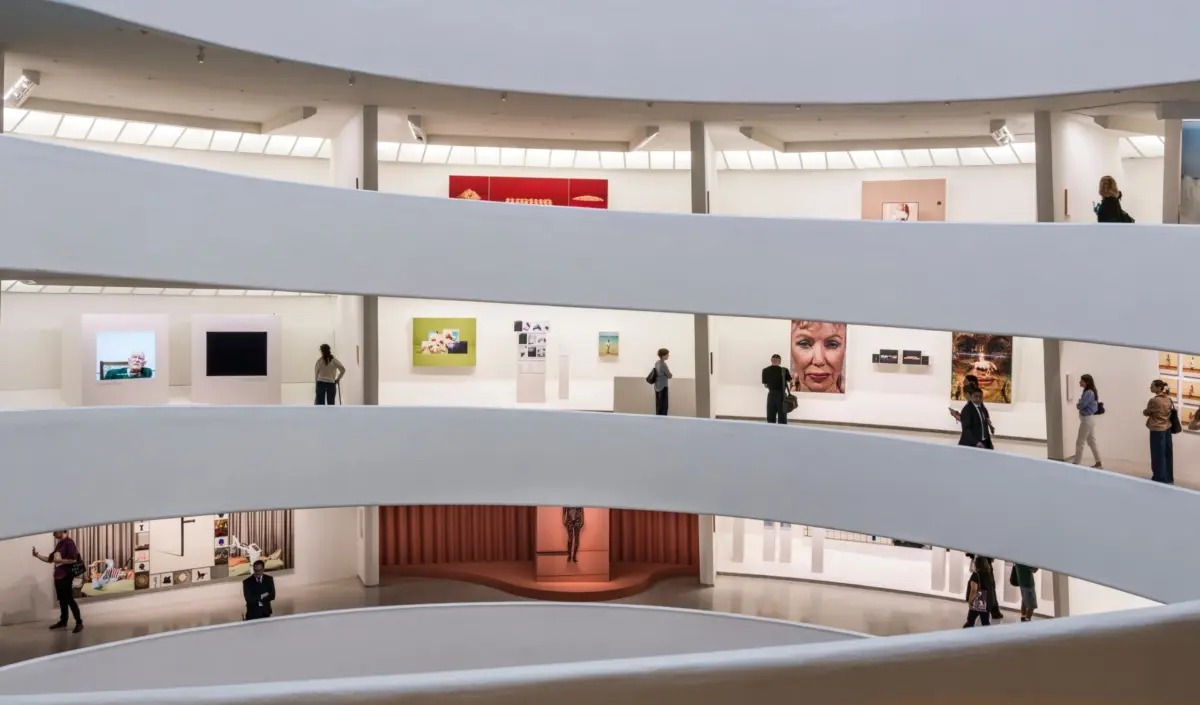
At the Solomon R. Guggenheim Museum, the iconic spiraling rotunda is currently home to Taryn Simon’s Father Country I Do Love You. This massive installation begins with a personal anecdote regarding an intelligence officer the artist’s father encountered years ago, a narrative hook that leads into Simon’s own investigation involving an anonymous ex-FBI agent. The exhibition is an ambitious undertaking, comprising more than a thousand individual images, texts, videos, and sculptures. Through these materials, Simon charts a labyrinthine series of stories-within-stories, tracing the lives of various characters, disparate locations, and historical events that the agent encountered throughout his career. It is the largest body of work ever to debut at the Guggenheim, and while the sheer volume of the exhibit might seem overwhelming, it reflects the often-absurd, non-linear nature of reality itself. Visitors have until March 14, 2027, to experience this intricate installation.

Amant: A Dialogue with the Earth
Tucked away among the warehouses of East Williamsburg, the arts organization Amant has become a vital hub for contemporary creators. While the site’s restaurant, Zoli, has garnered significant buzz since its opening this past summer, the primary draw for art enthusiasts is the campus-wide exhibition Sentient Earth. This project invites 28 artists to contemplate a provocative question: What would the planet say to us if it possessed consciousness? The result is a sobering, yet occasionally humorous, examination of human environmental impact. The exhibit features large-scale installations, including oversized blister pill packs presented as artifacts and objects that mimic the appearance of industrial mining tools and refuse. It is a work of undeniable urgency that forces a confrontation with our ecological footprint. Sentient Earth is free to the public and will be on view through February 14, 2027.
Museum of Modern Art: Surrealism and Systemic Reality
The Museum of Modern Art (MoMA) is currently highlighting the intersection of literature and visual art with The Surrealist Book: Tomorrow Lives in Mirrors. Rather than simply displaying books as objects, the exhibition frames them as the primary medium for the Surrealists’ ideological and formal experimentation. The show includes rare works from luminaries such as André Breton and Max Ernst. Of particular note is the inclusion of photomontages by Claude Cahun, a queer artist who utilized portraiture and poetry to challenge gender norms. Cahun is finally receiving the widespread recognition she was denied throughout the 20th century, making this a pivotal component of the exhibition.

On the second floor, MoMA presents Teresa Margolles: Aproximación al lugar de los hechos (Approaching the Scene). Drawing on her professional background as a forensic pathologist, Margolles uses a clinical, precise approach to document the epidemic of femicide and systemic violence in the United States, specifically focusing on Minnesota, California, and Texas. The work utilizes fragments—shattered glass, soil, and other remnants—to create an atmosphere of profound loss. The exhibition continues at MoMA PS1 in Long Island City, Queens, where the second part of the project, Teresa Margolles: En el lugar de los hechos (At the Scene), is on view through February. The Surrealist Book concludes on January 23, 2027, while the Margolles exhibition runs through the summer of 2027.
Museum at Fashion Institute of Technology: The Culture of the Doll
At the Museum at Fashion Institute of Technology (FIT), the exhibition Doll Dressing offers a fascinating look at how these miniature figures have served as both childhood companions and sophisticated design muses. Spanning three centuries, the exhibition explores how dolls have influenced our ideas about fashion and identity. Visitors can examine how contemporary designers like Margiela, Loewe, and Marc Jacobs have experimented with scale, as well as the cultural archetype of the "living doll" seen in figures ranging from 1960s icon Twiggy to modern lolita subculture. The exhibition also features a wide array of historical and pop-culture dolls, including classic Barbies, antique boudoir dolls, and the later iterations of Bratz and Takara figures. This exploration of our desire to play with form and appearance remains open until January 3, 2027.

Brooklyn Museum: From Manga to Cultural Heritage
The Brooklyn Museum is currently hosting the first major exhibition in the Americas dedicated to the global phenomenon of manga. Art of Manga features over 600 drawings that examine the genre’s indelible influence on modern storytelling and visual art. The collection includes original works from titans of the field, such as Hirohiko Araki, the creator of JoJo’s Bizarre Adventure; Eiichiro Oda, the force behind the best-selling One Piece; and the renowned horror artist Junji Ito.
For those interested in a different kind of figurative art, the museum is also presenting Hopi Kachina Dolls: Blessings for a Balanced World on the fourth floor. This exhibition highlights 53 hand-carved and painted wooden figures, which have traditionally been given to Hopi girls and women as they reach significant milestones in their lives. The exhibit provides a respectful and detailed look at these cultural artifacts, which symbolize spiritual guidance and community continuity. The Art of Manga exhibition closes on January 31, 2027, while the Hopi Kachina Dolls exhibition is scheduled to run through June 27, 2027.

The New York Historical Society: The Soundtrack of a City
Rounding out the city’s major cultural offerings is You Should Be Dancing: New York, 1976 and Beyond at The New York Historical Society. Serving as the final installment in the museum’s six-part series celebrating America’s 250th anniversary, the exhibition documents the vibrant, overlapping scenes of disco, punk, and hip-hop that emerged from the economic turmoil of a bankrupt New York City. The collection is rich with authentic ephemera, including an original awning from the legendary club CBGB, handwritten lyrics from icons like Patti Smith and Richard Hell, invitations to the exclusive Studio 54, and early draft scripts for Saturday Night Fever. It is a comprehensive look at the creative resilience of the city during a transformative era. The exhibition will be open to the public through April 2, 2027.