Margaret Hamilton, the visionary computer scientist whose pioneering work in software engineering provided the critical foundation for NASA’s Apollo missions and successfully guided humanity to the lunar surface, has died. She was 90 years old. Her passing on September 30 was confirmed by her former employer, the Massachusetts Institute of Technology (MIT), which played a central role in her storied career.
Hamilton was a trailblazer in every sense of the word, operating in a field that, during the 1960s, barely existed as a recognized discipline. As the leader of the team that developed the onboard flight software for the Apollo space program, she did more than just write code; she helped define the very concept of "software engineering." At a time when computing was often viewed as a secondary task compared to hardware development, Hamilton’s rigorous approach to software reliability ensured that the lunar landings were not merely theoretically possible, but practically achievable.
In a poignant statement following the news of her death, MIT reflected on her profound influence, noting that to describe Hamilton as a pioneer or someone ahead of her time would be a dramatic understatement. The institution acknowledged that she was effectively a software engineer before the term had even entered the mainstream lexicon, laying the groundwork for the digital age that would follow.
From Academic Beginnings to the Frontiers of Space
Born in Indiana in 1936, Hamilton’s path to the stars began with a rigorous academic foundation in mathematics. She studied at the University of Michigan in 1955 before transferring to Earlham College, where she earned her Bachelor of Arts in mathematics in 1958. Shortly after, she moved to Boston, Massachusetts, alongside her husband. It was during this period that she sought employment at MIT, initially with the practical intent of supporting her husband while he pursued his law degree. Little did she know that this transition would place her at the epicenter of the greatest technological challenge of the 20th century.
Hamilton worked at MIT from 1959 until the mid-1970s. During this tenure, she rose to become the director of the Software Engineering Division. Her arrival at the laboratory marked a significant moment for the institution, as she later recalled in a 2019 interview with the Guardian. Reflecting on her early days, she noted that she was drawn to the work both by the sheer ambition of the project and the fact that it was entirely uncharted territory. She held the distinction of being the first programmer to join the division and the first woman the team hired, navigating a male-dominated environment with a focus on technical excellence and systemic innovation.
Architect of Apollo’s Success
The significance of Hamilton’s work cannot be overstated. As leader of the Software Engineering Division, she oversaw the team responsible for designing, testing, and writing the onboard in-flight software for NASA’s Apollo 11 mission. This software was the invisible tether between the astronauts and the Moon, guiding Neil Armstrong and Buzz Aldrin to a safe landing on the lunar surface.
One of the most defining moments in the history of space exploration occurred in 1969, just minutes before the Apollo 11 Lunar Module, the Eagle, touched down. The onboard computer suddenly triggered a series of alarms, signaling that the system was being overwhelmed by data. This error threatened to derail the entire mission, as the computer struggled to process a flood of incoming information while simultaneously attempting to execute the landing sequence.
Under less capable guidance, this overload could have resulted in a catastrophic failure. However, Hamilton and her team had anticipated the possibility of such system errors. They had engineered "priority-driven software," a design philosophy that allowed the computer to effectively manage its own workload. When the alarm sounded, the software was programmed to immediately shut down non-essential background tasks and reallocate all processing power to the most critical priority: the landing itself. This fail-safe, a direct result of Hamilton’s insistence on robust error detection and recovery, ensured that the Eagle landed safely.
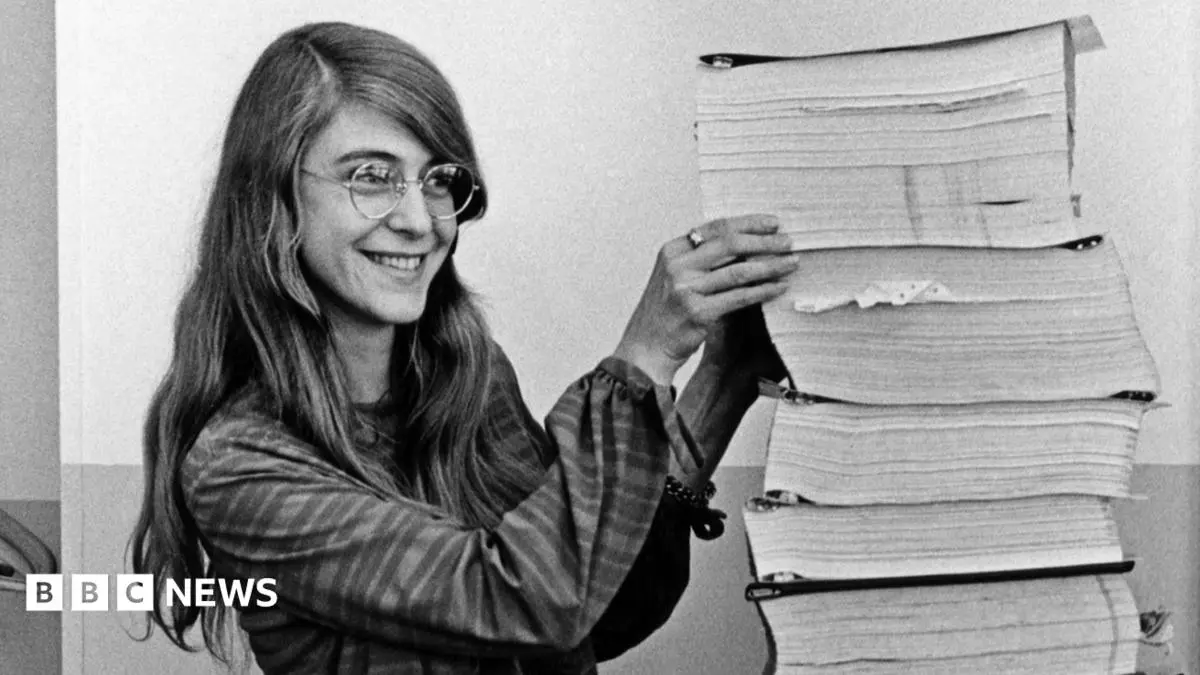
This triumph of engineering was captured in a now-iconic 1969 photograph, which has since become a visual shorthand for the dawn of the software age. The image depicts a young Margaret Hamilton standing beside a stack of printed computer code that towered as high as she was. That stack represented the physical manifestation of the logic, safety checks, and programming that allowed humanity to traverse the void of space.
A Legacy of Innovation and Recognition
After her time at MIT, Hamilton continued to shape the industry, utilizing her extensive expertise to found her own software companies. Among these was Hamilton Technologies, an organization that remains based in Massachusetts and continues to honor the principles she championed throughout her career.
The impact of her work eventually earned her the highest civilian honors. In 2016, President Barack Obama awarded Hamilton the Presidential Medal of Freedom, the nation’s highest civilian honor, in recognition of her monumental contributions to science and space exploration. During the ceremony, President Obama noted that Hamilton "symbolizes that generation of unsung women who helped send humankind into space." The award served as a long-overdue acknowledgement of the pivotal role she played in a mission that was often framed purely in terms of rockets and hardware.
Educational institutions that shaped her early life also mourned her loss. Earlham College expressed its deep sadness in a social media statement, noting its gratitude for the opportunity to have celebrated her extraordinary achievements throughout her life. The college affirmed that her pioneering spirit and remarkable legacy would continue to inspire generations of students, who are now often referred to as "Earlhamites."
Hamilton’s influence transcends the specific technical solutions she provided for Apollo. She shifted the perception of software from a secondary task to a primary pillar of engineering, emphasizing that code must be as reliable, well-documented, and rigorously tested as the metal and fuel that propel a spacecraft. Her methodology set the standard for critical systems that govern everything from modern aviation and medical equipment to the global internet infrastructure we rely on today.
As the world remembers Margaret Hamilton, she leaves behind a family who carries on her legacy: she is survived by her daughter, a son-in-law, two grandsons, and four great-grandchildren. Her life stands as a testament to the power of intellectual curiosity, the importance of persistent innovation, and the quiet, often unseen labor that makes the most daring human achievements possible. While she is no longer here to guide the next generation of engineers, the software that safely touched down on the lunar surface remains a permanent monument to her genius.