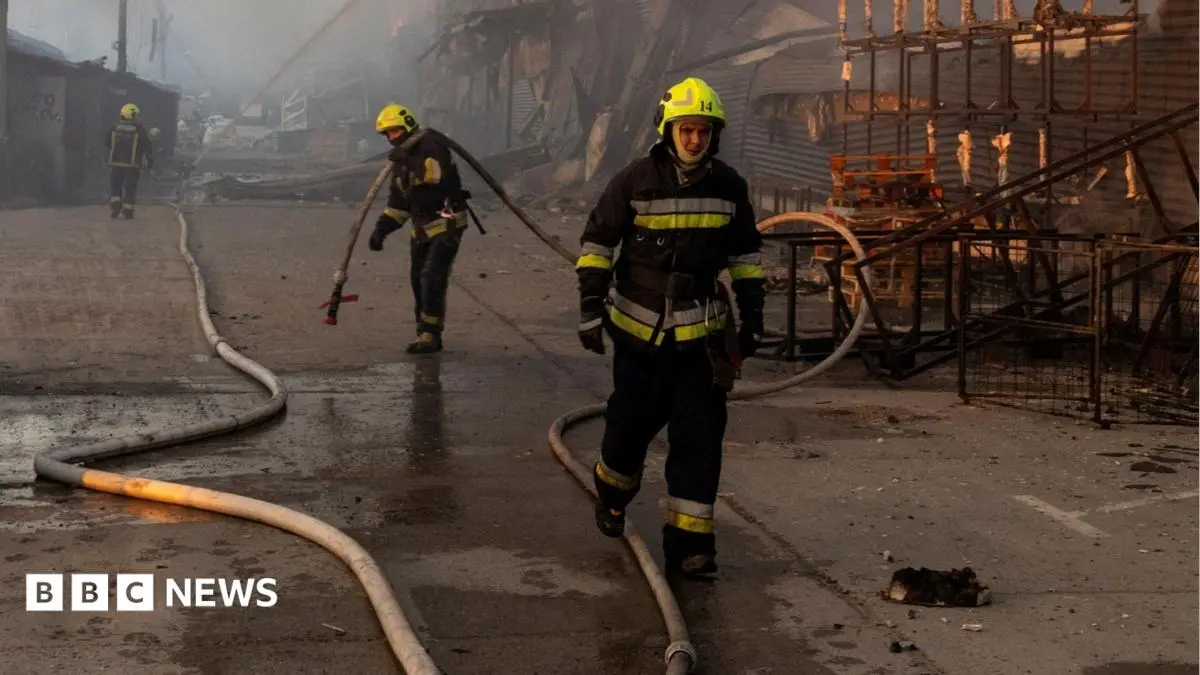
At least 20 people have been confirmed dead following a massive wave of overnight Russian missile strikes across central and eastern Ukraine. President Volodymyr Zelensky has decried the bombardment as one of Russia’s “most vile” military operations to date, marking a grim escalation in a conflict that has already claimed thousands of civilian lives. The widespread attacks, which spanned several key regions, appeared to be timed with macabre precision to coincide with the lead-up to Vladimir Putin’s 74th birthday on Wednesday.
The human toll of the strikes is severe and continues to rise. In the Chernihiv region, a residential building in the city of Pryluky was reduced to rubble, becoming the epicenter of the tragedy. President Zelensky described the destruction of this civilian structure as a “birthday ‘gift’ to Putin,” a statement that underscored the psychological warfare and intentional targeting of non-combatants that has characterized this latest campaign.
Initially, reports from the president’s office indicated five deaths, but as search-and-rescue teams combed through the twisted metal and pulverized concrete of the five-storey apartment block, the State Emergency Service of Ukraine confirmed that the death toll had climbed to 14. Heartbreakingly, among those recovered from the wreckage were four children. The intensity of the assault has left at least 50 others injured, including seven children, and officials fear that more victims may remain trapped beneath the debris as emergency responders work through the hazardous conditions.
The strikes were not confined to Chernihiv; they represented a coordinated, multi-pronged effort to paralyze infrastructure across the nation. Explosions were reported in the capital, Kyiv, as well as in the strategic industrial hubs of Dnipro, Kremenchuk, Zaporizhzhia, and Oleksandriya. According to President Zelensky, the Russian military unleashed a staggering 70 missiles in total, aiming to strike “painfully and demonstratively” at the heart of Ukrainian civilian life.
Strategic Retaliation and the Energy Front
As the dust settled on the impacted regions, the Ukrainian leadership signaled that the assault would not go unanswered. President Zelensky disclosed that over the past 24 hours, Ukraine had executed a series of retaliatory strikes deep within Russian territory, hitting targets in the Perm, Samara, and Astrakhan regions. These operations targeted four specific facilities, including two oil installations and a military training ground.
The strategic nature of these exchanges highlights a growing focus on energy infrastructure, which has become a primary theater of the war. Moscow had previously warned that it would intensify strikes against Ukraine’s power grid following successful Ukrainian attacks on Russian energy assets. Zelensky confirmed that energy infrastructure was indeed one of the “key targets” of the overnight barrage, an admission that suggests both sides are now locked in a cycle of attrition aimed at crippling the opponent’s ability to maintain economic and domestic stability during the winter months.
Zelensky took the opportunity to renew his urgent appeals to Western allies, emphasizing that current air defense capabilities are insufficient to neutralize the sheer volume of Russian weaponry. He noted that while the military successfully intercepted some of the incoming missiles, the sheer density of the attack overwhelmed existing systems, allowing too many projectiles to reach their targets. Without enhanced air defense support packages, Ukraine remains acutely vulnerable to these high-altitude, long-range missile campaigns.
Escalation in the Black Sea
The conflict has also spilled over into the maritime domain, with significant instability rocking the Black Sea. In addition to the aerial bombardment, President Zelensky stated that there was “also a response in the Black Sea,” though he offered limited details. However, regional reports and maritime tracking data have painted a clearer picture of the chaos unfolding in international and coastal waters.
On Tuesday evening, dramatic footage surfaced showing a massive plume of thick, black smoke billowing from an oil tanker off the coast of Sochi. The Russian transport ministry later confirmed that the Liberian-flagged Aframax Rio oil tanker had been struck by unmanned maritime drones. While Russian authorities asserted that the crew was successfully rescued, the attack on a civilian-flagged vessel highlights the dangerous environment for commercial shipping in the region.
The situation is further complicated by the sinking of another vessel, the Alfa Watan. Bulgarian officials, including Vice-Admiral Rumen Nikolov of the Maritime Administration Executive Agency, confirmed that the search for the ship’s missing crew had been halted. The vessel was reportedly hit by a drone on Tuesday while sailing in the Black Sea. Although specific details regarding the crew remain sparse, authorities believe the ship, which had been anchored near the Bosphorus strait before heading north, was carrying Syrian nationals. Maritime tracking data placed the vessel’s last known position within the Bulgarian exclusive economic zone, roughly 70 nautical miles east of the town of Byala.
The instability has affected multiple vessels. Prime Minister Rumen Radev of Bulgaria reported that a second ship, which was transporting grain, was also struck within the same zone. Fortunately, all 18 crew members aboard the grain carrier were rescued. While Bulgaria has refrained from formally attributing blame for these specific maritime strikes, the incidents coincide with an overall increase in Russian military activity and aggression throughout the eastern Black Sea.
A Protracted and Vicious Conflict
The convergence of the brutal missile attacks on Ukrainian cities and the maritime disruption in the Black Sea marks a new, intensified phase of the war. For the citizens of Pryluky and other affected cities, the overnight violence serves as a harrowing reminder of the war’s volatility. The death of children in the residential strike has sparked widespread outrage, with the Ukrainian government framing the attack as a deliberate act of terror timed for political symbolism.
As Moscow remains silent regarding the specific accusations surrounding the overnight strikes, the international community continues to monitor the situation closely. The combination of targeted strikes on energy infrastructure, the destruction of civilian housing, and the encroachment of the conflict into commercial shipping lanes suggests a Russian strategy aimed at exerting maximum pressure on the Ukrainian state and its partners.
With the recovery efforts ongoing in Pryluky and the regional authorities assessing the damage to energy networks, the focus in Kyiv remains on securing the defensive equipment necessary to stem the tide of such attacks. President Zelensky’s assertion that the strikes were designed to be "demonstrative" speaks to a broader attempt by the Kremlin to project power and sow discord, even as the human cost of these actions continues to mount. The resilience of the Ukrainian population remains under immense strain as they grapple with the consequences of an offensive that has shown little regard for the distinction between military targets and the sanctity of residential life.
As the war enters this latest, highly volatile chapter, the interplay between retaliatory strikes, aerial bombardment, and maritime sabotage underscores the unpredictable nature of the conflict. With no immediate end in sight and both sides appearing committed to a strategy of mutual damage, the humanitarian implications for Ukraine and the surrounding region continue to grow, leaving millions to face an uncertain and perilous future.