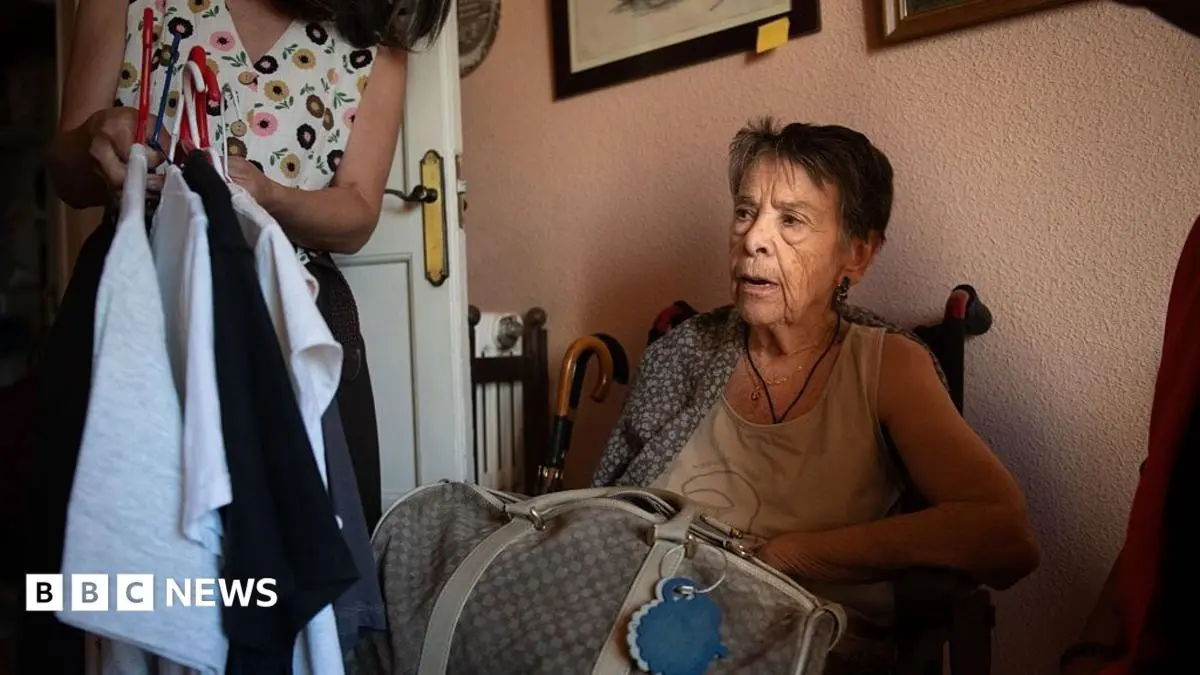
The death of Maricarmen Abascal, an 87-year-old woman whose forced eviction from her lifelong home became the flashpoint for a nationwide movement against Spain’s spiraling housing crisis, has sent shockwaves through the country. According to a statement released by the Madrid Tenants’ Union, Abascal passed away after a harrowing period of displacement that ignited intense political turmoil and triggered the announcement of early national elections.
Abascal had resided in her Madrid apartment for more than seven decades, a home first leased by her father in 1956. However, her long-standing tenure came to a traumatic end on September 23, when she was forcibly removed on a stretcher. Her inability to meet the astronomical rent hikes imposed by her new landlord, the investment firm Urbagestión, transformed her into a symbol of the vulnerability faced by elderly tenants in an increasingly commodified housing market.
The company had acquired the property in 2018 and subsequently raised the rent from a manageable €500 per month—protected for years by historical rent caps—to a staggering €2,650. Even when the firm later offered a “concession” to lower the rate to €1,650, the amount remained €300 higher than Abascal’s total monthly pension, making it an impossible burden for her to sustain.
A Tragedy Foretold
The Madrid Tenants’ Union expressed profound grief at the news of her passing, framing her death not merely as a personal tragedy, but as a defining moment in Spanish social history. “We regret to announce that Maricarmen passed away today,” the union stated. “Her situation marked a turning point in the history of this country.”
Alicia del Río, a spokesperson for the union, offered a scathing indictment of the forces that led to this outcome. “Speculation costs lives, and today rentierism has finished killing our colleague Maricarmen,” she said. While the landlord had reportedly offered a late agreement to allow her to return to the apartment at a lower rate, the bureaucratic and physical toll of the eviction had already taken its toll; Abascal was hospitalized shortly after her removal and was unable to finalize the legal paperwork before her condition deteriorated.
For her part, Abascal seemed to understand the broader implications of her plight. In a video recorded from her hospital bed in the days following her eviction, she spoke with a quiet, steely resolve: “I haven’t managed to defend my home, but I have fought so that others can learn to fight for what’s theirs.” The union noted that while a belated agreement had been reached to restore her housing, the solution arrived too late. They described her final weeks as a "torturing process" that was entirely avoidable.
Political Fallout and Legislative Deadlock
The circumstances surrounding Abascal’s eviction have served as a catalyst for a deeper political crisis in Spain. For weeks, the case had been a central topic in the media, with three previous attempts to evict her having been successfully blocked by the courts. When the final eviction proceeded, public outrage surged, manifesting in massive protests across the country.
This social pressure placed the coalition government, led by Prime Minister Pedro Sánchez, in a precarious position. The government sought to respond with emergency housing legislation designed to curb rent hikes and protect vulnerable tenants. However, the proposed measures faced stiff opposition in Congress and were ultimately rejected last week.
The failure to pass this legislation acted as a spark for further unrest. Over the weekend, tens of thousands of citizens took to the streets in cities across Spain, demanding systemic reform. The rejection of the bill in parliament served as a primary driver for the political instability that has now engulfed the government.
In a bid to navigate this impasse, Prime Minister Sánchez announced on Monday that he would call for early elections to be held on November 29. Sánchez, who heads a leftist coalition lacking a parliamentary majority, stated that he requires a "broader progressive majority" to "overcome the resistance of the elites" and push through necessary housing reforms.
However, the housing issue is only one facet of the difficulties facing the administration. Sánchez has been grappling with multiple pressures, including allegations of corruption within his party, the rising cost of living, and contentious debates regarding immigration policy. Most opinion polls suggest that the opposition People’s Party (PP) is currently positioned to emerge as the largest force in the upcoming election. Analysts note, however, that a victory for the conservatives would likely require a coalition agreement with the hard-right Vox party to secure a majority.
A Nation in Mourning and Protest
The political rhetoric has been sharply divided, yet the death of Abascal prompted a rare moment of formal acknowledgement from the highest levels of the Spanish government. Prime Minister Sánchez extended his condolences to her family and loved ones, stating: “All my love goes to Maricarmen’s family and loved ones. A hug as well to everyone who today feels this loss as their own.”
Alberto Núñez Feijóo, the leader of the opposition People’s Party, also issued a statement on X (formerly Twitter). Attempting to move past the immediate political finger-pointing, he wrote: “No campaign, no parties, no self-interested exploitation. No more stones in the wall. In the face of a person’s death, only respect is in order.”
Despite these calls for solemnity, the streets of Madrid told a different story. Following the news of her passing, protesters gathered in the Puerta del Sol, one of the capital’s main squares, which has served as a makeshift protest encampment for the past two weeks. On Wednesday evening, candles were lit in her memory, and participants were seen embracing in a shared display of grief and defiance.
Hundreds of demonstrators later marched toward the parliament building, chanting, "The struggle continues, Maricarmen lives." For many of the protesters, the tragedy has galvanized their resolve rather than silenced it. Nora Boumghait, a 25-year-old protester, captured the sentiment of the crowd: "Even though she’s dead, a struggle has begun that will not stop. It doesn’t matter who governs, because they will not stop us."
The movement shows little sign of abating. Earlier on Wednesday, prior to the announcement of her death, housing unions had already called for a nationwide general strike scheduled for November 11 to demand comprehensive housing reforms.
The death of Maricarmen Abascal has transformed a local housing dispute into a nationwide clarion call. As the country moves toward an early election, the issues of rent control, the rights of long-term tenants, and the influence of property investment firms are expected to dominate the discourse. The Madrid Tenants’ Union, echoing the final wishes of the woman who became their unlikely icon, reminded their members and the public of her parting message: "Above all, we will fulfil what she always asked of us: ‘fight, keep fighting for what is yours.’"
As the protest encampments continue to grow and the political parties prepare for a high-stakes campaign, the memory of an 87-year-old woman, removed from her home on a stretcher, remains a potent symbol of the human cost of Spain’s housing crisis. Whether the upcoming election provides the "broader majority" that the government seeks or brings a shift in power, the mandate for change has been written clearly on the streets of Madrid.