Somewhere between high-profile industry exploits and major political developments, a long-anticipated project within the blockchain ecosystem officially came to fruition. Paul Sztorc, the founder of LayerTwo Labs and the primary driving force behind the contentious Bitcoin Drivechain proposals known as BIP300 and BIP301, has officially launched eCash—a separate hard fork of the Bitcoin network designed to introduce advanced payments, privacy features, and expansive application capabilities to a blockchain built directly from Bitcoin’s foundational code.
The hard fork went live on October 29, arriving after more than a decade of persistent advocacy from Sztorc for sidechain technology within the broader cryptocurrency community. The launch provides eligible Bitcoin holders with an unexpected financial windfall: an equivalent balance of the new network’s native token, ECX, distributed on a one-to-one basis relative to their holdings at the time of the snapshot.
The launch of eCash marks a significant milestone in an ongoing ideological debate within the cryptocurrency sector regarding how Bitcoin should evolve. While conservative developers and maximalists have long championed a cautious approach to base-layer changes to preserve security and decentralization, Sztorc and his supporters argue that this protective stance has calcified into a form of stagnation.
"We need to actively sabotage the ‘degrowth’ policies killing Bitcoin," Sztorc told Magazine, pulling no punches regarding his assessment of the status quo. "We want to find the true Bitcoin builders and give them the tools to actually innovate. We just need the open-minded, risk-taking contrarians to come and build."
As the network establishes its footing, developers and long-term holders alike are evaluating what eCash actually offers, how the mechanics of the fork function in practice, and what the market response has revealed about the appetite for alternative visions of Bitcoin’s utility.
What is eCash?
Developed under the umbrella of LayerTwo Labs, eCash is an independent hard fork of Bitcoin that emerged directly from Sztorc’s vocal frustrations with what he characterizes as "complacency narratives" and "cult-like toxicity" currently hindering Bitcoin’s technological expansion.
The cornerstone of the eCash network is the implementation of Drivechains. This system is designed to grant developers the freedom to construct independent sidechains equipped with specialized features—ranging from unique payment rails and privacy enhancements to digital asset issuance and prediction markets—all without requiring any modifications to the base-layer protocol of Bitcoin or, in this instance, eCash itself. Furthermore, the architecture aims to incentivize miners by allowing them to maximize their overall revenues through the accumulation of additional transaction fees generated across the various sidechains.
Even at its mainnet launch, the ecosystem hit the ground running with five distinct sidechains operating alongside the core network: BitNames, BitAssets, Thunder, Truthcoin, and zSide. LayerTwo Labs has indicated that additional infrastructure is already in development, with two more sidechains—the quantum-resistant Photon network and the decentralized exchange CoinShift—slated to join the ecosystem at a later date.
Sztorc has spent more than ten years championing the concept of Drivechains, maintaining that Bitcoin’s notoriously conservative development philosophy has severely constrained its long-term potential. In his view, expanding the network’s utility is paramount to its survival and dominance in a rapidly evolving financial technology landscape.
"Anything that isn’t maximizing network usage is simply a distraction," Sztorc says, emphasizing the economic engine that powers proof-of-work blockchains. "Users, the ones who actually pay transaction fees to miners, will win in the long run."
Getting Access to the New Coins
The eCash fork officially executed at Bitcoin block 973,728. Anyone who maintained full control over their private keys at the precise moment of this block snapshot automatically became the rightful owner of an equivalent ECX balance on the new chain.
"If you held the keys to your BTC at that exact block, you now own the exact same amount of ECX," representatives from LayerTwo Labs explained. "It is that simple, and you can access them right now."
However, navigating the technical realities of hard forks requires caution. For Bitcoiners who practice self-custody, claiming and managing the new asset demands the use of a wallet that explicitly supports the eCash network, alongside a careful adherence to safety protocols designed to prevent accidental loss of funds. Because the eCash network shares its early transaction history with Bitcoin, an unprotected transaction executed on one chain runs the serious risk of being maliciously or accidentally replayed on the other.
LayerTwo Labs has issued explicit warnings to self-custody users regarding transaction safety. "Never move your BTC first, as an ordinary, unprotected BTC spend can easily be replayed on the ECX network," the company cautioned. Although replay protection mechanisms are theoretically built into the protocol, the development team strongly advises holders to move or secure their ECX balances first before executing any standard transactions involving their underlying BTC.

For individuals who keep their Bitcoin holdings on centralized cryptocurrency exchanges, the process is entirely out of their hands. Such holders remain at the mercy of exchange policies regarding distribution, requiring them to check whether their specific trading platform has officially chosen to support the hard fork and credit users with the corresponding ECX airdrop.
Where Can Holders Trade ECX?
Successfully accessing a newly airdropped token is only the first hurdle; finding liquid markets to trade, buy, or sell that asset presents an entirely separate challenge. As a newly minted network, ECX is not yet widely integrated into major tier-one cryptocurrency exchanges, and holders must also remain cognizant of regional tax implications, which often treat cryptocurrency hard forks and airdrops as taxable events depending on local regulatory jurisdictions.
Early adoption among exchanges has been selective. NeoxEX announced that it opened native ECX deposits, withdrawals, and spot trading on October 29, supporting trading pairs including ECX/USDT, ECX/USDC, and ECX/BTC. Meanwhile, CoinW has outlined plans to distribute ECX to eligible Bitcoin holders, with timelines for deposits, withdrawals, and trading markets to be detailed in subsequent announcements.
For decentralized finance participants, alternative avenues have also emerged. Orca, a prominent decentralized exchange operating on the Solana blockchain, has implemented a liquidity pool allowing users to swap USDC for wrapped ECX, designated as wECX. While this provides a viable mechanism for market participants to gain exposure to the token’s price action, it relies on a wrapped asset bridging across a completely different blockchain infrastructure rather than facilitating native ECX trading directly on the eCash network itself.
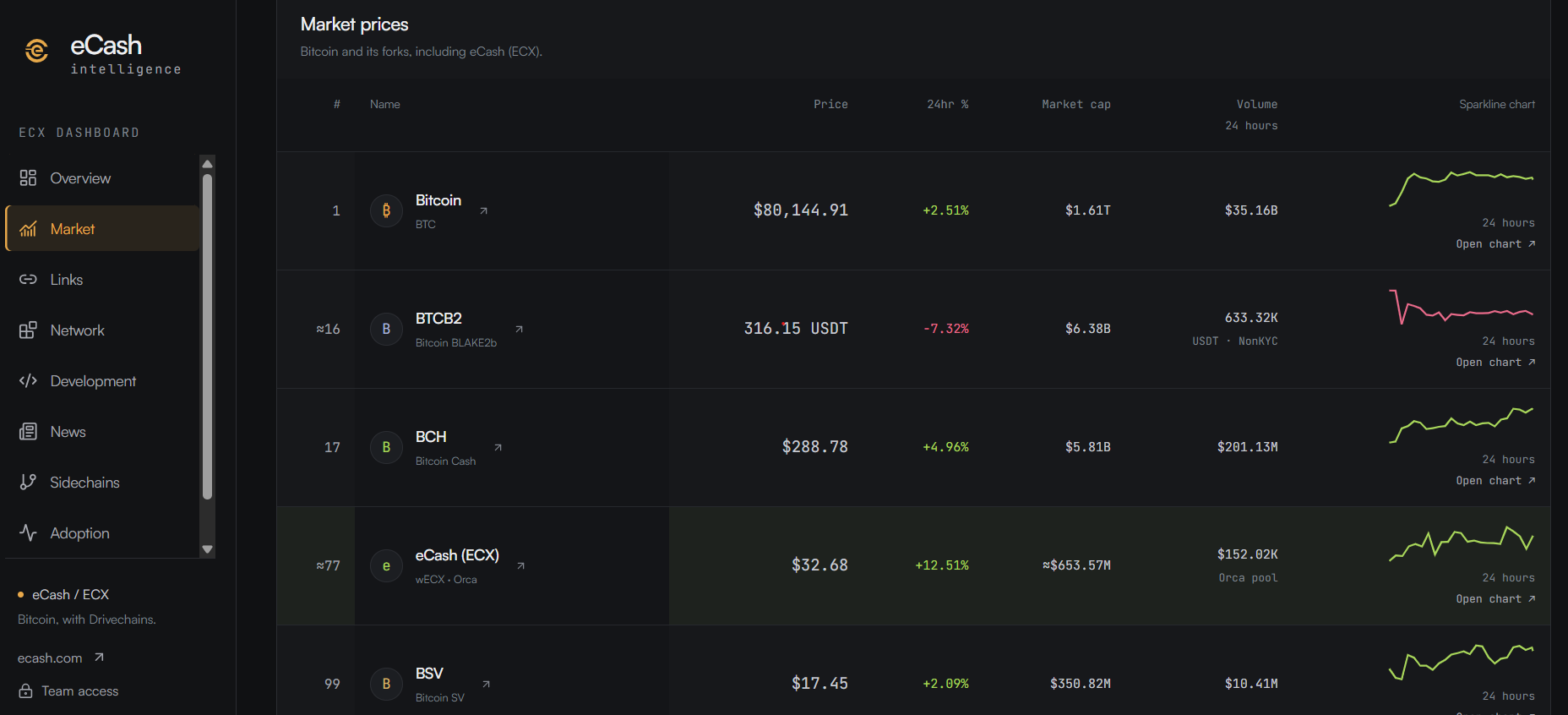
Market data tracking for the nascent token has been fragmented. CoinMarketCap placed ECX at a valuation of $32.63 with approximately $355,000 in 24-hour trading volume, whereas CoinGecko categorized the asset as a preview listing without a live price or tracked exchange markets. Prominent crypto market data provider Kaiko confirmed it does not currently track ECX, reflecting the limited availability of comprehensive independent market data during the immediate post-launch period.
LayerTwo Labs reported that early informal trading activity saw the token fluctuate between $40 and $50. However, the organization did not provide granular order book depth or aggregate trading volume statistics to substantiate those figures, instead pointing observers toward the total value locked within the Orca liquidity pool as a proxy for evaluating available market liquidity.
"If our fork replicates even a fraction of [Bitcoin Cash] BCH’s initial performance, the liquidity will be staggering," Sztorc asserted, adding that participants concerned about current liquidity levels are free to simply hold their coins and evaluate their options at a later date. "We are actively adding new exchanges and trading pairs, so the user experience will only improve. Otherwise, you’re welcome to take your free money and leave."
A Different Vision for Bitcoin
Ultimately, Sztorc acknowledges that the long-term viability and valuation of eCash will not rest solely on speculative fervor or initial airdrop enthusiasm. Instead, the project’s success will be measured by tangible metrics: whether third-party developers actually construct useful applications on its sidechains, and whether real users demonstrate a willingness to pay transaction fees to utilize them. Generating active paying customers and sustainable fee revenue remain the primary benchmarks of success for eCash during its foundational first year.
Sztorc remains unfazed by persistent criticism directed at the security model of Drivechains, particularly regarding the theoretical risk—often described by detractors as a superstition—that miners could coordinate a dishonest 51% attack to steal funds locked within the sidechains.
"If you genuinely believe miners will torch their own billion-dollar operations for a short-term theft on an L2, then you shouldn’t trust Bitcoin’s L1 either," he said.
For the broader cryptocurrency community, the launch of eCash introduces a compelling dynamic: a fresh asset for Bitcoin holders and an expansive technical playground for contrarian developers. Whether ECX evolves into a thriving, utility-driven ecosystem or remains a niche experiment will ultimately depend on market adoption and whether developers and users embrace this alternative vision for Bitcoin’s future.