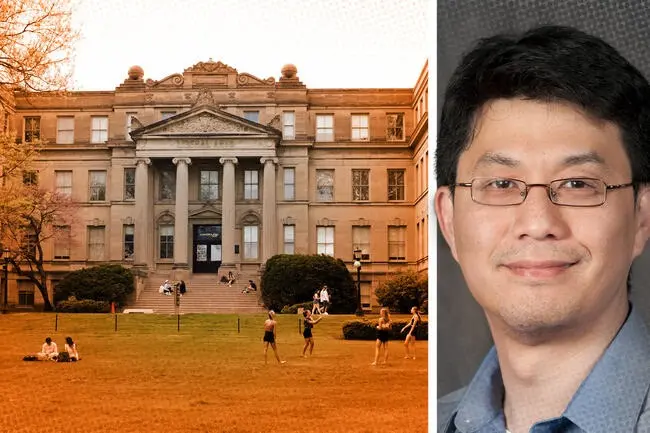
The Iowa Board of Regents voted unanimously on Thursday to appoint University of Iowa associate political science professor Brian Lai as the permanent director of the campus Center for Intellectual Freedom. The decision brings a swift resolution to a leadership vacancy created just weeks earlier when an out-of-state candidate who had been publicly offered the position ultimately declined to take it.
Lai, a tenured member of the university’s faculty who currently earns approximately $117,400 annually, will officially step into his additional responsibilities as director. In taking on the leadership role, Lai will receive an enhanced compensation package consisting of an extra $29,300 administrative stipend, a $26,100 summer salary, and a $5,000 annual research stipend to support his academic and administrative duties at the center.

The Center for Intellectual Freedom is one of several specialized civics centers established by Republican lawmakers on prominent public university campuses across multiple states in recent years. These centers have frequently found themselves at the center of broader debates concerning higher education governance, legislative oversight, and academic autonomy.
Board President Robert Cramer emphasized the practical and strategic advantages of selecting an internal candidate during Thursday’s board meeting, pointing to Lai’s existing standing within the institution. Cramer noted that because Lai is already connected with the university and holds tenure, those institutional factors immediately resolve several logistical and administrative hurdles that often accompany external executive searches. Furthermore, Cramer highlighted Lai’s nuanced understanding of the legislative intent behind the establishment of the center, noting the statutory requirement for institutional autonomy, particularly regarding the center’s independent control over faculty hiring decisions and the approval of its academic coursework. Cramer described Lai as an internal leader who genuinely wants to work collaboratively with the university rather than against it.
The appointment marks a pivotal turning point for the Center for Intellectual Freedom, which experienced a remarkably turbulent first year of operations. Under the watch of now-former Interim Director Luciano I. de Castro—who was initially one of 11 original finalists considered for the permanent position—the center faced intense internal friction alongside a 26-member advisory council. Tensions reached a boiling point in September when nearly half of that advisory council, a group that included vocal conservative-leaning faculty members, tendered their resignations en masse.

Following the mass resignations, de Castro released a comprehensive, roughly 400-page report that levied sharp criticisms against the Board of Regents, the board office, and university leadership. In the report, de Castro accused officials of improperly sidelining him and marginalizing his authority as the center’s leader. He formally petitioned the board to suspend its ongoing search for a permanent director while these governance issues were addressed.
Despite the explosive report and the deep divisions within the advisory council, the Board of Regents opted to press forward with the recruitment process. Last month, the board publicly announced its intention to hire Carson Holloway, chair of the political science department and interim chair of the philosophy department at the University of Nebraska at Omaha, for the directorship. However, the plan unraveled when Holloway informed board member Christine Hensley that he was declining the offer in favor of accepting a faculty position at the University of Florida.
Reflecting on the protracted and winding recruitment path during Thursday’s proceedings, Hensley acknowledged the difficulties the board faced in filling the position, remarking that it had been a long and somewhat complicated process to arrive at the final decision. With the board’s unanimous vote, the university can now move forward under Lai’s leadership as he prepares to assume the director role.