Being with Alex Katz in Lincolnville, Maine, is an experience unlike any other in the art world. Located just ten minutes from the scenic harbor of Camden, the landscape strikes a unique balance—rural without feeling entirely remote, tucked away in the deep woods yet just a short, effortless drive from vibrant seaside life. The winding local road, flanked by the tall, standing-up-straight pine trees that are immortalized in so many of Katz’s most famous paintings, leads directly to the small beach where the author, her late husband Tad, Alex, and his wife Ada once ate lobster rolls while laughing and talking just eight years ago.
Things are different on this return visit. Tad is no longer here, and neither is Ada, who no longer makes the journey up from New York City. Yet, despite her physical absence, Ada’s presence is everywhere, woven into the very fabric of the property and the history of the art created there.

The desire to return to Maine was driven by a pull toward Alex and the bright-yellow house that he and Ada have visited nearly every summer since they married in 1958. Arriving at eleven o’clock on a bright August morning, the visitor finds the artist seated at a round wooden table placed directly on the green lawn outside. Wearing an orange baseball cap, Katz is enjoying coffee and elevenses alongside his poet son, Vincent, and Vincent’s wife, Vivien, who manages the studio. Also gathered around the table are their 27-year-old twin sons, Isaac and Oliver, accompanied by their respective girlfriends, Anna and Kaylie, and Eno—named after musician Brian Eno—the family’s ever-present dachshund. It is a quintessential family affair, one that could easily pass for an Alex Katz painting come to life, missing only his lifelong muse, Ada.
Joining the group feels seamless, as if no time has passed since Alex and the visitor last spoke. Reflecting on his quiet, focused lifestyle during the warmer months, Katz laughs and notes that the isolation of the Maine woods offers a welcome reprieve from social obligations. "The thing about being up here is, we don’t have to worry about the parties we’ve missed," he says with a laugh, capturing his dedication to his craft. "I sleep and work."

Katz speaks with a pithy, economical style that bears a striking resemblance to his visual art—something of a Hemingway-esque cadence. He remains sharply funny, prone to unexpected remarks that genuinely amuse him, often laughing at his own observations as if they catch even him by surprise. When the conversation turns to practical matters of aging, he shares a characteristic anecdote about trying to use a hearing aid. "I tried a hearing aid," he tells the visitor. "Lost it on the way home. Tried it again, lost that one too. They’re bad for painting." When asked why they are bad for his work, his deadpan response is immediate: "You don’t have to hear to paint."
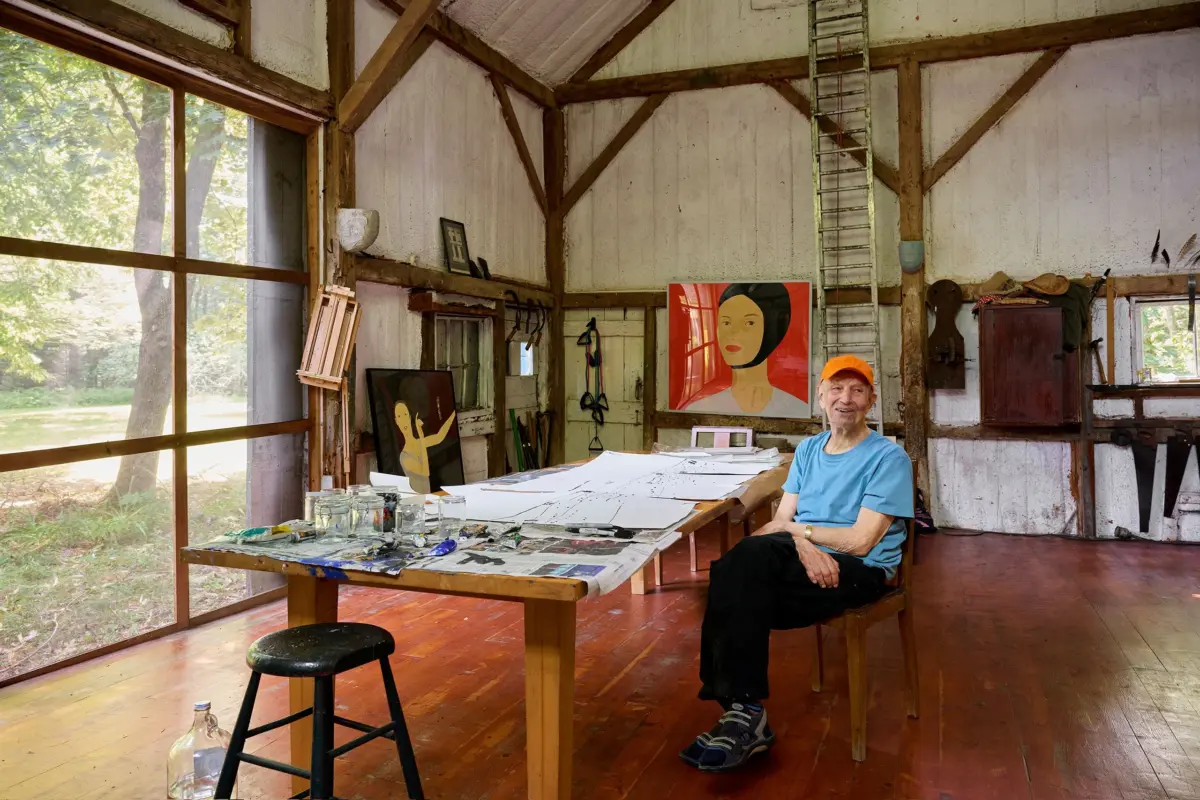
Katz’s studio sits a short, pleasant walk across the property, offering a direct view onto Coleman Pond, though in recent times he has also taken to painting inside the bright-blue barn studio attached directly to the main house. Katz and primary colors have always been on exceptionally good terms, a relationship evidenced by masterworks such as his unforgettable portrait of Ada against a bright-red background, now housed in the Whitney Museum. A similar large-scale close-up of Ada’s face—this time wearing a black bathing cap against a vivid red backdrop—hangs inside the barn in Maine.

Reflecting on the history of the property, Katz recalls the labor-intensive process of making the rustic homestead habitable. "I spent a lot of time fixing up this house," he says. "The thing was about to fall down. I bought it for nothing—$1,200—and the neighbors thought I got rooked." He originally purchased the property alongside fellow artists Lois Dodd and Jean Cohen, who was his wife at the time. "It was a half acre here and 20 acres down the road," he recalls. The main building itself has a colorful history, having originally served as a rum store owned by a blacksmith two miles away. The founders had to drag the structure across the landscape and place it on a new foundation. "But it didn’t fit," Katz adds with a chuckle. "About 20 years later we got a grown man to finish the foundation. Until that time, it leaked."
Unlike many artists who achieve immense commercial success and international acclaim, Katz does not live surrounded by the conventional trappings of wealth. He sleeps in a simple twin bed within a monastic room situated just off the tiny living room. He built the kitchen cabinets himself decades ago, and the charming potato-print wallpaper in the entryway was stamped by hand by Katz and Lois Dodd. Remarkably little has changed, either in the Lincolnville house or in the SoHo loft where he and Ada have lived since the 1960s—the very same space the visitor first encountered in 1982.

At 99 years old, Katz remains remarkably active, wiry, and fit. He claims to maintain a rigorous daily routine of 300 push-ups and continues visiting galleries. Rather than resting on his laurels or simply reproducing the imagery that made him famous, he is actively reinventing his artistic approach, stripping his canvases down to the bare essentials and painting entirely for himself.
"The past couple of years have been the biggest production of my life," Katz shares, noting that he has produced 150 substantial paintings. Recently, his focus has shifted toward depictions of the beach—rendering them as dark, compressed images that stand in stark contrast to the verdant, bright green Maine canvases of his earlier decades. Entering his late period, much like Willem de Kooning in his later years, Katz has emptied the picture plane of figures, leaving only himself and his canvases. From the very beginning of his career, he made his mark by intentionally bypassing traditional sentiment, emotion, character, and mood, choosing instead to paint the pure surface and the reality of external appearances.

Discussing his artistic motivations, Katz points to unexpected sources of inspiration. "This winter I didn’t care if I ever did another painting," he says. "I was inspired by a Monet in The Metropolitan Museum." He is referring to The Met’s massive 1919 masterpiece, Water Lilies. "I had a show with water paintings in Venice. I don’t think people got them. They love looking at them, but they don’t understand what they’re about. Water has three properties: weight, transparency, and motion. They viewed the paintings as illustrations of water, but no one understood what I was doing."
What Katz was actually doing was refusing to stand still, relentlessly pushing his practice forward. Driven by boundless curiosity, he continues to reinvent himself, seeking to understand the core of what he loves most: creating a new picture and surprising himself every single time. His persistence and singularity remain striking. While his career has evolved across various chapters, its foundational elements endure—flowers, trees, landscapes, people, and, above all, Ada.

Katz’s fierce independence and drive were forged early in life. "To be a painter, you have to be aggressive," he explains. "My parents always argued. So I was brought up to be aggressive." He grew up in St. Albans, a vibrant, culturally rich neighborhood in Queens characterized by its strong Black history and jazz culture—hosting legends such as Count Basie, Ella Fitzgerald, and John Coltrane—alongside a diverse mix of Irish, English, German, and Italian families.
His parents, Isaac and Sima Katz, met after emigrating from Russia. Sima initially turned down Isaac’s marriage proposal, pursuing a successful career in the Yiddish theater on Manhattan’s Lower East Side under the stage name Ella Marion. Isaac, who emigrated separately, eventually reunited with her and worked for Sima’s brother in the wholesale coffee business. Sima was roughly ten years younger than Isaac. "She read about people like Isaac in novels but had never met anyone like him," Alex recalls. "He changed his clothes three times a day and had muscles on top of muscles." When Isaac asked her a second time, "he knocked her up, and I’m the result." Katz fondly describes his father as an snappy dresser with an appreciation for high style and culture—an "apprentice aristocrat" and "a Jew with muscles," adding with characteristic wit, "The difference was, he was intellectual. He was very smart." While Isaac initially hoped Alex would join him in the business world, he eventually accepted his son’s artistic ambitions, remarking, "Okay, I’ll work on your kid brother."

Growing up, Katz found himself surrounded by an unconventional domestic environment. "I was trying, trying, trying to do something ordinary," he writes in his art autobiography, Invented Symbols. "Everything in our house was so damn bizarre." His family members, particularly his father, were constantly repainting the rooms of their house in strange, experimental color combinations, including a pink sunroom decorated with triangles. Overwhelmed by the eccentricity, Katz eventually painted his own bedroom a neutral beige with brown trim.
As a quintessential New Yorker who read widely and enjoyed considerable independence, Katz was encouraged by his parents to draw on the walls with crayons. He attended the Woodrow Wilson Vocational High School in Queens specifically so he could dedicate half his day to art. Upon graduating from the Cooper Union art school in Manhattan, he made a characteristic choice for his summer studies, selecting the Skowhegan School of Painting and Sculpture over Yale’s prestigious summer program. "I was sick and tired of listening to teachers, and Albers"—referring to Josef Albers, head of Yale’s art school—"had a real point of view, and I didn’t want a point of view. I wasn’t interested in that." Later in his career, he similarly chose maverick gallerist Gavin Brown over blue-chip dealer Larry Gagosian.

When Katz began painting in the 1950s, Pop art was just emerging in New York alongside the explosive energy of Robert Rauschenberg and Jasper Johns. Yet Katz charted his own course, drawing upon the figurative traditions he had absorbed in his youth. His work remained unapologetically stubborn, much like the artist himself—who famously ate the exact same lunch of a can of sardines, a slice of tomato, lettuce, and one piece of bread every day for 15 years. His social circle primarily consisted of avant-garde poets such as Frank O’Hara, John Ashbery, James Schuyler, and poet-dance critic Edwin Denby. Denby introduced Katz to choreographer Paul Taylor, sparking a decades-long creative collaboration that saw Katz design striking sets and costumes for the Paul Taylor Dance Company.
The definitive turning point in Katz’s artistic identity arrived in the fall of 1957 when he met Ada Del Moro. At the time, he was struggling to find his footing, destroying scores of paintings in a rare crisis of self-confidence. Ada, who was working as a research biologist at Sloan Kettering, married Katz in February 1957, just three months after they met, when he was 30 and she was 29. Over the course of their nearly 70-year marriage, he has created more than 1,000 portraits of her. As art historian Irving Sandler aptly wrote in 1998, Ada "is woman, wife, mother, muse, model, sociable hostess, myth, icon, and New York goddess," taking on countless transformations through the artist’s hands.

Reflecting on his youth, Katz shares a formative memory of his father, who tragically died in a car accident when Alex was 16. As a teenager, Katz and a friend embarked on a grueling physical adventure. "We ran a bicycle 20 miles and made watercolors," he recounts, utilizing the active verb "ran" rather than "rode" to describe the journey. Upon returning, they showed the results to his father. While his companion aspired to commercial art—prompting his father to predict he would become a great commercial artist—his father looked at Alex and declared, "You’re going to be a fine artist."
Katz continues the story with evident delight, recounting it as his personal creation myth. "And then my father ended by saying, ‘Why do you have to ride 20 miles to make this? Why don’t you build your own backyard?’ I couldn’t see the backyard at all. And then, the final thing was, ‘don’t paint details.’" The core philosophy of the Alex Katz vision was laid out right there as a parting gift from his father just before Isaac’s death. "When he said, ‘Paint your backyard,’ I knew he was right."

As day turns to evening, the gathering concludes with a casual dinner of Thai takeout enjoyed around the wooden table outside the bright-yellow house. Surrounded by his family, Katz remains the undisputed paterfamilias, contentedly continuing to do exactly what he has always wanted to do.