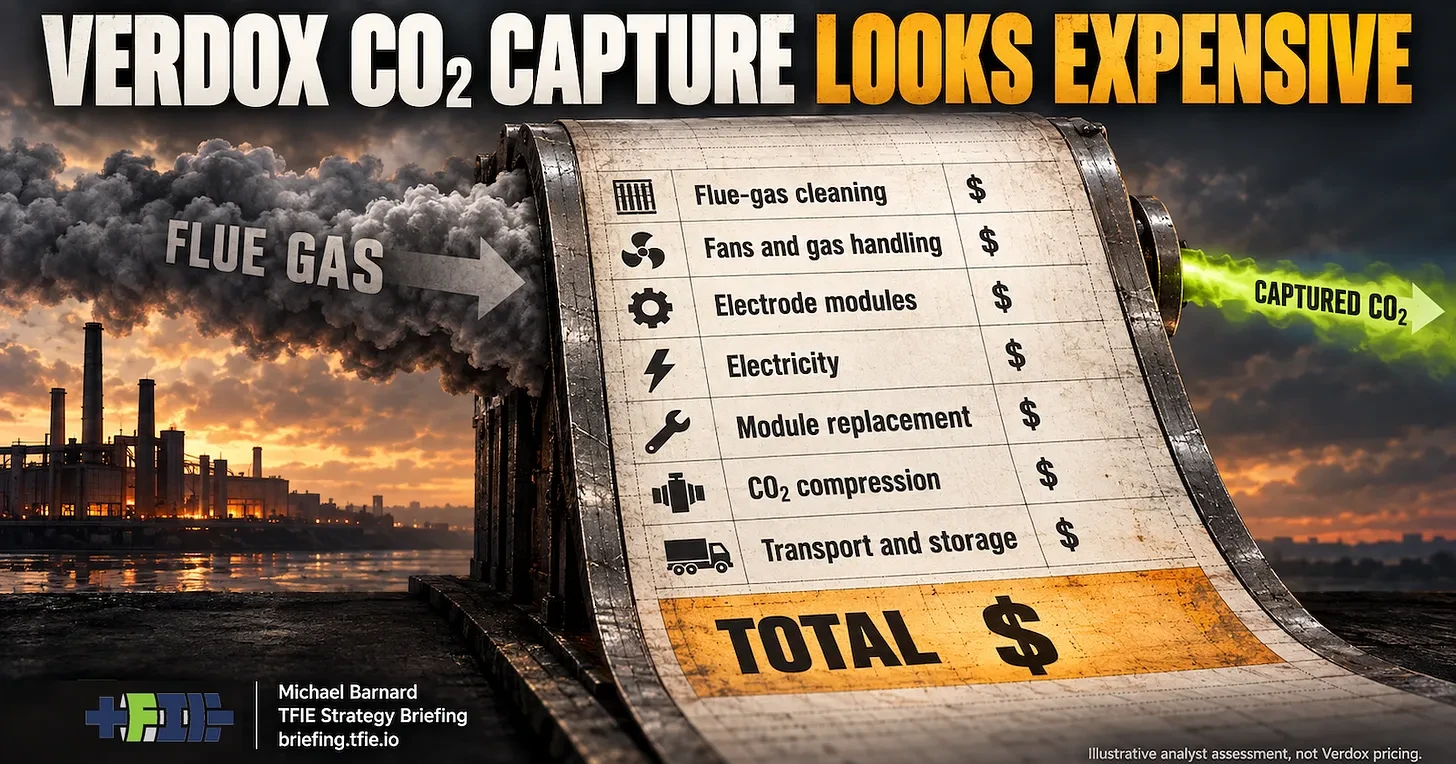
The economics of industrial carbon capture have long been scrutinized in laboratories and engineering boardrooms, but a recent trial at an aluminum smelter in Norway offers a clearer view of both the potential and the practical hurdles facing the sector. Verdox, a carbon-capture technology company, has successfully completed a two-month industrial demonstration of its electrochemical capture process at Hydro’s Sunndal aluminum smelter.
During the trial, the technology captured carbon dioxide from exhaust gas containing only about 1% CO2, successfully operating in the presence of complex industrial contaminants native to real smelter operations. Because the test was backed by Hydro and carried out in a live, active industrial environment rather than a sterile laboratory or a controlled, prepared gas stream, it carries significantly more weight than standard technology-company proofs of concept.
The demonstration establishes that Verdox’s underlying capture chemistry can survive and function in a harsh, relevant industrial setting. However, industry analysts and engineering experts emphasize that a successful chemical reaction is only the first step in a much longer economic chain. The trial did not establish what a commercial-scale installation would cost, how much electricity a full-sized facility would consume, how long finished capture modules would maintain their efficiency in continuous service, or what infrastructure would be required to condition and move the enormous volumes of dilute exhaust gas generated by a smelter. These are the critical variables that ultimately determine whether a promising chemical process can transition into a viable, self-sustaining industrial business.
The core challenge of capturing carbon from sources like aluminum smelters lies in gas concentration. When carbon dioxide makes up just 1% of an incoming exhaust stream, the vast majority of the gas passing through the facility consists of nitrogen, oxygen, water vapor, and other background constituents rather than the target molecule. Commercial-scale equipment must manage these massive volumetric flows, pushing the gas through extensive cleaning systems and capture modules while maintaining strict control over pressure losses, contaminant accumulation, and uniform flow distribution. Consequently, the physical size, capital cost, and power demand of auxiliary equipment—such as heavy-duty fans, complex ductwork, and pretreatment systems—must be factored into the overall economics, even when the electrochemical separation unit itself performs flawlessly.
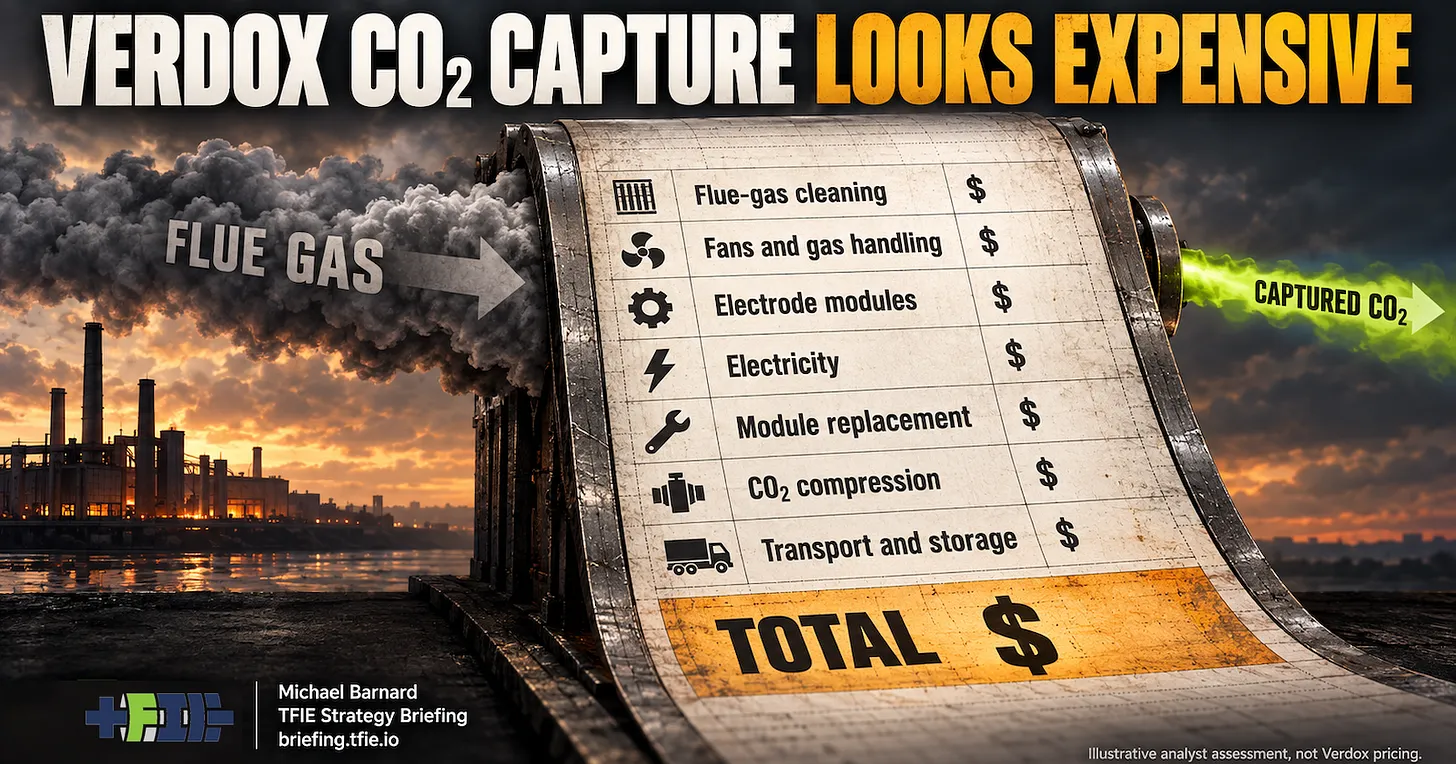
Verdox has published an energy consumption figure of approximately 1.5 gigajoules, or about 417 kilowatt-hours, per tonne of carbon dioxide captured using its process. While this metric provides a valuable benchmark for the electrochemical reaction, prospective investors and project developers require a precise equipment boundary to understand what is actually included in that figure. A complete commercial facility typically requires additional gas conditioning steps, such as gas cleaning, thermal management, switching and clearing mechanisms, pumps, cooling systems, and final product drying and compression. Publicly available data does not yet provide enough granular detail to determine precisely which of these parasitic energy loads are accounted for in the company’s headline energy figure.
Moving from batch testing to continuous industrial operation introduces an additional layer of engineering complexity. Verdox utilizes a quinone-bearing material that captures carbon dioxide when held in one electrical state and releases it when switched to another. Because a single capture surface cannot perform both uptake and release simultaneously, treating a steady stream of smelter exhaust requires a sophisticated arrangement. Facilities must employ multiple banks of capture modules operating at different stages of a staggered cycle, or an equivalent engineering design, to ensure that fresh flue gas can continue to arrive uninterrupted while other modules clear residual gas and release concentrated carbon dioxide.
The commercial footprint and financial viability of this equipment depend heavily on two operational factors: how much carbon dioxide each square metre of a finished module can process over time, and how long the active material can survive under continuous industrial exposure. While published laboratory cycling results provide reassuring evidence about the durability of the chemistry, they do not serve as a maintenance record for a commercial module exposed to real-world smelter gas for years. Replacement frequency directly impacts capital expenditure, ongoing operating costs, plant downtime, materials supply chains, and waste handling protocols. As a result, module longevity deserves just as much rigorous technical diligence as the electrical consumption of the capture reaction itself.
Furthermore, capturing the carbon dioxide is only part of the challenge; the gas must ultimately be transformed into a product that a pipeline operator or geological storage provider will accept. The CO2 released from the capture medium must be meticulously separated from any residual feed gas, collected, dried, and compressed to meet strict pipeline specifications. From there, the product must be transported and injected into suitable geological storage sites, a process governed by complex commercial contracts, stringent regulatory monitoring requirements, and dedicated infrastructure. A technically successful capture unit sitting beside an industrial plant represents only the first link in an extensive carbon-management chain.
In the specific context of aluminum smelting, investment decisions regarding carbon capture are further complicated by concurrent efforts to eliminate direct carbon emissions at their source. Conventional Hall-Héroult smelting relies on carbon anodes that are steadily consumed during production. According to assessments by industry leaders like Hydro and Rio Tinto, anode consumption accounts for roughly three-quarters of a smelter’s direct carbon emissions. Industrial players are investigating carbon capture partly because these direct emissions are notoriously difficult to eliminate at existing plants, but they are doing so while simultaneously developing entirely alternative smelting processes.

For example, the ELYSIS venture—a partnership between Rio Tinto and Alcoa—successfully started a commercial-size 450-kiloampere inert-anode cell at the Alma smelter in 2025. Meanwhile, Hydro’s HalZero program is pursuing a different technological pathway utilizing aluminum chloride, though it remains at an earlier stage of industrial development. Neither of these alternative smelting technologies offers an immediate drop-in replacement for every existing potline across the global industry, but both must be factored into the lifetime financial modeling of any carbon capture project expected to operate for decades.
For an existing smelter with substantial remaining operational life, investing in carbon capture can still represent a sensible business case if process conversion is exceptionally difficult, clean and affordable electricity is readily available, and geological storage can be accessed at a tolerable cost. Conversely, a plant that is rapidly approaching a major potline replacement cycle faces a fundamentally different strategic decision. In that scenario, capital deployed for carbon capture must directly compete with capital that could be used to fundamentally overhaul and decarbonize the core smelting process itself. The most appropriate economic comparison is highly asset-specific, depending heavily on the remaining lifespan of the facility and the technological alternatives available when the next major capital allocation decision arrives.
This same screening logic applies across the broader carbon-capture landscape. Certain industrial CO2 streams originate in conditions that are far more favorable than aluminum-smelter exhaust. Fermentation processes, biogas upgrading facilities, and select chemical operations can generate relatively concentrated, biogenic carbon dioxide streams that require significantly less separation work prior to compression and long-term storage. Where the underlying biomass is genuinely sustainable and permanent geological storage is accessible, capturing and storing such streams can deliver verified net carbon removal rather than merely avoiding emissions from an industrial process.
However, this reality does not eliminate the vital role for dilute industrial capture technologies. Existing manufacturing plants will remain in service for many years, certain process emissions are inherently difficult to abate at the molecular level, and not every industrial site possesses a commercially viable pathway for complete process conversion. Rather, this dynamic suggests that carbon-capture investments should always begin with a thorough evaluation of the emissions source, the availability of alternative remediation technologies, and the integrity of the entire chain leading to permanent storage, rather than ranking capture technologies primarily by the isolated performance of their separation materials.
Verdox has undoubtedly generated sufficient empirical evidence at the Sunndal smelter to justify continued industrial diligence and further technical exploration. The next wave of useful evidence will need to be strictly operational, encompassing a complete gas and carbon dioxide mass balance, verified electricity consumption measured across the entire integrated plant, pressure loss profiles, final product purity levels, module-area productivity, system availability, replacement schedules, and a confirmed storage pathway secured on commercial terms. Gathering these comprehensive measurements will be essential to transform a promising industrial demonstration into the foundation for a much firmer, bankable project assessment.