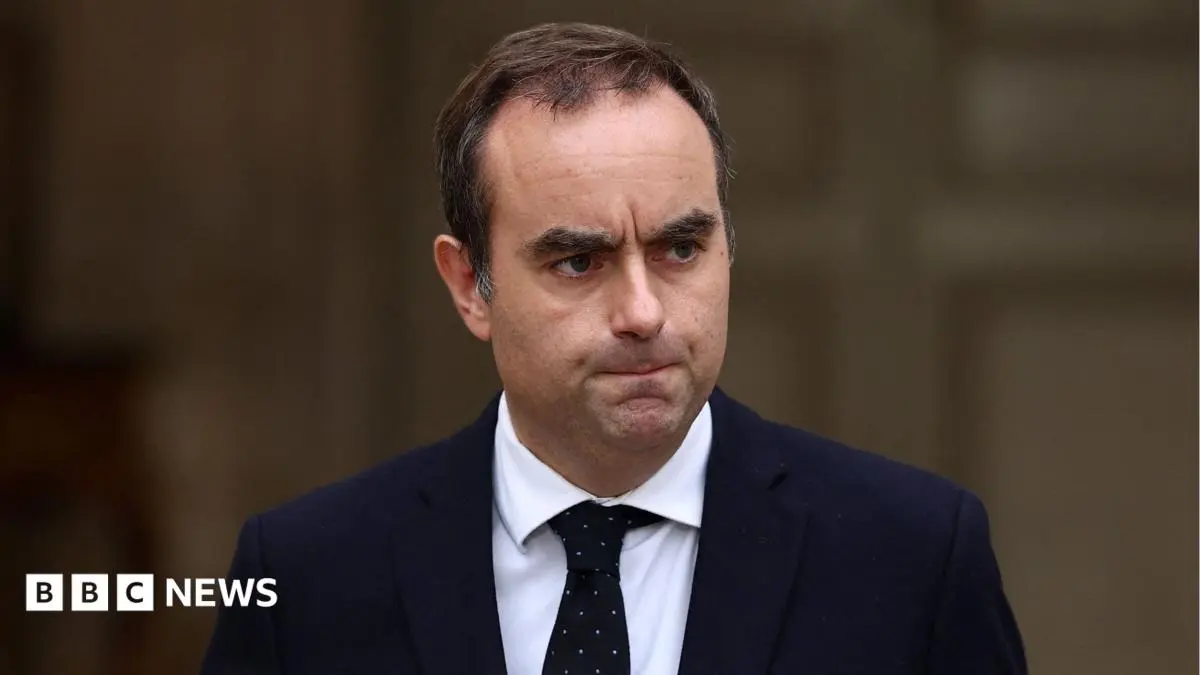
France’s Prime Minister Sébastien Lecornu has issued a stern warning regarding the country’s deepening wave of student unrest, condemning the recent surge in violence as “irresponsible.” The declaration follows a chaotic Monday that saw authorities conduct 164 arrests across the nation, as high school students increasingly turn to blockades and confrontational tactics to air grievances against the government’s education policies.
The demonstrations, which first erupted in the Île-de-France region surrounding Paris, have seen thousands of teenagers barricading school entrances and disrupting classes for days. What began as a localized expression of discontent has rapidly transformed into a broader movement, with reports of school blockades now emanating from Marseille, the northern Lille area, and the north-eastern town of Sedan. The core of the students’ frustration is rooted in a systemic lack of resources: they point to persistently overcrowded classrooms, severe teacher shortages, and the stress induced by Parcoursup, the centralized web platform used by French students to apply for entry into higher education.
As the situation on the ground continues to deteriorate, the rhetoric from the government has sharpened. Prime Minister Lecornu took to the social media platform X to denounce the tactics employed during recent protests. Citing reports of fireworks, fires, and physical confrontations in the vicinity of high schools, Lecornu stated unequivocally: “Fireworks, fires, violence near high schools: nothing justifies endangering students, staff, or police officers.”
The Prime Minister’s assessment is shared by Interior Minister Laurent Nuñez, who provided a sobering account of the toll taken during Monday’s unrest. According to official figures, 12 members of the security forces, 12 students, and three school staff members sustained injuries as the protests intensified. Across the country, approximately 180 schools were impacted by the disruptions.
Minister Nuñez, describing the nature of the demonstrations, drew a clear distinction between legitimate civil protest and what he characterized as criminal behavior. “These are not very typical protest movements,” Nuñez stated. “It is much more like urban violence, with a number of individuals who were masked, equipped with fireworks in tubes, equipped with projectiles, who clearly wanted to confront the internal security forces. It wasn’t about making demands; it was really violence in its purest form.”
Despite the government’s condemnation of the violence, the Union Syndicale Lycéenne (USL), the primary union representing high school students, has remained steadfast in its defense of the movement. The union argues that the intensity of the students’ actions is a direct and “legitimate response” to the dire conditions within the French lycées.
In a public statement posted on social media, the USL laid the blame for the current crisis squarely at the feet of the current administration. “Lack of teachers and staff, dilapidated schools, overcrowded schedules and classes, stress caused by Parcoursup… These issues are by no means inevitable, but simply the result of 10 years of Macron’s policies and the lack of resources in the national education system,” the union declared.
The USL has called for further mobilization, urging students to continue the blockades of their schools on Tuesday as a defiant act against what they describe as "budget austerity" and in defense of their fundamental rights to a quality education. The call to action is occurring in a wider climate of industrial unrest; on the same day, unions representing hospital workers, teachers, and broader civil servants scheduled a nationwide day of walkouts, citing stagnant wages and deteriorating working conditions.
The political fallout from the protests has been swift and divisive. Prime Minister Lecornu, while acknowledging that the frustrations of the student body are real and must be addressed, insisted that the violence must be condemned without reservation. He further accused the far-left France Unbowed (LFI) party of acting as an agitator, claiming the party is actively encouraging students to expand the movement beyond its original scope.
Jean-Luc Mélenchon, the leader of LFI, fired back at the government, accusing the Lecornu administration of orchestrating a heavy-handed response to what he described as peaceful, legitimate grievances. Mélenchon argued that the high school students involved in the movement were “harmless” and that the government’s decision to order a harsh crackdown was a provocation intended to stifle democratic dissent rather than solve the underlying educational crisis.
The situation remains volatile, particularly as reports of police conduct have also begun to emerge. The demonstrations have been marked by significant tension between students and law enforcement. In one concerning incident reported by the broadcaster BFMTV, a police officer allegedly fired a round from a grenade launcher—a tool typically utilized for crowd control—resulting in injury to a high school student. The incident has drawn significant public attention, and French authorities have confirmed that investigations into the circumstances surrounding these violent interactions have been launched.
As the movement spreads to regions such as the Alpes-Maritimes and Var in the south, the government faces a precarious balancing act. Prime Minister Lecornu emphasized that “the difficulties of high schools must be heard and addressed,” yet he maintains that those who engage in violence will be held legally accountable for their actions.
For many students, however, the government’s promises of reform appear increasingly hollow after a decade of what they perceive as systematic neglect. The blockade of school facilities serves as the most visible manifestation of this disillusionment. As the protests continue to ripple across France, the central question remains whether the government will be able to initiate a constructive dialogue with student representatives or if the cycle of confrontation and repression will continue to escalate.
The Ministry of the Interior has not provided granular details regarding the 164 individuals arrested on Monday, nor has it clarified what specific charges they may face. For now, the schools remain at the center of a national debate that pits the authority of the state against a generation of students who feel their future is being compromised by a lack of investment and failing infrastructure.
As Tuesday’s scheduled walkouts by broader civil service unions approach, the pressure on the government to provide a substantive response to the crisis is mounting. The intersection of student protests with broader labor unrest creates a complex landscape for the administration, which is struggling to maintain public order while facing a vocal, organized, and increasingly angry segment of the French population.
The coming days will be critical in determining whether the protests remain focused on educational reform or if they will continue to be eclipsed by the violent confrontations that have characterized the last 48 hours. With investigations into police conduct pending and the students showing no signs of backing down from their demand for systemic change, the situation in France’s high schools stands as a significant test for the government’s ability to manage social volatility while addressing the structural failings of the national education system.