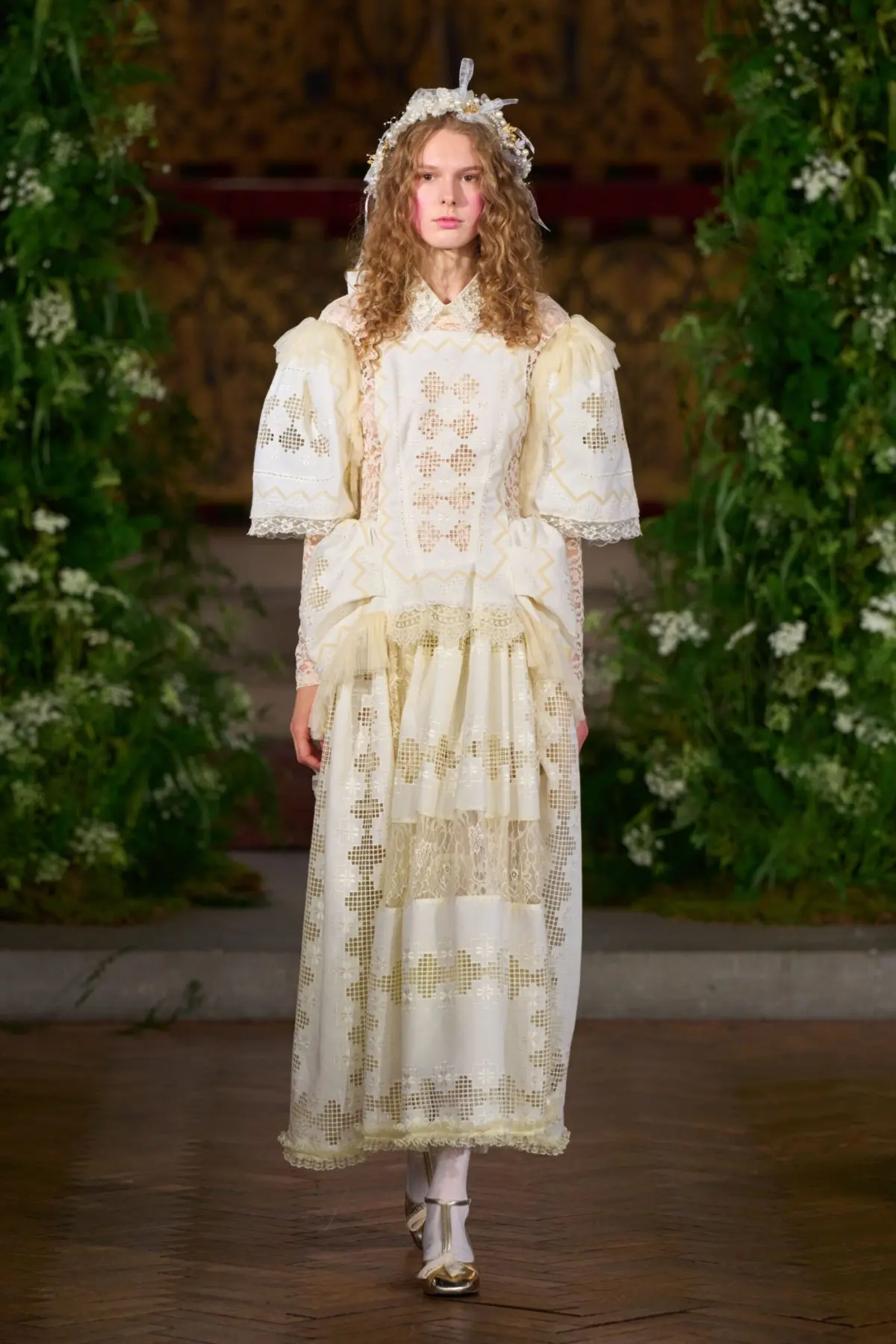
LONDON — Within the celestial, light-filled setting of St. Cyprian’s, Clarence Gate—a striking Victorian church situated next to the southern end of Regent’s Park—designer Bora Aksu brought a potent dose of bucolic fantasy to the runway on Friday morning during London Fashion Week. The presentation established a delicate yet striking balance between ethereal romanticism and grounded, historical subversion, captivating an audience gathered to witness the unveiling of the designer’s latest vision.
The show opened with an atmosphere of serene, pastoral innocence. Wafting down the aisle first came a series of pastoral brides clad in voluminous puff sleeves, delicate lace-trimmed ruffles, and intricate broderie anglaise. These looks evoked a timeless, romantic nostalgia, capturing the light streaming through the historic church’s architectural windows. However, this gentle introduction was soon disrupted as a handful of more subversive elements were slowly and deliberately worked into the collection.
As the presentation progressed, the soft femininity began to interface with structured tailoring. Trench coats and sharp suiting appeared on the runway, soon followed by functional yet unconventional additions such as bib harnesses, apron ties, and cinched cummerbund-style sashes. This interplay between soft, floating fabrics and rigid, utility-inspired lines created a visual tension that has become a hallmark of Aksu’s design language.
The narrative of the collection shifted once more toward its conclusion, marked by a striking trio of looks rendered in a deep, rich oxblood shade. This final sequence introduced a touch of the Gothic, featuring exposed corsetry and yarn that crept across the garments like branching tree roots. The visual transition was underscored by a gentle soundtrack of 1970s British psychedelic folk playing softly over the speakers, enveloping the venue in an atmospheric, contemplative mood.
The presentation served as a clear reminder that beneath all of Aksu’s signature frills and floaty femininity, there often lurks a darker, more masculine edge. As is custom for the designer, the intellectual and creative foundation for this duality lay, in part, in a historical figure who inspired the collection. For this season, that inspiration was found in the 17th-century portraitist Mary Beale, widely recognized today as Britain’s first professional female painter.
The rich crimsons that dominated the final looks of the runway show were not chosen at random; they were shades lifted directly from Beale’s historic paintings. Living and working during an era when women were strictly barred from formal academies and artist guilds, Beale managed to establish a thriving practice. She painted some of the most notable figures of her day and ultimately served as her family’s primary breadwinner, carving out an extraordinary space for herself in a male-dominated artistic landscape.
Aksu found deep resonance in Beale’s life, career, and personal philosophy. "She was really a big believer in equality between men and women, and I think she showed it in her life and work," Aksu explained following the show. This profound appreciation for Beale’s egalitarian spirit directly informed the collection’s structure, inspiring the incorporation of masculine elements derived from 17th-century men’s dress that counterbalanced the feminine silhouettes.
Equally compelling as the historical narrative was the extraordinary level of craft on display throughout the collection, most notably embodied in the form of a dazzlingly intricate lace technique. The story of this textile began back in the spring, when Aksu received an invitation from the mayor of the eastern Turkish city of Gaziantep to visit the region. During his trip, he discovered a historic lace technique that has been practiced there for over two centuries, traditionally produced solely by local women.
Explaining the laborious and specialized process behind the material, Aksu detailed how the artisans approach the textile. "They basically have this silk cloth, and they pull the threads of each line to create patterns—it takes three months, six months, depending on the pattern," the designer noted.
Traditionally, this delicate technique is utilized for household items such as bedspreads, tablecloths, and napkins. Aksu’s presentation marked the very first time the historic textile has ever been translated into a fashion context. Its inclusion on the runway served as a powerful testament to both Aksu’s endless curiosity as a creator and his distinct ability—particularly evident in his warm-weather collections—to build volume and theatricality into garments without ever making them feel overly heavy or burdensome to wear.