One of the fundamental lore pieces of the cryptocurrency ecosystem is that Bitcoin’s pseudonymous creator, Satoshi Nakamoto, sits atop a multi-billion-dollar fortune. For years, conventional wisdom has held that nearly 1.1 million BTC belongs entirely to this elusive figure. However, a deeper examination of the blockchain reveals that this colossal figure rests not on a direct identification of a person, but rather on a forensic trail linking a specific mining operation to Bitcoin’s earliest days. Furthermore, recent blockchain analyses show that this estimate can vary by more than 200,000 Bitcoin depending on how strictly analysts apply cryptographic "fingerprint" tests.
The distinction between tracking coins and identifying people became a central focus of industry speculation following a notable on-chain event. A cache of 600 BTC, originally mined in 2010, suddenly moved after remaining dormant for 16 years. This unexpected movement instantly triggered widespread speculation across the digital asset community that "Satoshi’s coins" had finally awoken from their slumber.
The moving coins originated from 12 long-dormant block rewards that had been mined across a four-day span in March 2010. They sat completely untouched until September 5, when an entity controlling the private keys spent them sequentially within a half-hour window. Despite the immediate flurry of excitement and market chatter, blockchain investigators quickly clarified that the person spending this $46 million stash was almost certainly not Satoshi Nakamoto.
The Blockchain Traces Coins, Not People
Prominent on-chain tracking entities, including Whale Alert, quickly investigated the transaction and found no direct connection between the 600 moving BTC and the mysterious creator’s legendary stash. Independent blockchain research firm Bitquery dug even deeper into the cryptographic data, discovering that 10 of the 12 blocks failed to match the distinctive mining pattern historically associated with Satoshi’s proprietary mining operation, widely known in the industry as "Patoshi."
According to Bitquery researcher Gaurav Agrawal, the two remaining blocks displayed only weak matches that could easily occur purely by chance. While the rewards were indisputably mined by a single machine, and whoever spent them this month successfully controlled the private keys, Agrawal highlighted the inherent limitation of distributed ledger technology. As he pointed out, the blockchain cannot tell us whether the hand holding the keys in 2026 belongs to the exact same person who operated the machine back in 2010.

This enduring mystery is unlikely to ever receive a definitive resolution because private keys can change hands through inheritance, direct sales, theft, or even recovery from discarded storage drives found in secondhand stores. Agrawal emphasized that the blockchain only records historical possession, noting that someone simply had access to the keys. Furthermore, the spending transactions utilized modern wallet software that the original 2010 client could not have generated, proving that at the very least, the legacy keys had to be loaded into contemporary software environments.
The Patoshi Pattern Behind the Fortune
If the blockchain alone cannot definitively tell us who owned those original coins, how did researchers arrive at the widely accepted figure of 1.1 million BTC belonging to Satoshi? The answer lies in circumstantial evidence meticulously pieced together over the past decade.
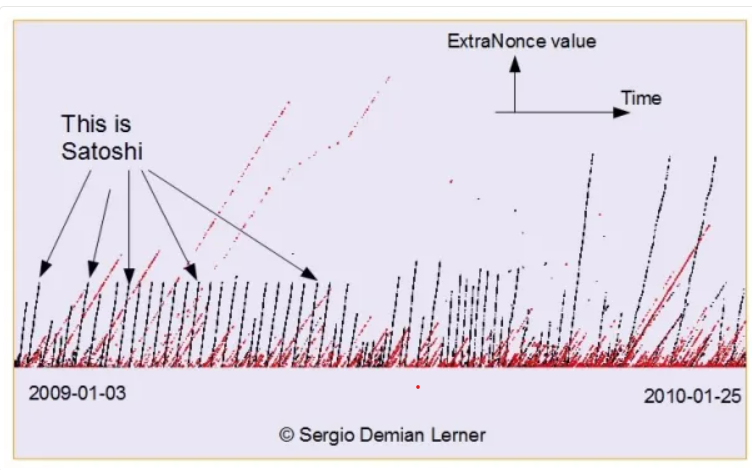
In 2013, security researcher Sergio Demian Lerner published a landmark analysis identifying a distinctive fingerprint embedded within Bitcoin’s earliest blocks. His research suggested that a single miner operated their hardware with slight operational variances compared to other network participants, creating a traceable pattern spanning thousands of blocks. Lerner estimated that this specific miner had accumulated roughly 1.1 million BTC, and more than a decade later, he continues to stand by his original mathematical calculations.
Reflecting on his findings, Lerner noted that his estimations remain accurate, though he adds the necessary disclaimer that the supporting evidence is entirely circumstantial. There is no direct mathematical proof or eyewitness testimony confirming the identity behind the machine. However, Lerner argues that the case connecting Patoshi to Satoshi extends far beyond just the isolated mining fingerprint. Several early Bitcoin pioneers—including prominent figures like Hal Finney, Dustin D. Trammell, Nicholas Bohm, and Mike Hearn—received early peer-to-peer transfers that explicitly exhibited the Patoshi pattern.
According to Lerner, all of those early transfers originated from coinbases matching the Patoshi pattern, providing compelling reasons to believe that Patoshi and Satoshi are the exact same individual, even if it falls short of absolute legal proof. Furthermore, Lerner points out that the miner appeared to be utilizing specialized proprietary mining software rather than the standard public client. Because this software was likely developed before Bitcoin officially launched to the public, it remains highly improbable that an entirely separate miner managed to develop a working specialized setup during the narrow window between the public announcement of Bitcoin version 0.1 and the mining of the genesis block. Whoever mined the Patoshi pattern started right at the absolute beginning.
Bitquery Rebuilt the Fortune From Scratch
Thirteen years after Lerner first identified the Patoshi pattern, Bitquery independently rebuilt the forensic fingerprint from raw blockchain data. The firm graded 54,316 individual blocks from Bitcoin’s formative era and followed the movement of every single coin through September 1, 2026.
Bitquery’s "highest grade" reconstruction aligned with the publicly recognized Patoshi list on 99.2% of all analyzed blocks. Additionally, the firm found zero exceptions when running a stringent timestamp-ordering test across 5,836 adjacent block pairs. Agrawal noted that he knows of no stronger validation test for this specific dataset.
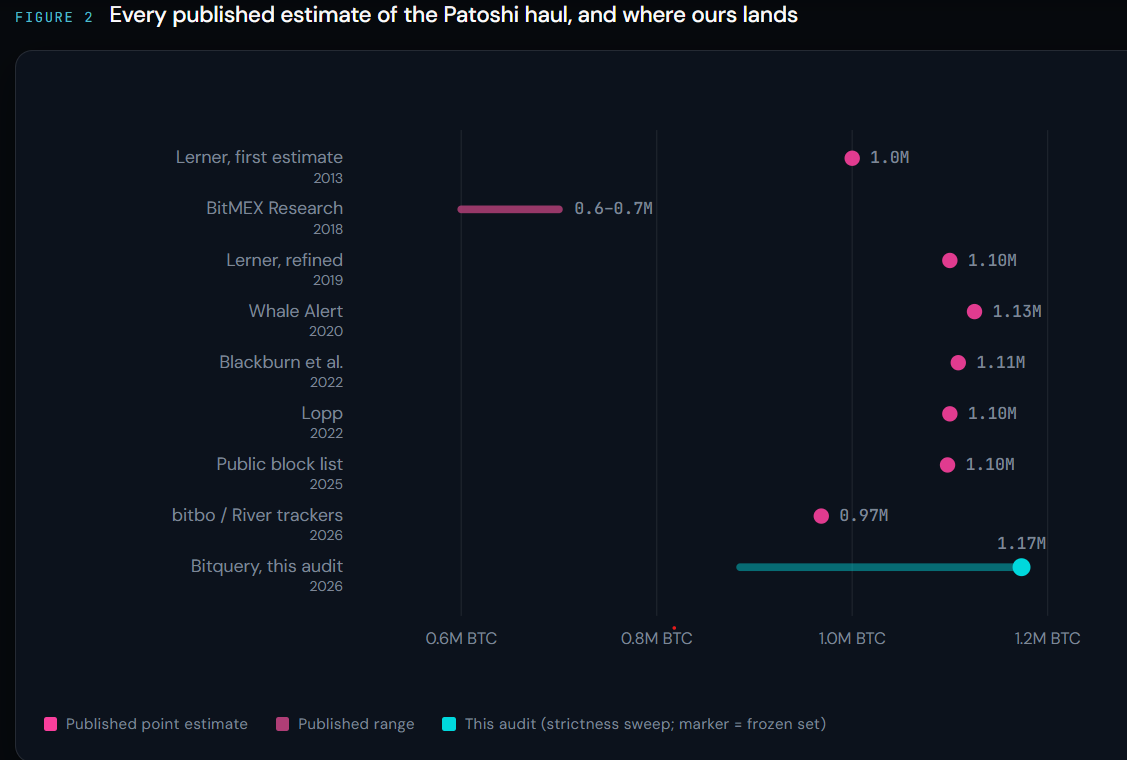
However, this comprehensive modern analysis also introduced nuances that cast mild uncertainty around the absolute accuracy of the famous 1.1 million BTC figure. The total amount uncovered by Bitquery varies depending on how strictly researchers apply the mining pattern parameters. When the fingerprint is run under the strictest criteria, it covers just under 0.9 million BTC. Conversely, the most generous reading of the data pushes the total estimate up to around 1.17 million BTC.
This variability does not necessarily invalidate Lerner’s foundational work; rather, it demonstrates how the calculated size of the Patoshi stash fluctuates based on the strictness of the mining pattern’s application. Because previously published estimates ranging from 1.0 million to 1.13 million BTC fall comfortably within Bitquery’s calculated range, the core consensus on the fortune’s approximate magnitude remains intact.
What Links Satoshi to the 1.1M BTC
Agrawal explains that the common assertion that Satoshi Nakamoto owns 1.1 million BTC is actually a stack of three distinct claims. The assertion that the coins originated from a single, unique machine is supported by robust, verifiable evidence. However, the claim that this specific machine belonged directly to Satoshi Nakamoto remains circumstantial, and the assumption that the private keys remain under his personal control can never be definitively proven simply because the vast majority of those coins have never moved.
During their extensive research, Bitquery also uncovered a historical 2010 transaction that had not been documented in any previously published academic studies. On May 17, 2010, 600 BTC originating from early mining rewards moved across two separate transactions roughly an hour apart. The first transaction, executed at 22:04 UTC, spent 10 block rewards totaling 500 BTC, while the second transaction at 23:07 UTC spent an additional two block rewards totaling 100 BTC. These specific coins had been mined at various intervals throughout 2009, capturing rewards from both the earliest days and the closing months of Bitcoin’s first operational year.
Agrawal emphasizes the significance of this historical find, noting that it represents the clearest moment where the blockchain protocol itself—rather than an external statistical pattern—proves that these specific blocks belong together. It serves as close as the immutable ledger gets to confirming that blocks from across the entirety of 2009 were consolidated into a single wallet, mirroring what the Patoshi pattern claims for the entire set of early rewards.
Ultimately, while analysts can confirm that whoever controlled those keys maintained access to block rewards distributed throughout 2009, the true identity of the person behind them remains hidden. Unlike that historical May 2010 transaction, the 600 BTC that moved recently in September do not belong to the Patoshi miner, leaving no fresh forensic evidence to connect them directly to Satoshi’s legendary stash. As Agrawal concludes, since nothing in the underlying mathematics can conclusively settle the debate, the true ownership of the genesis fortune will likely remain an enduring mystery.