While military history often focuses on heavy armor, rugged all-terrain trucks, and tracked vehicles, conflict has frequently driven innovation down to unexpected machinery. World War II famously integrated two-wheeled transport into various armed forces, with motorcycles from multiple nations taking up active duty on the front lines. However, in the post-war era, an entirely different kind of two-wheeled vehicle was called into service for a distant and grueling conflict: the iconic Vespa.
When the French military approached the Italian scooter manufacturer Piaggio for assistance, France was already deeply entrenched in the dense and unforgiving jungles of Vietnam during the First Indochina War. At the time, Vespas had already earned a reputation among civilian owners for being remarkably rugged, dependable, and easy to maintain. Faced with the nightmare of navigating thick jungle terrain, the French military was in desperate need of a small, lightweight vehicle that its airborne paratroopers could deploy to maneuver through dense foliage while still packing a significant punch.
The Italian company answered the call, engineering a specialized military variant known as the Vespa 150 TAP. The acronym "TAP" stood for Truppe Aero Portate, which translates directly to airborne troops. To bring this vision to life, Piaggio’s French manufacturing subsidiary, Ateliers de Construction de Motocycles et d’Automobiles (ACMA), took on the task of producing the ruggedized 150cc scooter for military deployment.
The foundation for the military modification was the standard Vespa 150 VL3 scooter. ACMA offered the tactical machine in utilitarian camouflage colorways, specifically sand or green, designed to blend into operational environments. Underneath the bodywork, the Italians made critical mechanical adjustments. They replaced the original VL3’s problematic 150cc rectangular engine with a newly designed 150cc square engine. This updated power plant was engineered to rattle significantly less at idle, reducing noise signatures in the field. Furthermore, the new engine featured a smaller bore and slightly longer pistons, modifications that not only successfully minimized engine vibration but also improved fuel consumption. The resulting efficiency allowed the military scooter to achieve an impressive operating range of up to 124 miles on a single tank—an ideal characteristic for wartime conditions where supply lines were frequently stretched thin. Interestingly, production of the TAP 150 at the ACMA facility began just a year before the factory started building Vespa’s equally unconventional 400 microcar.
Do not fire the guns while on the Vespas
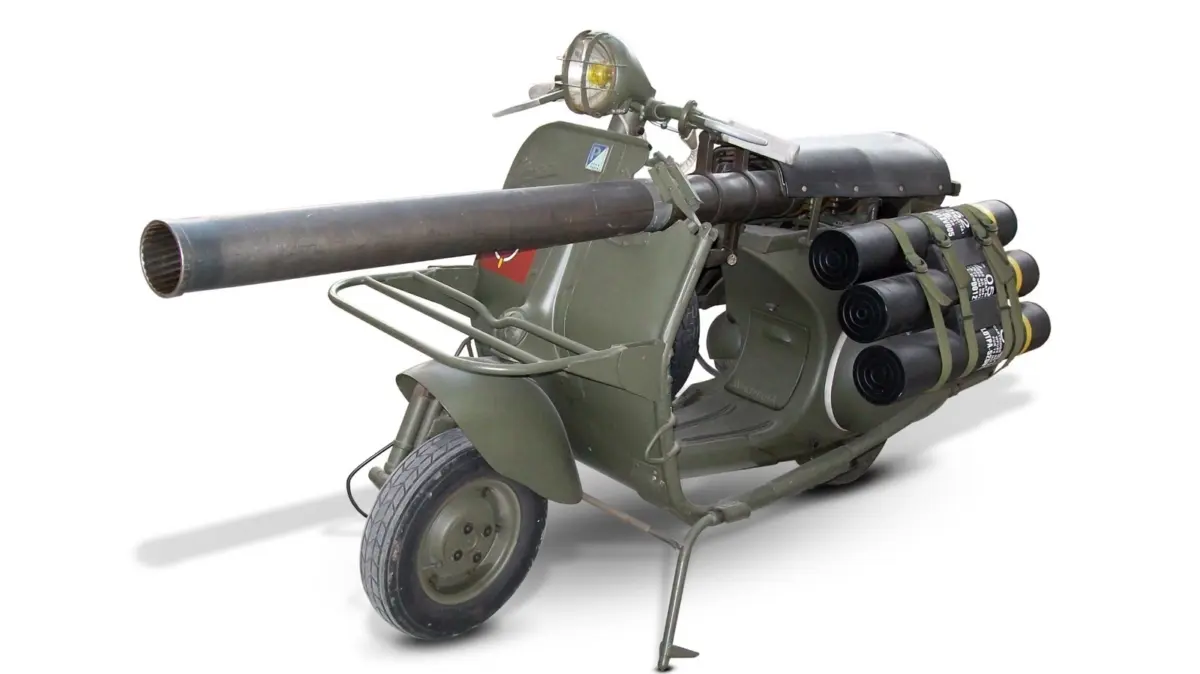
Despite sharing its basic lineage with civilian scooters, the military-spec Vespa 150 TAP featured modifications that set it worlds apart from anything seen on city streets. The most striking visual and functional difference was the inclusion of a massive American M20 recoilless gun—effectively a 75mm cannon—carefully mounted directly down the center of the scooter. The weapon was positioned under the operator’s seat and neatly notched into the front fairing to accommodate its bulk.
As military historians and archives have frequently pointed out, these specialized Vespas were never intended to be firing platforms while in motion. Instead, the scooters were strictly designed to carry the heavy weaponry to designated locations. Once troops reached a tactical position, the 75mm cannon would be physically removed from the scooter, dismounted, and set up on a tripod to engage enemy forces from a stationary position.
The reasoning behind this protocol was simple physics. While the Vespa 150 engine provided respectable power for its size, discharging a recoilless cannon of that magnitude while the scooter was actively moving would undoubtedly lead to catastrophic outcomes, ranging from immediate loss of vehicle control to severe injury or death for the rider.
Carrying such immense weight and hardware required a complete re-engineering of the scooter’s structural integrity. Engineers reinforced the bottom of the Vespa significantly, adding heavy rubber-coated framing designed to absorb the severe impact when the lightweight machine hit the ground after a parachute drop. The overarching operational strategy for these unconventional anti-tank vehicles involved deploying them directly into active fields of operation alongside French paratroopers, dropping them in pairs. Under this doctrine, one Vespa would carry the heavy recoilless gun and its primary operator, while a second accompanying scooter would transport essential combat supplies, including extra fuel, ammunition, and a dedicated loader. Some configurations even incorporated a specialized, single-wheeled utility trailer to maximize hauling capacity.
Vespa drops right into the Algerian War
By the time Piaggio and its French manufacturing partners fully ramped up production of these diminutive tactical anti-tank vehicles, the geopolitical landscape had already shifted. The French-Indochina War had formally concluded with the signing of peace agreements in 1954, just as the military scooter project was coming to fruition.
Consequently, rather than seeing widespread deployment in the jungles of Vietnam, the Vespa 150 TAPs officially launched in 1956 directly into the ongoing conflict in Algeria, where the French military urgently required highly mobile tactical assets. Throughout this period, two distinct iterations of the military scooter saw active service: the original TAP 56 model, and a slightly updated version designated as the TAP 59, which debuted in 1959 featuring minor refinements such as a newly styled plastic ACMA badge.
Despite their unique engineering and specialized purpose, the tactical lifespan of the armed scooter was remarkably brief. Piaggio officially brought production of the Vespa 150 TAP to a close in 1959, having manufactured a total of approximately 600 units. The concept of a combat-ready, heavily armed scooter ultimately failed to catch on within broader military doctrines, leaving the TAP as a singular, highly unusual anomaly in both scooter history and military archives.
Decades after leaving active service, original surviving examples of the Vespa 150 TAP occasionally emerge on the collector market, commanding immense attention and steep price tags from military and motorcycle enthusiasts alike. For those rare listings that display public pricing rather than an undisclosed "inquire for price" status, historical sales data from platforms like Classic Trader show that authentic units generally command anywhere from $33,000 to $46,000 USD, cementing the legacy of the world’s most heavily armed scooter as a prized piece of mid-century military history.