Held in the melancholy shadow of the shuttered Chiltern Firehouse during Frieze Week in London, last Tuesday’s gathering at The Hart could easily have passed for any contemporary art-contextualized fashion amplification. Yet, amid the jostle of thirsty freelancers, circulating trays of tartare, and high-profile guests like Alexa Chung, there stood a collection of bona fide British Old Masters of a quality and provenance rarely seen on the modern fashion scene in years. Displayed at the bar were the Stanhope Chelsea boot, the Skipton Oxford, and the Sidley lace-up, alongside a sophisticated women’s Sloane collection anchored by the polished-calf Susan ankle boot.
All of these footwear pieces are the proud products of Church’s, the storied Northampton shoemaker founded in 1873 and subsequently acquired by the Prada Group in 1999. Overseeing their prominent appearance at the bar was Denni Manzatto, who was appointed CEO of Church’s in 2022. Before joining the Prada Group in 2013, the former Goldman Sachs executive first encountered Church’s while working in private equity in London. At the time, the brand’s historic Jermyn Street store—which originally opened its doors in 1921—was situated just down the street from his office.
“Church’s has a higher than proportional meaning for the Prada Group relative to its business size,” Manzatto explains. According to the Prada Group’s H1 earnings reports, Church’s currently accounts for roughly 1% of the overall business, translating to approximately £32 million in annual sales. “It is a jewel that we should preserve, we should restore, and take to new heights.”
This philosophy explains the gathering at The Hart. After years of intensely discreet stewardship, Manzatto and the Prada Group are stepping into a dynamic new phase built around increased financial investment in Northampton and redoubled efforts to introduce a fresh congregation of footwear aficionados to the historic brand.

An Infatuation with Church’s
Like most enduring heritage brands, Church’s was once at the absolute cutting edge of manufacturing technology. As the company’s archivist, Simon Hill, explained during an exclusive factory visit in Northampton the following day, the brand’s 1881 “Adapted” boot was a monumental industry milestone. It was the first footwear design to make differentiated left-and-right shoes available on a true industrial scale. Church’s was originally founded by Thomas Church before his sons, Alfred and William, industrialized the town’s existing cottage-industry model. By bringing specialist makers together under one factory roof while carefully retaining the meticulous sequence of skilled processes that still structures production today, they revolutionized local manufacturing.
This system was born from a rich shoemaking tradition in Northampton that stretches all the way back to the Middle Ages. By its postwar peak in 1955, Church’s and its neighboring shoemakers were producing an astonishing 160 million pairs of shoes a year. However, the subsequent decline of the British Empire and the global rise of mass manufacturing—ranging from increasingly dynamic footwear centers in Italy to lower-cost production hubs in India and Southeast Asia—initiated a long, challenging period of decline for Northampton’s overall output.
Despite these macroeconomic headwinds, Church’s and a select group of its neighbors, including Tricker’s, Cheaney, and Edward Green, managed to survive. They achieved this resilience by transforming the traditional, labor-intensive manufacturing practices upon which the town was built into an increasingly appreciated point of difference in a homogenized global market.
The Prada Group first entered the Northampton landscape in 1999, when it agreed to a £106 million takeover of the then-publicly listed Church & Co. The Italian luxury powerhouse offered 950 pence a share, successfully fending off competing interest from Diego Della Valle of Tod’s. At the time, Patrizio Bertelli was explicit that Church’s distinct British identity and historic manufacturing base in Northampton were to be fiercely preserved and actively developed. He promised publicly to “maintain and possibly strengthen the British identity of Church’s” while simultaneously “preserving and developing its industrial presence in Northampton.”

Reflecting on the acquisition, Manzatto agrees that there was perhaps a deeply romantic instinct behind the move. Bertelli and Miuccia Prada grew up during an era when Church’s represented, in his words, “the pinnacle of English shoemaking and shoemaking in general.” He adds, “There was definitely a fascination in the first place.”
Bringing It All Back to the UK
When Manzatto took charge of the brand in 2022, however, the day-to-day reality he encountered proved to be significantly less romantic. “Business-wise, the situation was more difficult than I had originally anticipated,” he notes. For years, Church’s had been operating largely as a separate company and legal entity. A critical pillar of his executive mandate has been to integrate the brand much more closely with the broader Prada Group, thereby giving the smaller English enterprise direct access to its Italian parent company’s extensive corporate, industrial, technological, and commercial infrastructure.
Currently, Church’s manufactures its core Goodyear-welted footwear locally in Northampton, while other specialized models—such as the iconic Shanghai shoe and certain contemporary sneaker designs—are produced within Prada’s directly operated manufacturing network in Italy. During our interview, Manzatto reveals that the strategic intention over the next few years is to transfer all of that production back to Britain, including product categories not traditionally associated with English shoe manufacturing. “Our vision over the next few years is to bring everything back to the UK,” he asserts.
Achieving this ambitious goal inevitably demands substantial investment in both the physical factory infrastructure and its skilled workforce. “We are investing a lot,” Manzatto states. He elaborates that Church’s is actively collaborating with local educational and vocational institutions to help cultivate a brand-new generation of craftspeople as long-serving shoemakers approach retirement age. Simultaneously, the manufacturing operation itself must acquire the advanced technical capabilities required to produce a much broader range of products. Manzatto emphasizes that the vast resources of the Prada Group make this challenging transition achievable: “If we were on our own, it would probably not be possible.”

This heavy financial investment comes at a time of an increasingly difficult operating environment for British manufacturing and retail sectors alike. Post-Brexit customs duties and administrative burdens, rapidly rising domestic employment costs, and the permanent loss of tax-free shopping incentives for international visitors have all significantly impacted businesses across the country. “That has impacted both our top line and our bottom line. It’s a fact,” Manzatto acknowledges. Yet, the Prada Group’s strategic response is not to reduce Church’s exposure to Britain or scale back its domestic operations. “In fact, we’re doubling down on the UK.”
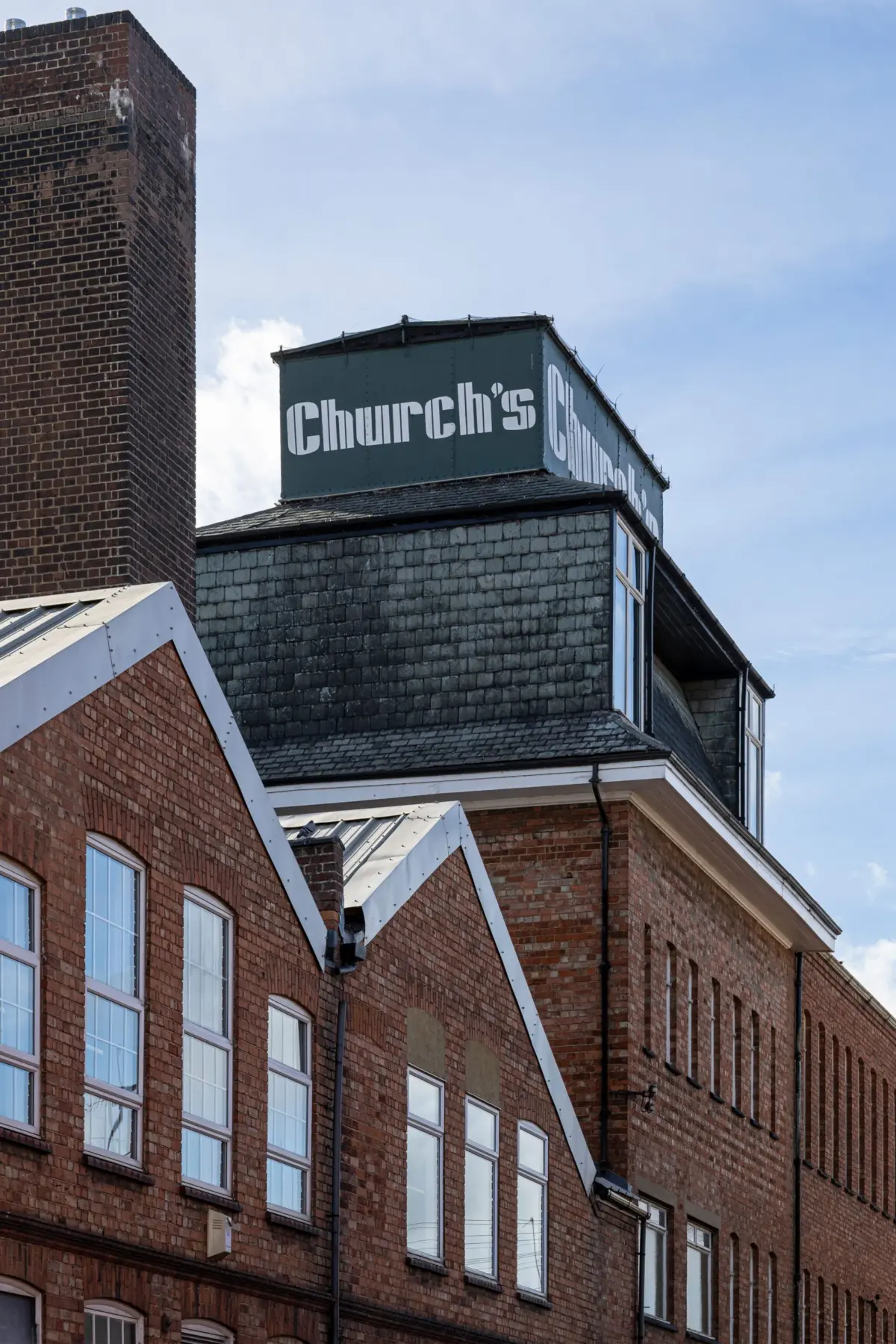
Church’s currently employs 137 people in direct manufacturing roles at its St James Road factory. Here, production still moves methodically through the exact sequence of specialist rooms originally established by the Church family generations ago: clicking (cutting), closing, lasting, making, finishing, and polishing. During our guided tour—which is attended by fashion editors hailing from Italy, Japan, and the United States—visitors dive deep into the intricate technicalities of traditional English shoemaking as classic tracks like “Boogie Shoes” by KC and the Sunshine Band play softly over the factory tannoy system.
Inside the workshop, one former apprentice, now a full-time artisan, is intently stationed at her workbench, applying color by hand to shoes destined for Church’s pinnacle product tier: the Crown collection. She stands out on the busy factory floor both for her casual, effortless mastery of the spray gun and the striking finery of her full punk aesthetic. Upstairs in the company archive, Simon Hill proudly displays other shoes that she has personally engraved and decorated. According to Hill, apprentices are actively encouraged to experiment during their training because that vital creative freedom fosters advanced skills that ultimately feed back into commercial production.
Manzatto points directly to the Crown and Royal collections—where individual pairs of shoes can take up to 12 weeks and require more than 320 distinct manufacturing processes to complete—as definitive proof that discerning clients are more than willing to pay for exceptional workmanship when its true value is properly and transparently communicated. “If you come out with exceptional products, and of course, if you’re able to share with your clients what it takes to create these products… there is no price resistance.”

Yet, Manzatto is careful to emphasize that his overarching business strategy is not to transform Church’s into a fast-moving fashion brand dependent on constant, disruptive novelty. “The vast majority of our sales come from continuity products,” Manzatto explains. While seasonal collections remain an important element of the brand’s offering, the perennial, timeless styles drive the business “by a large extent.” He notes that many of the brand’s newest customers come specifically to purchase the iconic, durable Goodyear-welted shoes for which Church’s has earned its enduring global reputation.
On the factory floor, nestled right alongside vintage, decades-old machinery, are brand-new digital screens tracking workflow efficiency that proudly bear the Prada Group logo. Following Church’s successful partial integration into the broader Prada Group infrastructure, Manzatto believes the brand can now “look to scale up again.” He identifies womenswear as a key area ripe for commercial opportunity and suggests that North America will likely serve as the brand’s first major geographical focus starting in 2027.
“We aim to do more and better of the same,” he concludes, “to become even more established, even more recognized, even more iconic, even more English.”