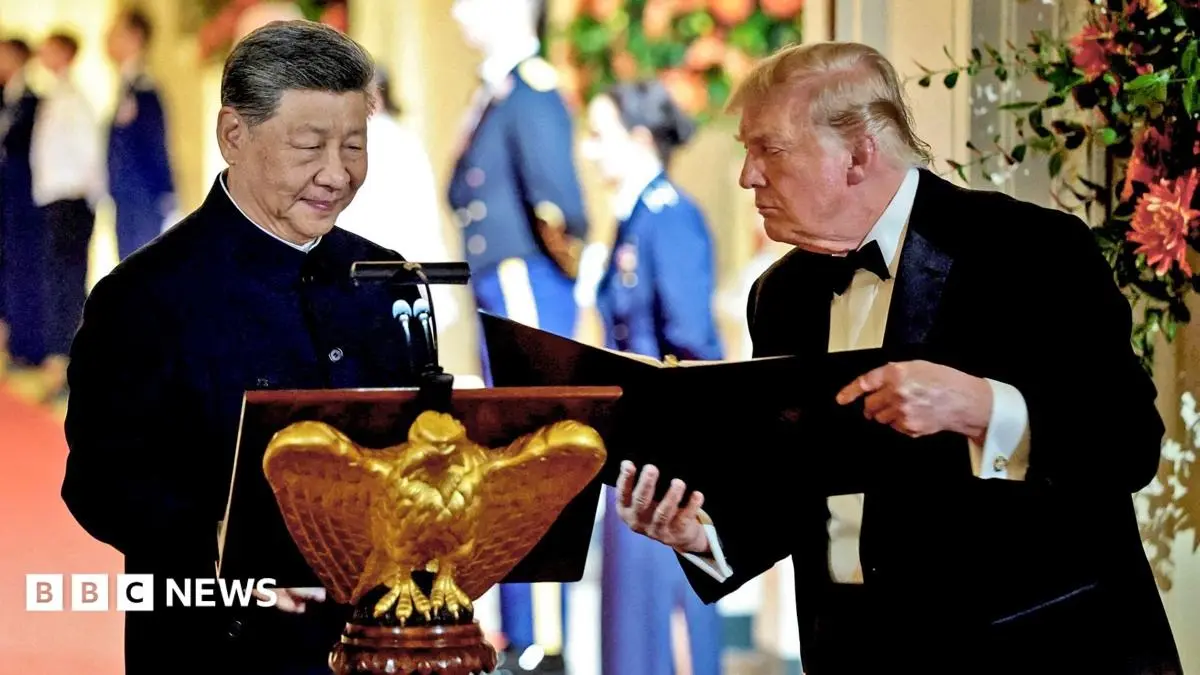
In a display of pageantry and high-stakes diplomacy, President Donald Trump hosted Chinese leader Xi Jinping for a lavish state dinner, using the occasion to emphasize what he described as an exceptionally strong personal and professional bond between the two global powers. Amidst a backdrop of high-level industry titans and political heavyweights, the two leaders sought to project an image of unity and strategic cooperation, framing the current era as a pivotal moment for the future of US-China relations.
Trump, welcoming his counterpart to the United States, wasted little time in underscoring the warmth of their current engagement. "We’ve never gotten along better," the President remarked, signaling a desire to move beyond the friction that has frequently defined the bilateral relationship in recent years. His tone throughout the evening was marked by a blend of grandiosity and personal overtures, aiming to emphasize the deep-seated history that binds the two nations together, even as he navigated the evening with his characteristic off-the-cuff style.
In one of the event’s more unconventional moments, the President took a detour from his prepared remarks to highlight a personal endeavor: his ongoing ballroom construction project. In what he termed a "special treat" for his guests, Trump extended an invitation to Xi and his wife to be the first to tour the facility, which remains roughly a year away from completion. "Anybody who wants to walk into a construction site that’s nice and clean and sparkling, it’s our honour to have you do so," Trump noted, momentarily shifting the focus from international policy to the pride he takes in his private real estate developments.
The diplomatic gestures continued as the evening progressed, with Trump presenting the Chinese leader with a sculpture of a bald eagle. The gift, which the President noted had been designed with the input of First Lady Melania, was intended to symbolize the "free and soaring spirit of America." Expressing his hope that the sculpture would find a permanent home in Beijing, Trump framed the gift as a tribute to the dignity of the Chinese leadership and the mutual respect he believes the two countries share.
For his part, President Xi expressed profound gratitude for the reception he and his wife received, describing the hospitality as marked by "meticulous care and consideration." He echoed the President’s optimistic sentiment, stating that the leaders were "making history in our bilateral engagements." Xi’s remarks were carefully calibrated to emphasize stability, focusing on the necessity of a "constructive China-US relationship of strategic stability." He characterized the discussions held throughout the day as "sincere and in-depth," suggesting that these exchanges would serve as a foundation for a more predictable and cooperative future.
Xi’s address also delved into the shared historical narrative between the two nations, aiming to ground the modern relationship in the common struggles of the past. He pointed specifically to the alliance formed during the Second World War, when the two nations stood together against Japanese aggression, and invoked the legacy of "ping pong" diplomacy during the Nixon administration as a model for how the two countries have previously overcome ideological divides. By framing the relationship as one "forged in blood and fire," Xi sought to elevate the perceived stakes of their current partnership, urging both sides to explore a "new approach for major countries to get along." His final message was one of mutual benefit, suggesting that the goals of the United States and China could be "mutually reinforcing" if managed with the right strategic framework.
The event, held in a grand dining hall, served as a powerful testament to the intersection of American political and corporate power. The guest list was a "who’s who" of the American establishment, featuring a wide array of cabinet members, conservative broadcasters, and the leaders of the nation’s most influential technology and banking firms.
As members of the press were granted entry to the dining hall, the atmosphere was a mix of serious geopolitical deliberation and elite social networking. In one corner, SpaceX CEO Elon Musk, who has recently taken on an advisory role regarding the streamlining of government operations, was seen commanding the attention of nearby guests with an animated story that left them laughing. Elsewhere, Defense Secretary Pete Hegseth appeared in a more contemplative mood, seated beside his wife and in close proximity to Jared Kushner and White House Chief of Staff Monica Crowley.
The presence of the technology sector was particularly notable, reflecting the central role that innovation and digital infrastructure now play in US-China competition and cooperation. Among the titans of industry in attendance were Apple’s Tim Cook, OpenAI’s Sam Altman, Google’s Sundar Pichai, Amazon’s Jeff Bezos, and Nvidia’s Jensen Huang. The seating arrangement itself offered a glimpse into the administration’s priorities; both Cook and Huang were seated at the same table as the two heads of state, underscoring the importance the White House places on the intersection of artificial intelligence, manufacturing, and global trade.
The influence of the tech world was further evidenced by the presence of other industry leaders, including Mark Zuckerberg and Jeff Yaas, the billionaire investor known for his significant stake in TikTok. The guest list also spanned the corporate spectrum, with executives from General Motors, Visa, Paramount Skydance, and ExxonMobil representing the traditional pillars of the American economy.
President Trump had touted the event’s reach ahead of time, clearly pleased with the turnout of the country’s elite. "Everybody wanted to be there," he remarked. "I would say you have the entire tech world, the entire banking world, and a lot more." The inclusion of his own family, including his children Ivanka, Eric, and Tiffany, added a personal layer to the event, reinforcing the President’s vision of a government that integrates his closest confidants with the nation’s most successful business leaders.
Despite the comprehensive nature of the guest list, there were gaps that caught the attention of observers. Notably absent from the proceedings was Anthropic, one of the most prominent and high-valued artificial intelligence firms currently operating. While the White House did not offer a public explanation for the company’s absence, the omission prompted questions about the criteria used to curate the guest list for such a high-profile gathering. The BBC reached out to Anthropic to determine if they had been invited or if the company had declined to attend, but the firm’s non-participation remained one of the few points of intrigue in an otherwise tightly orchestrated evening.
As the dinner drew to a close, the prevailing narrative remained one of calculated optimism. By bringing together the architects of global tech and the heads of the world’s two largest economies, the event served as both a diplomatic performance and a strategic signal to the international community. Whether the "sincere and in-depth" exchanges between Trump and Xi will result in a tangible shift in the long-term trajectory of the US-China relationship remains to be seen, but for one night in Washington, the emphasis was firmly placed on shared history, mutual interests, and the potential for a stable, if complex, future.