President Volodymyr Zelensky has issued a stern warning to the international community, declaring that Russia has significantly widened the scope of its ongoing invasion by deliberately targeting Ukraine’s digital backbone, including data centres and internet service providers. According to the Ukrainian leadership, these strikes are not merely collateral damage but a calculated effort to cause maximum disruption to the daily lives of millions of ordinary citizens, crippling their ability to communicate, study, and work as the war enters a brutal new phase.
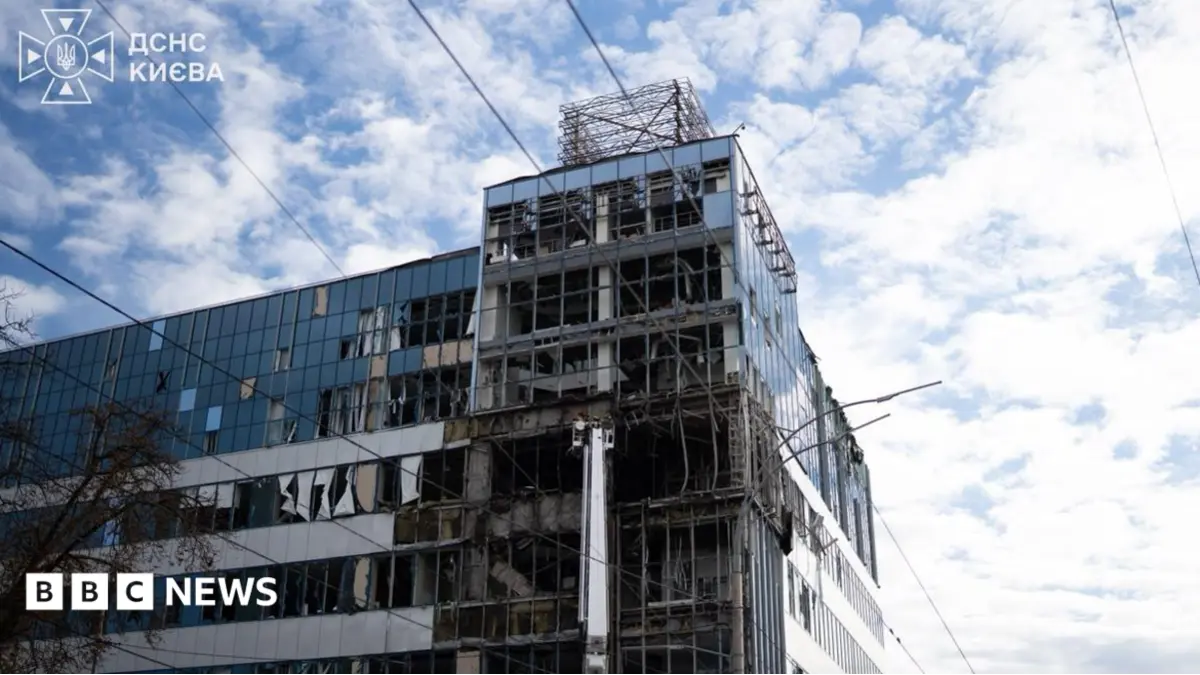
The strategic shift in Moscow’s targeting policy has manifested in a series of precision strikes against facilities that maintain the nation’s connectivity. On Friday, a Russian drone strike decimated a business centre in the heart of Kyiv, resulting in the tragic deaths of four people and causing extensive damage to a data centre housed within the building. In a separate, harrowing incident, a 14-year-old boy was killed during the same wave of attacks. Israel’s foreign ministry has since confirmed that the teenager was an Israeli citizen, adding a somber international dimension to the escalating violence.
The Russian Ministry of Defence has openly acknowledged targeting the data centre, justifying the strike by claiming the site was being utilized by Ukrainian military intelligence. However, Ukrainian officials vehemently reject this narrative, arguing that the strikes are part of a wider "hybrid war" aimed at breaking the morale of the civilian population.
The physical impact of these attacks on the civilian infrastructure has been immediate. On Wednesday, approximately 100,000 households in Kyiv and the surrounding region were plunged into darkness regarding their internet access due to Russian strikes. The ripple effects have been felt as far away as the north-western city of Lutsk, where officials reported that electronic information boards at public transport hubs ceased functioning on Friday. The Lutsk city council explicitly attributed these failures to the damage inflicted upon data centres in the capital.
A Campaign Against ‘Life-Saving Information’
In a social media address, President Zelensky characterized the strikes as an attempt to erase "ordinary life" from the map. "The Russians are constantly expanding their escalation operation: American and other businesses, data centres, internet providers—for Russia, all ordinary life is simply a target," Zelensky wrote. He urged the global community to recognize the gravity of these attacks, insisting that Russia must be made to feel the consequences of what he termed a campaign of "terror."
Foreign Minister Andrii Sybiha underscored the severity of the situation, noting that by targeting digital infrastructure, Moscow is attempting to disrupt the flow of "life-saving information." He pointed out that, in a country under constant threat of bombardment, digital networks are the conduits for critical air-raid alerts. "Rapid alerts about missile and drone threats are essential—they save lives. This is critical civilian infrastructure… It is not a military target. It is essential to keeping everyday life functioning," Sybiha stated.
In response to the mounting threat, President Zelensky convened a meeting with his top defence and security officials late on Friday. He announced that "additional decisions" had been reached to fortify the country’s data centres and critical communication facilities, aiming to ensure their resilience and continuous operation against future sabotage or kinetic strikes.
Serhii Beskrestnov, a top adviser on defence technologies to the Ukrainian president, acknowledged on Thursday that the nation might face localized disruptions as the conflict intensifies. He also warned that consumers could see an increase in the cost of internet services as providers scramble to cover the massive financial burden of repairing damaged equipment and rerouting traffic. Despite these challenges, Beskrestnov sought to reassure the public, emphasizing that Ukraine’s internet network is highly decentralized by design. Because of this structure, he stated firmly, the country "will not be left without internet access."
Commercial and Strategic Fallout
The specific facility hit in Friday’s Kyiv attack was operated by Datagroup. The firm reported that while its specialists were working to assess the full extent of the damage, they had successfully mitigated the outage by rerouting all services to backup sites. The persistence of these private enterprises highlights a broader trend: as the strikes intensify, many firms have begun the painstaking process of migrating their data from vulnerable, damaged servers to more secure facilities located abroad, effectively creating a digital "government-in-exile" to safeguard the nation’s archives and operational data.
Kyiv Mayor Vitaliy Klitschko provided a grim update on the human toll of the recent aggression, confirming that the overnight attacks on Friday left seven people dead and 59 injured. The Russian Ministry of Defence has maintained a defiant posture, confirming that it has systematically targeted a series of data processing and telecommunications hubs over the past few days, specifically naming New-Telco, United DC, Kyivstar, and Parkovyi. BBC verification teams have since confirmed the destruction of the Inkom business centre, which housed the Datagroup facility.
This digital offensive coincides with a wider intensification of Russian military strategy. In recent weeks, Moscow has stepped up its campaign against Ukraine’s energy and railway grids, clearly intending to inflict maximum hardship as the winter season approaches. Conversely, the Ukrainian military has intensified its own operations, striking Russian oil refineries and logistical nodes, which Kyiv maintains are vital for funding and sustaining the Russian war effort. Since President Vladimir Putin launched his full-scale invasion in 2022, Moscow has seized approximately 20% of Ukrainian territory, creating a static yet violent frontline that remains the focal point of European security.
Diplomacy and International Tensions
Despite the rhetoric of total war, President Putin hinted at a potential shift in stance during remarks on Friday. He told reporters that Moscow would "give careful thought" to the prospect of resuming direct peace negotiations with Kyiv, though he couched the possibility in conditional terms. Putin cited recent "massive" Ukrainian attacks on the capital, Moscow, and other regions as a factor in his calculations. "It’s all possible," Putin said, while maintaining that Ukraine "must feel our retaliatory strikes" and that any future decisions would be predicated on "the Russian Federation’s interests."
This follows President Zelensky’s previous indication that he would be open to trilateral talks involving the United States. However, Kyiv and its Western allies remain deeply skeptical of Moscow’s intentions, frequently accusing Putin of using the guise of diplomacy to buy time while attempting to annex more Ukrainian land. Furthermore, Putin reiterated his long-standing claim that Moscow has "no plans" and "no reason" to expand the conflict into Europe—a statement that echoes his assurances prior to the 2022 invasion of Ukraine.
While the kinetic conflict continues, the European Union has moved to strengthen Ukraine’s hand. Top diplomat Kaja Kallas announced the release of €6.6 billion in funding for Ukraine, describing the injection of capital as "good news for Ukraine and bad news for Russia." The package includes €900 million for the EU’s Military Assistance Mission and a €1 billion fund dedicated to the joint procurement of military equipment. "Moscow’s hybrid attacks try to intimidate Europe into scaling back its support for Ukraine," Kallas noted in a post on X. "Europe is doing the opposite."
The fear of Russian sabotage is not limited to Ukrainian borders. On Wednesday, Polish prosecutors launched an investigation into a suspected arson attack on a Starlink satellite station in Wola Krobowska. The National Prosecutor’s Office stated that there is a "reasonable suspicion" that the perpetrators were acting on the orders of Russian special services. The facility is a crucial node, transmitting internet traffic through Poland to various regions, including Ukraine, via SpaceX’s satellite constellation.
As European NATO members face an increasing frequency of "hybrid" incidents—ranging from the attempted drone attack on Germany’s Leipzig/Halle Airport to France’s emergency efforts to protect its own critical infrastructure—the incident in Poland serves as a stark reminder that the digital and physical war against Ukraine is increasingly becoming a continental challenge. For now, Ukraine remains in a race against time, attempting to harden its digital infrastructure against a foe that has made the disruption of modern life a central tenet of its military strategy.