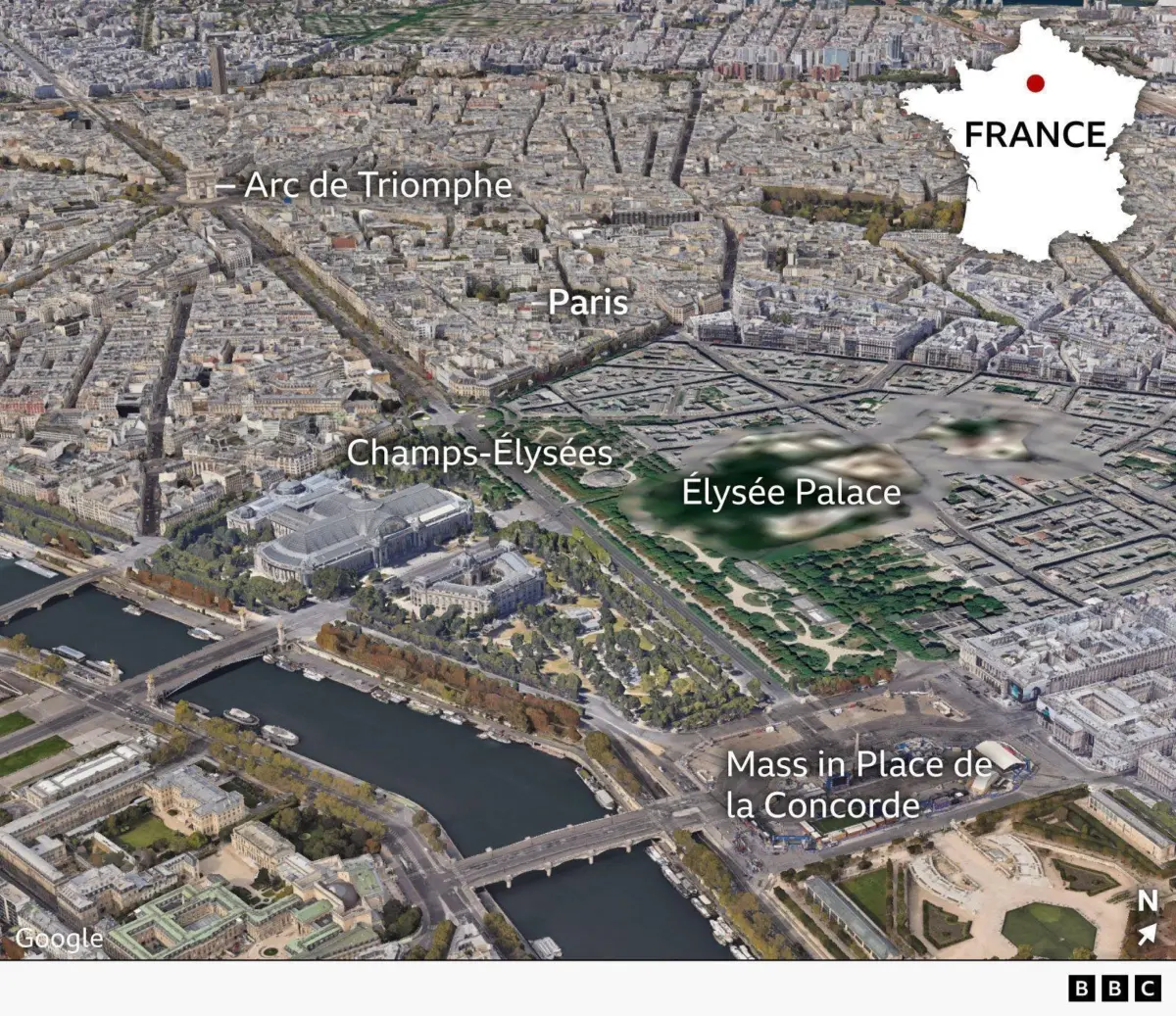
Hundreds of thousands of faithful and curious onlookers flooded the center of Paris on Saturday, transforming the iconic Champs-Élysées into a site of profound religious fervor as Pope Leo XIV arrived for a massive open-air Mass. The atmosphere in the French capital was electric, with the pontiff greeted by rhythmic chants of "Leo, Leo" as he made his way toward the Place de la Concorde.
Traveling in the traditional popemobile, the head of the Catholic Church moved slowly down the historic avenue, passing beneath the shadow of the Arc de Triomphe. The scene was one of immense logistical and spiritual scale, with security forces managing crowds that stretched as far as the eye could see. At various intervals along the route, the Pope paused his procession to greet the throngs of people lining the streets, offering blessings to infants held aloft by their parents and acknowledging the thousands of well-wishers who had gathered since the early hours of the morning.
The centerpiece of the visit, the open-air Mass, was held at a specially constructed altar in the Place de la Concorde. Organizers had anticipated an attendance of more than half a million people, a figure that appeared to be matched by the sheer density of the crowds surrounding the historic square. The event serves as the cornerstone of the Pope’s four-day apostolic journey to France, a visit that the Church views as a significant moment in the spiritual life of the nation and the broader European continent.

A Delicate Balance of State and Faith
The visit has drawn significant attention not only for its religious significance but also for its intersection with the complexities of French politics. France, which maintains a constitutionally mandated, strict separation of church and state, has seen a careful choreography regarding the Pope’s reception.
French President Emmanuel Macron, who hosted the pontiff for an hour of formal discussions at the Élysée Palace on Friday, has opted not to attend any of the scheduled Masses during the trip. This decision is widely viewed as a deliberate attempt to honor the secular principles of the French Republic. While the President remains absent from the liturgical events, the state is nonetheless represented. The President’s wife, Brigitte Macron, and Prime Minister Sébastien Lecornu were both in attendance at the Place de la Concorde, signaling a gesture of official recognition of the Pope’s status as both a religious leader and a head of state.
The significance of the event was further underscored by the presence of several prominent figures from the French political landscape. With the next presidential election cycle looming on the horizon, the Mass served as a gathering point for a cross-section of the nation’s political elite. Observers noted the attendance of Marine Le Pen, leader of the hard-right National Rally, as well as conservative figure Bruno Retailleau. Centrist politicians, including former Prime Minister Edouard Philippe and Gabriel Attal, were also observed in the crowd, reflecting the breadth of the event’s appeal across the political spectrum. The presence of such diverse political actors underscores the enduring influence of the Catholic Church in the public and cultural discourse of France.

Addressing the Invisible and the Future
Before the grandeur of the afternoon Mass, the Pope spent his morning focusing on the more vulnerable segments of society. He paid a visit to the Maison Bakhita center, an organization dedicated to supporting refugees and migrants. The visit was characterized by a message of inclusivity and compassion, with the pontiff praising the staff and volunteers for their dedication.
"You invite us to see those who are invisible," the Pope remarked during his visit to the center. He emphasized that, in a world often fractured by division, it remains entirely possible for individuals from vastly different backgrounds to "encounter one another and to live together in dignity and peace." His words were met with gratitude by those present at the center, highlighting the Church’s ongoing commitment to humanitarian aid and social integration.
In addition to his focus on the marginalized, the Pope took the opportunity to reiterate his vision for the role of women in modern society. He characterized them as playing a "fundamental role in building a civilization of love," a sentiment that resonated with the themes of his wider visit.

These humanitarian efforts follow his more sobering remarks made on Friday, when the Pope addressed Church and state officials at the Élysée Palace. During that appearance, he issued a stark warning regarding the rapid advancement of artificial intelligence. Drawing on his concerns about the dehumanizing potential of technology, he cautioned against the risk of "losing our humanity amid a paradise of machines." The warning has sparked a wider conversation about the ethics of technological progress and the responsibility of institutions to ensure that human dignity remains at the center of innovation.
A Journey Through French History and Spirituality
The scale of the crowds seen in Paris is, according to Church officials, reflective of a broader, latent spirituality currently being felt across France and Europe. The momentum of the visit is expected to continue through the weekend and into early next week. On Sunday, the pontiff is scheduled to travel to the Pyrenean sanctuary of Lourdes, where roughly 150,000 pilgrims have already registered to participate in the Mass.
The final leg of his journey will take him to Metz in northeastern France on Monday. There, he will pay homage to Robert Schuman, a pivotal figure in the post-war reconstruction of Europe and one of the founding fathers of the European Union. Schuman, a deeply religious man, is currently a candidate for beatification, and the Pope’s tribute is expected to highlight the importance of faith in the creation of a peaceful and unified Europe.

For many, the visit holds a particularly personal resonance due to the Pope’s own family history. Born in Chicago in 1955, the pontiff was originally named Robert Prevost. His connection to France is rooted in his ancestry; his paternal grandmother was born in the port city of Le Havre in Normandy in 1894. After moving to the United States and marrying, she and her Italian husband adopted the name Prevost, which had been her mother’s maiden name. This connection to the region has added a layer of poignancy to his visit, bridging the gap between his American upbringing and his deep, ancestral ties to the French soil.
As the sun sets over the Place de la Concorde, the sheer number of attendees and the enthusiasm of the crowds suggest that, despite the secular nature of the modern French state, the influence of the Catholic Church and the figure of the Pope remain profound. The coming days of the visit will likely continue to be defined by this intersection of traditional faith, modern political reality, and the personal history of a man who now stands as one of the most prominent global voices in the contemporary era.