In the pulsing heart of Harajuku, inside the legendary teeny-bopper mall La Foret, designer Mikio Sakabe staged a runway presentation that captured the delicate and complex intersection of contemporary Japanese youth culture, commercial melancholy, and the human yearning for escapism. Known for his ability to translate subterranean cultural currents into highly coveted, commercially viable fashion, Sakabe chose the iconic Tokyo shopping hub to debut a collection rooted in a surprisingly unconventional starting point: Japan’s gravure magazines.
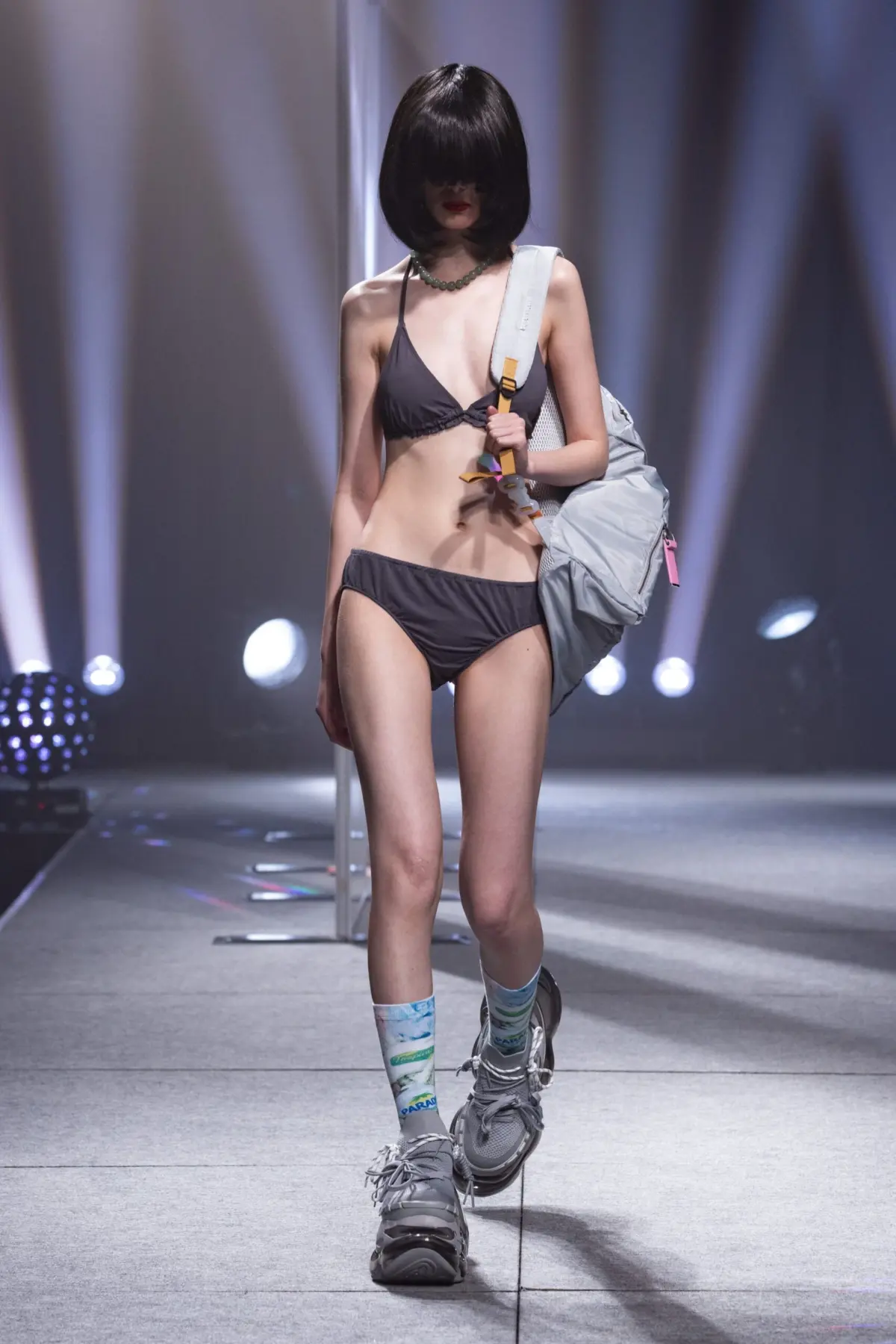
For decades, these male-marketed, vaguely erotic publications have occupied a distinct space in Japanese visual culture. Featuring wide-eyed, innocent-looking models posing in a mix of lingerie, swimwear, and elaborate cosplay, gravure magazines provided Sakabe with the raw visual vocabulary for a collection he conceptually envisioned as a "swimsuit show held in a shopping mall."
The designer noted the unique emotional atmosphere of the venue, which served as much more than just a backdrop. "There’s something interesting about the concept of a fashion show in a Japanese fashion mall. It feels bright and showy, but it’s also a little sad," Sakabe explained, reflecting on the transient, hyper-commercialized nature of the environment. To amplify this sense of urban alienation and fleeting consumerism, the runway was intentionally left littered with discarded coffee cups and drink cans, grounding the high-fashion spectacle in the mundane reality of a busy afternoon at the mall.
As the presentation unfolded, the garments themselves told a story of juxtaposition and contradiction. Alternating with straightforward, unadorned bikinis that directly nodded to the gravure magazine inspiration, models emerged in Sakabe’s trademark deconstructed, oversized tailoring. Shirty silhouettes were aggressively slashed and layered into chaotic, asymmetric shapes, some festooned with delicate frills while others featured floppy, whimsical appendages that eerily resembled oversized bunny ears. This tension between structured tailoring and chaotic, surreal detailing is a hallmark of Sakabe’s design ethos, a philosophy that has earned him a devoted and massive following across Asia.
The styling of the models further unified the disparate elements of the collection while reinforcing its surrealist tone. Every model wore the signature eye-obscuring, helmet-like wigs that have become a defining element of Sakabe’s aesthetic over the past few seasons. When asked about these heavy, anonymous headpieces, the designer remarked with characteristic nonchalance, "somehow I really like them." Obscuring the models’ faces served to depersonalize them, transforming the runway into an army of wandering avatars navigating a consumerist labyrinth.
Grounding the avant-garde silhouettes was a footwear choice that has become a phenomenon in its own right: the bubble-soled sneakers from Grounds, Sakabe’s smash-hit footwear project. Founded in 2019, the footwear label has grown exponentially over the years and now employs around 100 people globally, cementing Sakabe’s influence not just as a conceptual womenswear designer, but as a commercial tastemaker capable of creating cultural footwear moments.
Sakabe, who famously shares an educational background as a classmate of Demna during their formative years in Antwerp, has long been recognized as an expert at mining the depths of underground culture. He possesses a rare talent for twisting obscure or counter-cultural references into ironic fashion statements that nonetheless maintain an undeniable commercial allure.
Like much of the designer’s past work, this collection was fundamentally concerned with the human desire to escape from reality—and the inherent futility of trying to do so. The presentation played heavily on the contrast between the hyperreal, heavily edited superficiality of gravure culture and the banal, everyday context of a shopping mall. It was a meditation on modern escapism, where individuals seek refuge in fantasies, only to find themselves hemmed in by physical and commercial realities.
The narrative arc of the collection culminated in a striking final look. A half-worn shirtdress brought the overarching conceptual framework into sharp focus. Decorated with meticulous slits of silver that caught the mall’s fluorescent lighting, the garment’s openings appeared almost like portals to another universe—a visual metaphor for the desire to break free from the constraints of the material world. As the presentation concluded in the historic halls of La Foret, Mikio Sakabe once again proved his unique capacity to merge high-concept sociological commentary with wearable, highly sought-after contemporary fashion.