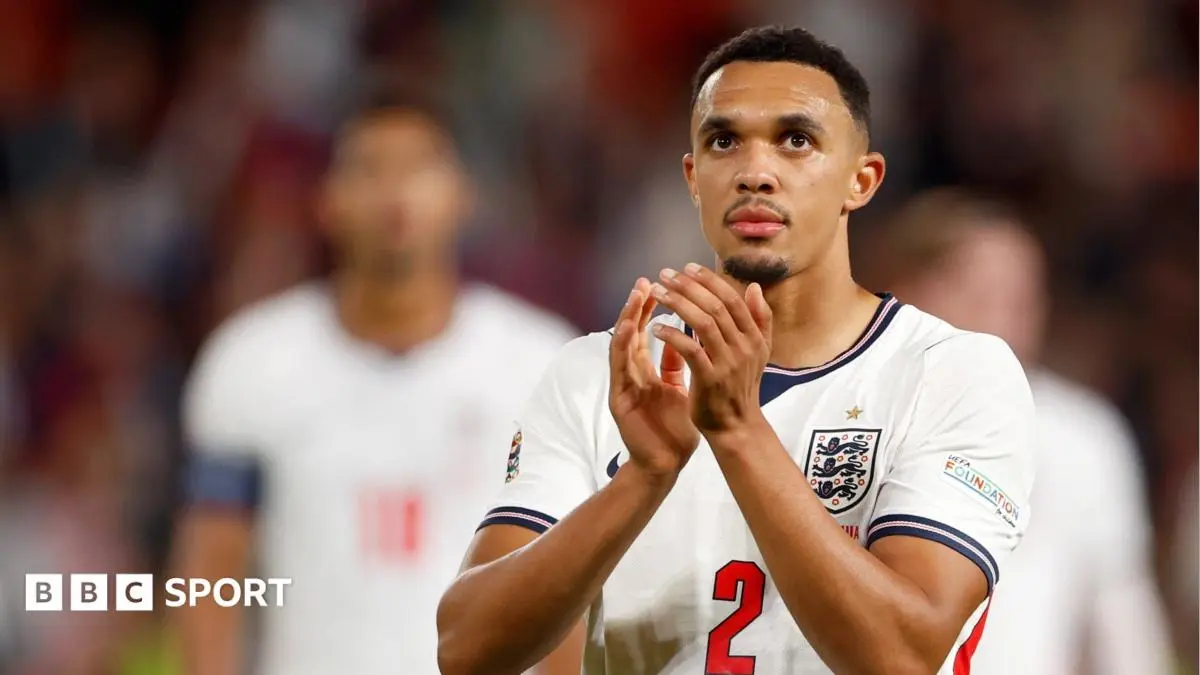
For the duration of Thomas Tuchel’s tenure as England head coach, the status of Trent Alexander-Arnold has been a subject of relentless debate, serving as one of the most enduring and complex narratives surrounding the national team. The 27-year-old, who has evolved from a Premier League champion at Liverpool to a marquee signing for Real Madrid, has often found himself on the periphery of the England setup, viewed by his manager as a player whose defensive vulnerabilities potentially outweigh his creative output.
This marginalization was starkly illustrated by his omission from last summer’s World Cup squad—a decision that raised eyebrows given England’s ongoing struggles to find a settled and reliable presence at right-back. For many observers, it appeared that the specific profile Tuchel demanded for the position was one that Alexander-Arnold simply did not fit, rendering his international prospects dim. Yet, in a surprising turn of events, Tuchel recalled the defender for the current four-game Nations League camp, ending a period of exile that had seen the player increasingly isolated from the manager’s long-term tactical vision.
Against this backdrop of skepticism, Alexander-Arnold was handed a starting berth in Prague against the Czech Republic. It was a high-stakes encounter for England, who were looking to recalibrate following a demoralizing 3-2 defeat to World Cup holders Spain at Wembley. As he stepped onto the pitch, the Real Madrid star became the ninth right-back to be utilized by Tuchel across 24 matches—a statistic that underscores the instability of the position under the current regime. However, with something to prove and the eyes of his critics firmly fixed upon him, Alexander-Arnold produced a world-class display that may finally compel his coach to focus on his transformative attacking capabilities rather than his perceived defensive shortcomings.
The match itself presented a unique challenge. England, while largely in control, found themselves struggling to break down a resilient 10-man Czech side. The visitors had been handed an early advantage when Pavel Sulc was dismissed in the 25th minute following a reckless challenge on Elliot Anderson, but England failed to capitalize on the numerical superiority during the remainder of the first half. The breakthrough finally arrived two minutes after the interval, courtesy of a piece of individual brilliance from the man who now simply goes by the name "Trent" on the back of his shirt.
In the moments leading up to the goal, Alexander-Arnold had showcased his trademark intensity, embarking on a lung-busting 70-yard run to provide an additional outlet in the final third. When that specific attacking sequence broke down, he did not retreat; instead, he regained possession with composure before whipping a magnificent, teasing delivery across the box. The cross floated in a perfect arc, bypassing three Czech defenders to find Anthony Gordon, who executed a stooping header with clinical precision. It was a goal born of elite vision and technical execution, proving that while Tuchel may harbor reservations about Alexander-Arnold’s defensive positioning, the player offers a unique selling point that few others in world football can replicate.
Following the match, Tuchel acknowledged the quality of the contribution, though he remained characteristically measured in his praise. Speaking to BBC Radio 5 Live, the head coach noted, "He did very well. He had an excellent assist. Overall, like everyone, he was professional, top attitude and one decisive action." Tuchel went on to clarify that the team’s tactical adjustments played a role in the performance, adding, "We never doubted that he can produce these kinds of assists. The deeper position in the second half suited him more than the higher position in the first half. Overall, I think we had a good and professional performance. Of course, the red card, especially an early red card, is such a heavy influence in the game. It makes the task sometimes a little bit more complicated psychologically."
For Anthony Gordon, the goal was the culmination of a long-standing desire to play alongside a passer of Alexander-Arnold’s caliber. "I make that run time and time again and only a certain number of players have that ability, technique and bravery to be willing to make the mistake trying that pass," Gordon explained. "That’s why he’s so good and I’ve been dying to play with him for that reason. He’s had his own journey with England. He would’ve liked to have played more than he has but he’s been a great character during this camp. I’ve really enjoyed being around him."
The statistics from the evening support the narrative that Alexander-Arnold remains a vital creative engine. Despite the inherent risks associated with his high-pressing, forward-thinking style, he was highly involved in the play. Only Elliot Anderson recorded more passes in the final third (41 to Alexander-Arnold’s 32), and only Gordon created more chances than the right-back’s three. These figures highlight a player who, when given the license to roam and influence the game, remains one of the most productive assets in the England squad.
However, the shadow of past tactical experiments continues to loom over his international career. Football fans remain haunted by Sir Gareth Southgate’s ill-fated decision to trial Alexander-Arnold in a midfield role during Euro 2024—an experiment that was abandoned after just 54 minutes against Denmark and never revisited. This history of misuse has left many to wonder if Alexander-Arnold has ever truly been given a fair, settled environment in which to thrive.
As England prepares for their upcoming fixture against Croatia in Rijeka—a match to be played behind closed doors—the pressure remains high. For Alexander-Arnold, who turns 28 in October, this current camp feels like a critical juncture. If he cannot solidify his standing with Tuchel now, after demonstrating such a clear game-changing ability, it raises the question of whether he ever will.
Reflecting on his return to the international fold, Alexander-Arnold remained diplomatic and hopeful. "It was amazing. It’s always an honour to represent my country," he said. "It’s been a long time, but I’ve always believed I can play for England. That belief has always been there and it was about proving it at club level. The manager gave me a chance, now hopefully he is happy with how I played."
Whether that performance is enough to shift the long-term thinking of his head coach remains to be seen. What is certain is that in Prague, Alexander-Arnold did everything within his power to change the conversation. As England eventually sealed the victory with a late goal from captain Harry Kane—his 87th in 123 international appearances—the focus shifted toward the future of the Nations League campaign. For now, the defensive questions have been sidelined, at least temporarily, in favor of the undeniable offensive talent that Alexander-Arnold brings to the pitch. The ball, quite literally, is back in Tuchel’s court.