When football fans consider teams that have conquered the new Wembley, the conversation inevitably drifts toward the tactical dominance of Pep Guardiola’s Manchester City. It is well-documented that City secured three consecutive League Cup titles between 2018 and 2020, eventually adding a fourth in 2021. However, long before the sky blues established their domestic stranglehold, a club from the ninth tier of English football achieved a feat that remains unparalleled in the modern era of the non-league game.
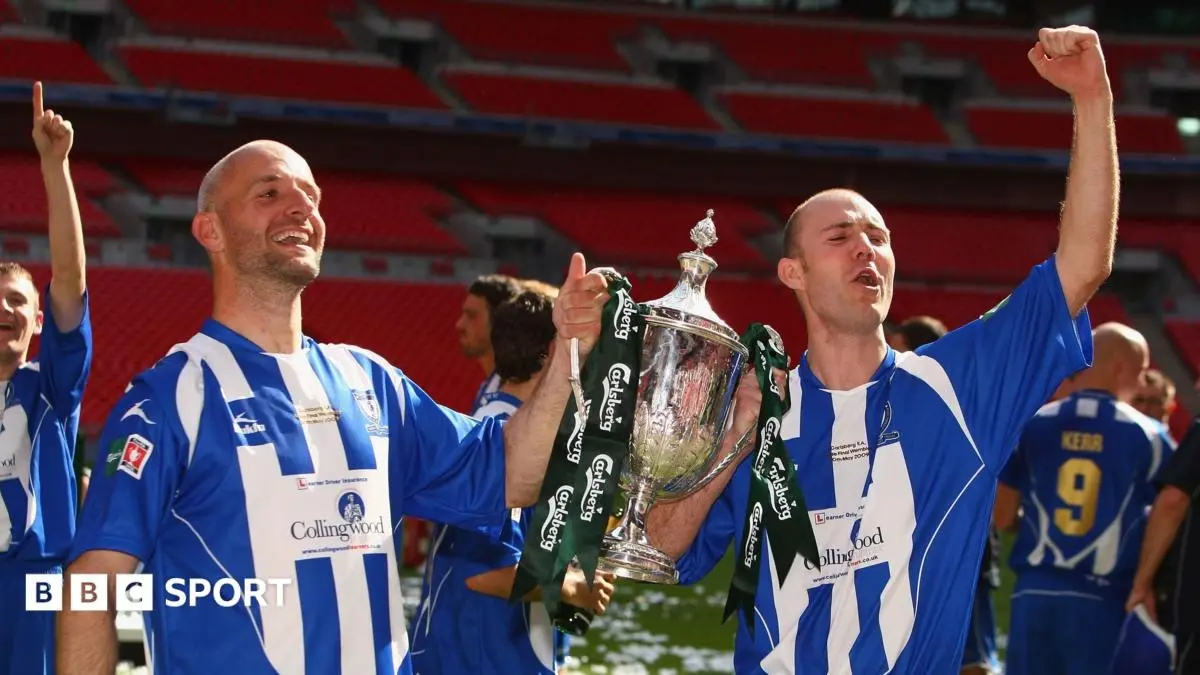
Whitley Bay, the proud Northern Football League side known as "The Seahorses," wrote their names into folklore by winning three successive FA Vase finals between 2009 and 2011. Since the inception of the FA Vase in 1974—a competition designed specifically for amateur clubs—Whitley Bay stands alone as the only team to have lifted the trophy four times, with that historic hat-trick serving as the centerpiece of their golden era.
The architect of this remarkable run was an unassuming IT manager from Sunderland, Ian Chandler. Having enjoyed three separate playing spells at the club, Chandler took the managerial reins in 2004. Over the course of his ten-year tenure, he successfully balanced the high-pressure demands of a professional software career at Sage with the delicate, time-consuming art of semi-professional football management. For Chandler, the job was never just about 90 minutes on a Saturday; it was about utilizing the quiet moments of his workday to obsess over scouting reports, logistics, and hotel bookings.
The seeds of this historic run were sown in the disappointment of the 2007-08 season. Whitley Bay had reached the semi-finals of the FA Vase, only to be dismantled 4-0 by Lowestoft Town in the first leg. Despite a spirited second leg at Hillheads Park that saw the team storm to a 3-0 lead within twenty minutes, they ultimately fell short of the final. The heartbreak of that near-miss became a catalyst for change. Chandler, a man who would later become synonymous with Wembley success, developed a rigid superstition following that defeat: he would never again grant a pre-match interview. The last time he had spoken to the press, the result had been a disaster, and he refused to tempt fate again.
Whether through that renewed, singular focus or a collective burning desire among the players to rectify their previous failure, the group steeled themselves for a historic pursuit. "It’s the hardest thing to keep a team together—as soon as players get noticed, they get picked up at a higher level," Chandler recalls. "But after we got to the Vase semis, players wanted to stay and prove what they could do. Then the lads wanted to do it again. And again."
Despite his deep-rooted allegiance to Sunderland, Chandler modeled his tactical philosophy on the high-octane, front-foot football of Kevin Keegan’s mid-90s Newcastle United. Entertainment, in the eyes of the Whitley Bay manager, was an objective equal to winning. The team often played with reckless abandon, frequently deploying three—and on one memorable occasion, two—defenders to chase down results. "The Premier League can be so boring; fans want to be entertained, that’s what we promised," he explains.
Chandler’s appointment by chairman Paul McIlduff in 2004 had been a gamble on a man with no prior managerial experience. Yet, the chairman knew he had secured a club icon—the very man who had scored the winning goal in the 2002 FA Vase final at Villa Park. After a period of transition, Chandler molded a side that became the envy of the non-league pyramid.
"We played good football. We had pace on the wing, fantastic midfielders, and strikers who were deadly," says McIlduff, who has served as chairman since 2001. "When we brought them in, it was about fitting the psychology of the dressing room. No one thought they were better than anyone else; they played for each other."
Central to this spirit was Paul Robinson, affectionately dubbed the "Whitley Bay Maradona." A product of the Newcastle United academy, Robinson spent his career navigating the competitive landscape of North East non-league football. His dual role working for Chandler at the Sage software company meant that the boundary between professional and footballing life was non-existent. "He was my manager at work and football, I was sick of him," Robinson jokes, though he admits the proximity was a benefit when it came to securing time off for crucial cup ties.
The pressure of the workplace was often relieved by daydreams of Wembley glory. "Zoning out happened regularly, picturing scoring and winning, what the opposition would be like—hoping they were rubbish so we could have an easy stroll," Robinson admits. His contribution on the pitch was monumental, perhaps never more so than in the 2010 semi-final second leg against Barwell. With the tie hanging in the balance, Robinson’s last-minute diving header in torrential rain secured a 6-5 aggregate victory, triggering a euphoric pitch invasion at Hillheads Park.
For the players, these rounds felt like the "big time." Home crowds of up to 3,000 fans created an atmosphere that mirrored the historic FA Cup runs of the 1990s. The team became so adept at managing the psychological weight of big games that they began to psych out their opponents before a ball was even kicked. Robinson recalls a quarter-final against Biggleswade in 2009 where the opposition arrived in suits and ties, treating the fixture as a day out. Whitley Bay, sensing an opportunity to dismantle their confidence, promptly won 5-2. By the end of their reign, the reputation of The Seahorses preceded them; teams were often beaten before they stepped off the coach.
The success of the team became a source of immense pride for the working-class town of Whitley Bay. Volunteers were the lifeblood of the operation, working tirelessly to galvanize the local community. Jenn Robinson, the wife of late board member Mike Robinson, remembers the frenzy of the lead-up to the finals. The town was awash in blue and white, with local businesses decorating their windows and a makeshift ticket office operating out of a van parked outside Woolworths.
"Everyone wanted to come and watch, we got so many local sponsors," Jenn recalls. "I still do buffets and things for players and long-standing fans. We have a game tonight, and I’m making the sandwiches now."
The logistical challenges were immense. For the first final, the club chartered a train that successfully navigated the route to Wembley. By the second year, the organization faltered, and the train terminated at Kings Cross, forcing fans and players to scramble for taxis to the stadium. Yet, despite these hiccups, the club’s presence at the national stadium became a recurring event. For some, the experience was surreal; Jenn Robinson remembers being ushered into the royal box, only to be told by a security official that she was sitting in the seat reserved for Prince William.
The journey itself evolved over the three years. Chandler’s son, Benjamin, served as the team mascot for all three finals, a permanent fixture in the dressing room. Chandler notes that while the first final was defined by nerves and a scrape of the team bus against a stadium wall, the subsequent trips were marked by a more composed determination to complete the hat-trick.
On the pitch, the results were definitive. In 2009, they defeated Glossop North End 2-0 before 12,200 spectators. The following year, they routed Wroxham 6-1, with Paul Chow scoring after just 21 seconds—a record for the fastest goal in a Wembley final that stood for 13 years until Ilkay Gundogan’s strike in the 2023 FA Cup final. The trilogy was completed in 2011 with a hard-fought 3-2 victory over Coalville Town, secured by an 86th-minute winner from Chow.
The celebrations that followed were equally memorable. While the first victory felt like a quiet, stunned realization, the subsequent years saw the team bond over extended stays. In 2010, the squad spent five nights in Marbella, a trip the players cite as one of the best experiences of their lives. The 2010 trophy lift was particularly poignant, as the team celebrated with former teammate Mark Taylor, who had been diagnosed with motor neurone disease shortly after playing in the 2009 final.
The aftermath of their dominance brought the players and management into a strange, brief orbit with the sporting elite. Chandler found himself at Manchester awards ceremonies rubbing shoulders with Sir Alex Ferguson and Sven-Göran Eriksson, while his players returned to their day jobs to the bemusement of colleagues.
The golden era eventually drew to a close with Chandler’s departure in 2014. Since their 2011 success, the club has not secured another major honor and currently remains in the ninth tier of the football pyramid. However, the legacy of that team persists in the North East. Even years later, Chandler finds himself approached in local pubs by strangers who remember the magic of the Whitley Bay era. It was a time when a group of part-time players, led by an IT manager, proved that with enough belief, the dream of Wembley could become a reality—not just once, but three times over.