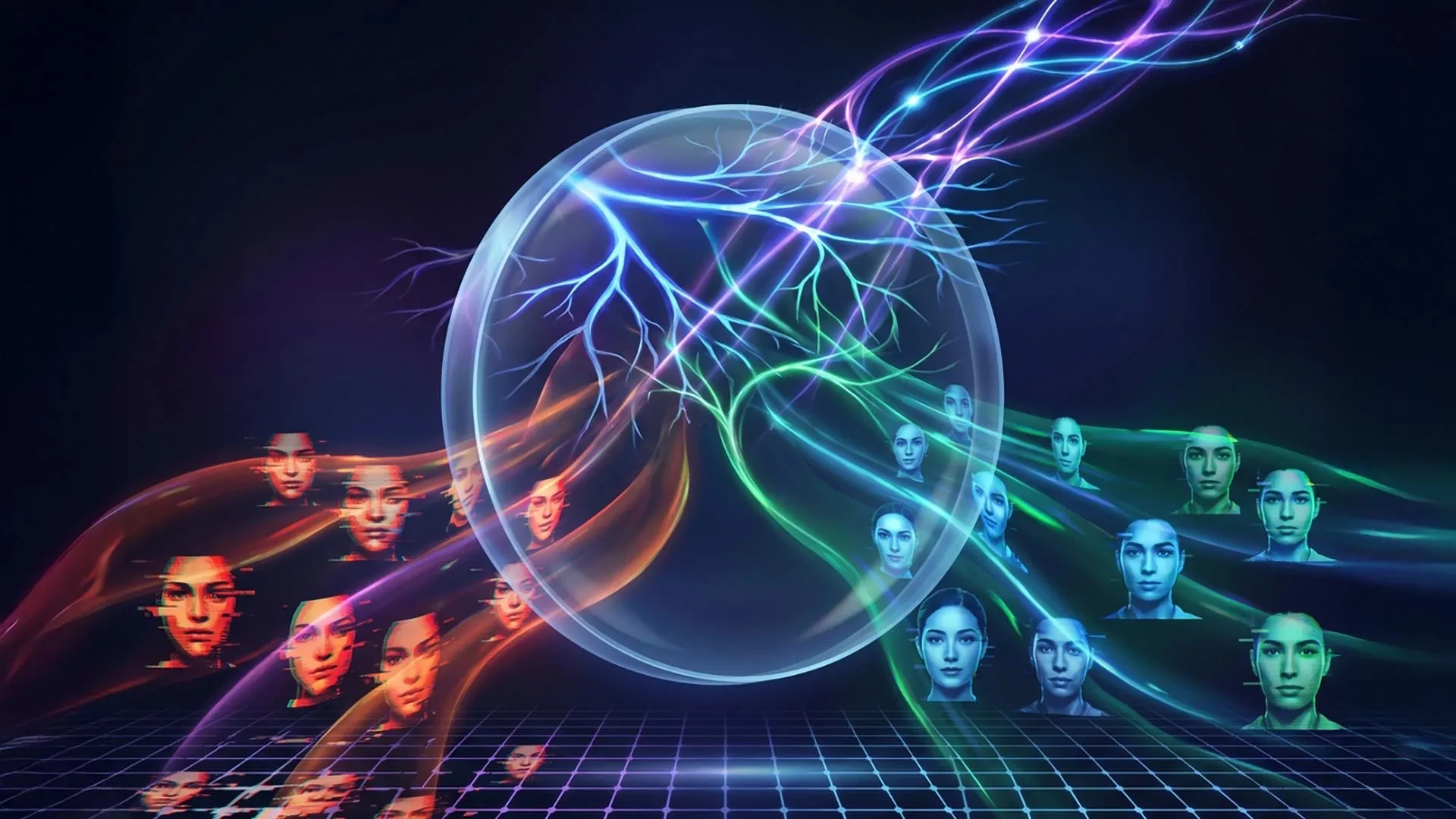
In an era where generative artificial intelligence is evolving at a breakneck pace, the integrity of digital media has become a primary security concern. As synthetic videos—or "deepfakes"—grow increasingly indistinguishable from reality, the race to develop robust, scalable detection systems has intensified. Now, a team of researchers at the University of California, Los Angeles (UCLA) has unveiled a breakthrough: a new optical-neural processor that leverages the physical properties of light to identify deepfake content with unprecedented speed and accuracy.
The innovation, detailed in the study "Scalable, Energy-Efficient Optical-Neural Architecture for Multiplexed Deepfake Video Detection" published in the journal eLight, represents a departure from traditional digital detection methods. While conventional systems typically process video files sequentially using power-hungry digital hardware, the UCLA technology utilizes light to analyze 15 or more video streams simultaneously. This high-throughput approach is designed to serve as a formidable, attack-resilient first line of defense against the tidal wave of manipulated content flooding the internet.
The Growing Challenge of Deepfake Detection
The urgency for such a technology is driven by the rapid democratization of high-quality generative AI. As models become more sophisticated, the artifacts that once betrayed a video as fake—glitches in facial movement, unnatural lighting, or inconsistencies in skin texture—are becoming harder to spot. Traditional deepfake detectors are struggling to keep up, not just in terms of accuracy, but in terms of sheer operational capacity.
Most existing detection architectures rely on massive amounts of digital computation. A single deepfake analysis can require hundreds of billions of floating-point operations. When platforms are tasked with screening millions of hours of video content, the cumulative energy consumption and processing time required to perform these checks become prohibitive. Furthermore, digital systems are inherently vulnerable to adversarial attacks. Malicious actors have learned to introduce subtle, imperceptible perturbations into fake videos specifically designed to confuse neural networks, effectively "blinding" them to the manipulation.
To address these systemic hurdles, a team led by Professor Aydogan Ozcan developed a hybrid digital-optical system that offloads the most intensive parts of the detection process from silicon chips to the physical realm of light propagation.
A Hybrid Architecture for Parallel Processing
The core mechanism of the UCLA processor is an ingenious marriage of digital preprocessing and passive optical decoding. The process begins with a lightweight digital encoder, which extracts essential information from each video—capturing critical spatial, spectral, and temporal features. Once this compact representation is obtained, the information is transformed into a specific phase pattern. This pattern is then displayed on a programmable spatial light modulator, effectively encoding the video’s "identity" into a wavefront of light.
As this optical wavefront propagates through a free-space-based, passive optical decoder, the actual work of classification takes place. Unlike a digital neural network that requires electricity to flip billions of transistors to reach a conclusion, this system uses the physical diffraction of light to perform the necessary computations. At the terminal end of the system, paired optical detectors capture the output, producing an authenticity score for each video stream.
By replacing a computationally demanding digital decoding network with a physical process, the system can evaluate multiple video streams in a single optical pass. This parallel processing capability is the defining advantage of the UCLA design, allowing for a level of scalability that is difficult to achieve with purely electronic hardware.
Nearly 98% Accuracy Across 15 Videos at Once
In rigorous experimental trials using visible light, the researchers demonstrated the processor’s capability by analyzing 15 Celeb-DF videos simultaneously. The results were highly promising: the system achieved an average detection accuracy of 97.79%. Perhaps more importantly for a security tool, the processor demonstrated a sensitivity of 99.86% and a specificity of 95.72%.
Sensitivity is a critical metric in content moderation, as it measures the system’s success in correctly flagging manipulated videos. The 99.86% sensitivity rate translates to a false-negative rate of approximately 0.14%, meaning that only a negligible fraction of fakes would slip through the detection net. To test the robustness of the architecture, the researchers pushed the system to process 18 videos in a single pass. Even at this increased load, the processor maintained an impressive detection accuracy of 96.13%, confirming the stability and potential scalability of the optical approach.
Enhancing Performance Through Optical Depth
One of the most striking features of the UCLA processor is its ability to scale in complexity without a proportional increase in energy consumption. The team discovered that they could significantly improve performance by increasing the physical depth of the passive optical decoder—essentially adding more diffractive layers.
When researchers integrated two optimized passive diffractive layers into the system to combat more complex deepfake manipulations, detection accuracy saw a boost of approximately 6.8%. These layers act as static optical structures that perform calculations through the natural diffraction of light. Because these structures are passive, they require no additional electrical power during the inference process. This suggests a future where artificial intelligence systems can become more sophisticated and accurate without the ballooning energy costs that currently plague high-end digital neural networks.
Resilience Against Emerging Threats
The researchers also sought to test the processor against the latest generation of AI-generated content, specifically targeting videos produced by Google’s VEO-3 model. These newer models are designed to create footage that lacks the telltale artifacts associated with earlier deepfake technology, rendering many existing detectors obsolete.
Despite the sophistication of VEO-3, the UCLA optical processor, with only minimal fine-tuning, achieved 94.80% accuracy and 97.61% sensitivity on these previously unseen videos. This indicates that the fundamental features learned by the optical architecture are robust enough to generalize to new, more advanced forms of synthetic media.
Furthermore, the system’s design offers inherent security benefits. Because the inference process relies on physical diffraction, the parameters of the model are effectively "baked" into the hardware. This makes the system resistant to black-box adversarial attacks and provides a significant hurdle for white-box attackers attempting to reverse-engineer the detector. Because the internal parameters of the optical structure are difficult to measure or reproduce, designing adversarial inputs to fool the system becomes an exceptionally difficult task. The processor also demonstrated reliable performance when subjected to environmental stressors such as image noise, blur, and JPEG compression, underscoring its utility as a dependable tool for real-world scenarios.
A First Line of Defense for the Digital Age
The researchers emphasize that their optical processor is not intended to replace existing digital detection models, but rather to act as a highly efficient, high-throughput first layer of defense. In a large-scale deployment, a vast volume of incoming video content could be screened by the parallel optical processor. Only the content identified as suspicious would be forwarded to more computationally intensive digital models for a granular, final assessment.
This tiered approach offers a balanced solution: the optical layer provides the speed, energy efficiency, and security necessary for mass screening, while the digital layer provides the depth required for complex forensic verification. As generative AI continues to evolve and the volume of synthetic content on social media and news platforms grows, such hybrid systems may become an essential component of the global effort to authenticate media.
The development of this technology is the result of a collaborative effort involving Parnian Ghapandar Kashani, Dr. Shiqi Chen, and Professor Aydogan Ozcan. Their work, rooted in the UCLA Electrical and Computer Engineering Department, the UCLA Bioengineering Department, and the California NanoSystems Institute, paves the way for a future where optical computation plays a central role in protecting the truth in our digital landscape. Through the simple, elegant physics of light, the UCLA team has provided a new path forward in the ongoing struggle to secure the digital world against the encroaching tide of misinformation.