
In the volatile world of consumer packaged goods (CPG), the line between a promising startup and a cautionary tale is often defined by a company’s ability to pivot when the economics of its business model begin to fray. For Hero Bread, a low-carb, zero-sugar bakery brand, the year 2022 served as a defining crucible. When YuChiang Cheng stepped in as interim chief marketing officer while representing 444 Capital, he found a company with significant promise but a business structure that was rapidly approaching a breaking point.
Founded in 2019 by Cole Glass—who was driven to solve his own severe food allergies related to pollen—Hero Bread had garnered early attention for its ability to deliver the texture and taste of traditional bread without the typical carbohydrate load. By October 2021, the company had secured a high-profile partnership with fast-food giant Subway, a move designed to skyrocket brand awareness by placing products directly into the hands of millions of consumers. While the visibility was undeniable, the reality behind the scenes told a different story.
As Cheng began to dig into the financials, it became clear that the unit economics of the Subway partnership were fundamentally unsustainable for a company of Hero Bread’s size at that time. The infrastructure required to scale production and delivery for a massive franchise operation was not yet in place, and the financial strain was beginning to jeopardize the company’s future. In a move that demonstrated both foresight and the difficult courage required in leadership, the company decided to terminate the partnership. "We were just too small at the time and couldn’t service it, didn’t have the resources and all the infrastructure put in place to effectively deliver that," Cheng explains. "So we backed out of it."
The Strategic Pivot to DTC and Retail Success
Following the exit from the Subway deal, Cheng pivoted the company’s focus toward a direct-to-consumer (DTC) model. This was not merely a defensive maneuver; it was a deliberate strategy to reclaim control over the customer experience and establish a feedback loop that would allow the brand to refine its product offerings in real-time. By engaging directly with its audience online, Hero Bread could iterate faster, foster brand loyalty, and leverage organic word-of-mouth growth.

This shift proved to be the catalyst for a broader resurgence. Cheng, who transitioned into the role of CEO in November 2023, has since overseen a period of aggressive expansion and operational stabilization. The market’s confidence in this new direction was underscored in June 2024, when the company announced it had raised $21 million in a funding round that closed in under 90 days. With participation from investors including Cleveland Avenue, DNS Capital, and Composite Ventures, the company’s total lifetime funding surpassed $68.5 million.
The results of this strategic realignment are reflected in the company’s top-line performance: Hero Bread generated $54 million in annual revenue last year. Beyond the revenue figures, the company’s footprint has expanded significantly, with its retail presence growing from roughly 4,000 to 10,000 doors in just two years—a journey that now includes a major rollout at Target.
Navigating the Retail Landscape
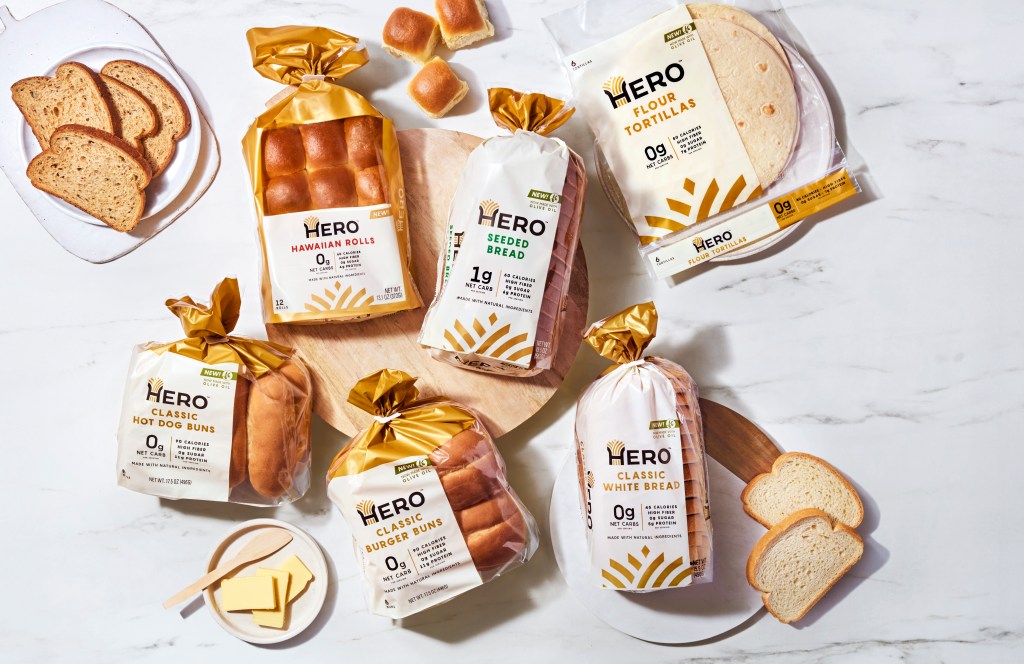
The challenge for any DTC-native brand is successfully translating its online success to the physical shelf. Many brands struggle to find the right retail partners, often misaligning their product positioning with the demographic of the grocery chain. Hero Bread began with a core set of staples—white bread, seeded bread, burger buns, hot dog buns, and flour tortillas—that were designed to drive high-frequency, weekly purchases.
When it came time to enter the retail market, the leadership team faced a common debate: should they position the product as a niche, natural-food offering for retailers like Whole Foods and Sprouts, or as a mainstream staple for chains like Publix and Target? "It’s a very mainstream taste profile," Cheng notes, reflecting on the initial uncertainty. "So there was a lot of debate, if this is going to be more of a Publix, Target type product, or is this going to be more of a natural Whole Foods, Sprouts, type of product."

Rather than choosing one path, Hero Bread decided to experiment across the board. They launched simultaneously in Market District, Publix, and Sprouts to gauge performance. Within six months, the data was clear: the product was resonating with consumers across all three channels. This prompted a departure from the conventional CPG wisdom, which usually dictates that a brand should zero in on a single retail channel and focus on regional density before expanding further. "We were very, very fortunate in that," Cheng says. "So instead of picking channels, we decided to pick retailers that were more enthusiastic regardless of what channel they were in."
Balancing Affordability with Premium Craftsmanship
As the brand matures, it has developed a dual-track strategy that balances the scale of traditional retail with the concierge nature of DTC. Cheng acknowledges that retail expansion is essential for affordability; the ability to move massive quantities of pallets on a truck allows the company to reach a wider audience at a lower price point than the costs associated with individual ecommerce shipping.
However, the DTC platform remains the heart of the company’s innovation strategy. The website, hero.co, serves as an exclusive venue for products that are too delicate or labor-intensive for mass-market retail, such as their Crafted Collection. These items, which include hand-baked croissants, lemon poppy seed scones, and shortbread biscuits made with brown butter, are produced in collaboration with world-class culinary talent, including Michelin-starred chefs. The model also extends to strategic collaborations, such as their popular pretzel bites developed with Auntie Anne’s. "These are small-batch, largely handmade products that are exclusive to hero.co, where it just wouldn’t make economic sense for us to hand-roll 300,000 to 400,000 croissants," Cheng explains.
Furthermore, the DTC site acts as a low-risk laboratory for product development. By testing new items online, Hero Bread can validate consumer demand before committing to the massive production runs required for retail distribution. A prime example is the company’s expansion into the bagel category. In December 2024, the brand launched limited-edition bagels on its website to gauge interest. "We weren’t sure if people would want to buy bagels from us," Cheng says, "so we initially made them in smaller batches, sold them at hero.co, and they quickly became one of our best-selling items." The success of that test led to a full-scale retail launch within just six months.
A Culture of Resilience
As Cheng leads the company into what he characterizes as the "third chapter" of its DTC playbook, he emphasizes that the success of the business is inextricably linked to the resilience of its leadership. For Cheng, the journey is defined not by a lack of failure, but by the persistence to move forward through adversity. "It’s how many times you can try again, regardless of how many times you’ve fallen down or how much blood you get on your face," he says. "There is a level of courage that is really necessary."
That philosophy of resilience has been the engine behind Hero Bread’s ability to survive its early growing pains and evolve into a significant player in the bakery category. As the company continues to scale, its goal remains clear: to dismantle the barrier between health-conscious, low-carb living and the simple, everyday pleasure of eating bread. By meeting consumers where they are—whether that is in the aisles of a major national retailer or through a curated delivery to their doorstep—Cheng believes the brand is well-positioned for its next phase of growth. "We’re always trying to meet the consumer where they are," Cheng says. "There’s a specific Hero fan, and then there’s the overarching bread fan. We believe that the more people who try us, the more people who will believe in us."