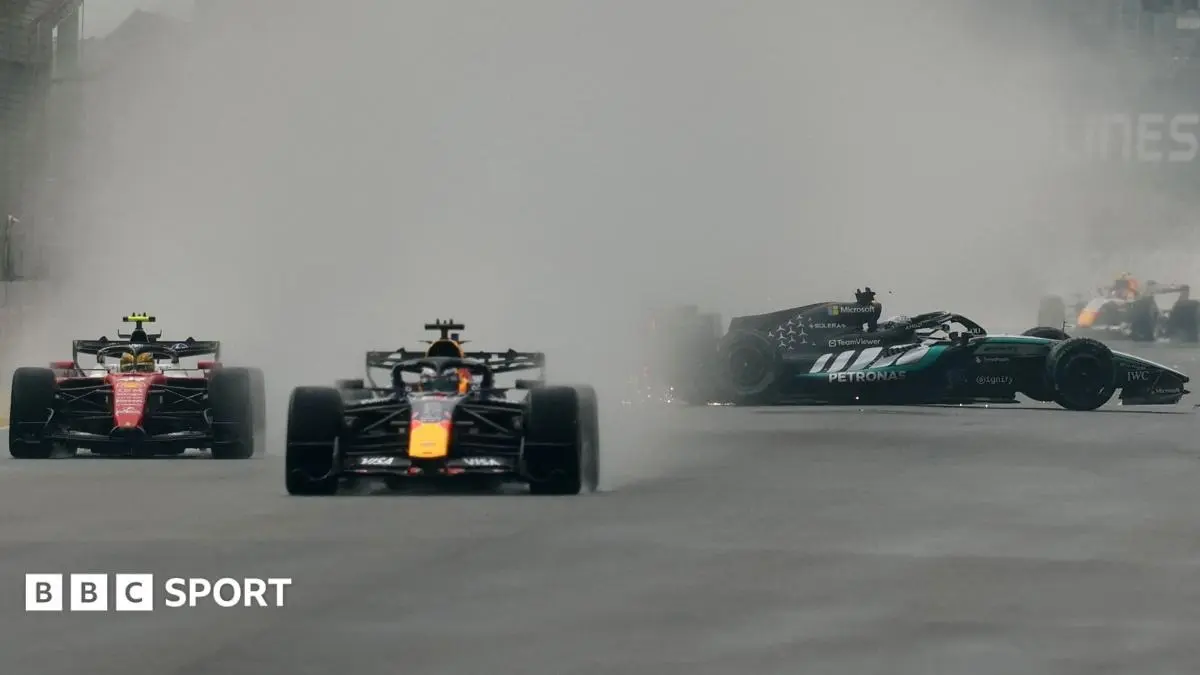
Max Verstappen’s masterful campaign took another significant step forward under the humid night skies of Marina Bay, as the Red Bull driver claimed victory in a chaotic and incident-packed sprint race at the Singapore Grand Prix. In a contest defined by unpredictable weather and high-stakes drama, Verstappen managed to navigate a treacherous track and a series of interruptions to extend his dominance, while his primary rivals fell victim to the unforgiving nature of the circuit.
The race, which had been delayed by 30 minutes due to a fierce tropical downpour, began under conditions that tested the absolute limit of the drivers’ concentration. With half of the Marina Bay street circuit bathed in dry conditions and the other half slick with standing water—particularly around the technical challenges of Turns Two and Three—the track surface was a complex puzzle of grip and volatility. After the field completed two reconnaissance laps behind the safety car to assess the stability of the asphalt, the lights finally went out for a standing start, setting the stage for what would become one of the most volatile sprints of the season.
George Russell, driving for Mercedes, had arguably his best chance of the weekend to challenge the status quo. Off the line, he displayed lightning reflexes, beating Verstappen to the first corner and seizing the lead. It was a statement of intent from the Briton, who looked poised to breathe new life into his fading title aspirations. However, the complexity of the half-wet, half-dry track proved to be a merciless adversary.
As the race moved through the opening lap, Russell maintained his composure, but his undoing arrived at the final corner. In a moment of high-pressure miscalculation, Russell pushed just a fraction too hard. "I just misjudged it, got more power than I was expecting from the battery, got a little wider than I expected and touched the white line," Russell admitted following the race. "Rule number one in the wet is don’t touch the white line. Very silly mistake."
The result was a violent loss of control. His Mercedes spun across the track, clattering into the inside wall before rebounding toward the outside. It was a harrowing moment as the rest of the field swerved in a desperate scramble to avoid the stationary silver machine. Miraculously, the pack managed to navigate the obstruction without further contact, bringing out the safety car and neutralizing the race while marshals cleared the track.
The retirement of Russell was a pivotal moment not just for the race, but for the championship landscape. With his Mercedes teammate Kimi Antonelli ultimately moving up the order to finish fourth, the points swing was significant. The young Italian now enjoys a commanding 89-point lead in the championship standings, a cushion that underscores the consistency he has maintained throughout this challenging campaign.
Once the safety car period concluded and the race resumed, the dynamic at the front shifted. Verstappen, now inheriting the lead, found himself under immediate pressure from Ferrari’s Lewis Hamilton. The seven-time world champion had performed a tactical masterclass at the start, vaulting from sixth on the grid to second place through a superb opening sequence. For a few laps, the familiar rivalry between the two—reminiscent of their epic 2021 clashes—was renewed, with Hamilton hunting the Red Bull through the twisty sectors of the Marina Bay layout.
However, the Red Bull’s pace proved superior. As the track continued to dry, Verstappen began to stretch his legs, easing away from the Mercedes to establish a comfortable buffer. It was a clinical performance from the Dutchman, marking his second Formula 1 victory in as many weeks, following his maiden win of the season at the Bahrain Grand Prix in Malaysia. Remarkably, this also represented Verstappen’s first-ever victory on the streets of Singapore, checking another box on his illustrious career resume.
Behind the leading duo, the race settled into a tense, tactical stalemate. Overtaking is notoriously difficult at Marina Bay, and the field remained largely static for the middle portion of the race as drivers managed their tires and navigated the varying grip levels. Ferrari’s Charles Leclerc held onto third place, though he found himself increasingly under threat as the race entered its closing stages. Leclerc struggled with the balance of his car, creating a bottleneck that allowed the McLarens of Oscar Piastri and Lando Norris, along with a surging Kimi Antonelli, to close the gap.
The intensity of the battle for the podium reached its breaking point on the final lap. Norris, having shadowed Piastri for several circuits, sensed an opportunity after securing a superior exit out of Turn Three. He moved to challenge Piastri for position at Turn Five. It was a high-risk maneuver on a narrow track, and the two McLaren teammates collided in a spectacular fashion. The contact sent both cars into a spin, with Piastri’s car striking the barriers and forcing his retirement from the race.
The stewards immediately launched an investigation into the collision. After reviewing the evidence, they opted to take no action, concluding that both drivers had contributed to the incident. While Norris was able to continue, his race was effectively ruined; he plummeted down the order to finish eighth, behind the Racing Bulls’ Liam Lawson, Haas driver Oliver Bearman, and Audi’s Nico Hulkenberg.
The incident drew immediate scrutiny regarding the logic of the move. While Norris had positioned himself alongside his teammate, he was criticized for the risk-reward ratio of the attempt. With only a single point at stake for the position and no collective benefit to the team’s overall points tally, the move was widely viewed as a marginal and ultimately ill-advised decision that cost the team a strong finish.
As the dust settled on the Marina Bay street circuit, the narrative of the sprint race remained dominated by the extremes of the weekend. For Verstappen, it was a day of measured aggression and control, further cementing his authority at the top of the standings. For Russell, it was a harsh lesson in the volatility of wet-weather racing. And for McLaren, it was a painful reminder of the thin line between competitive racing and self-inflicted disaster.
The podium was completed by Lewis Hamilton, who capitalized on his stellar start to secure a valuable second place, and Charles Leclerc, who held on to third despite his late-race struggles. As the teams pack up and look toward the remainder of the season, the results in Singapore serve as a stark reminder that in the world of Formula 1, championship momentum can shift in the blink of an eye—or the touch of a white line.