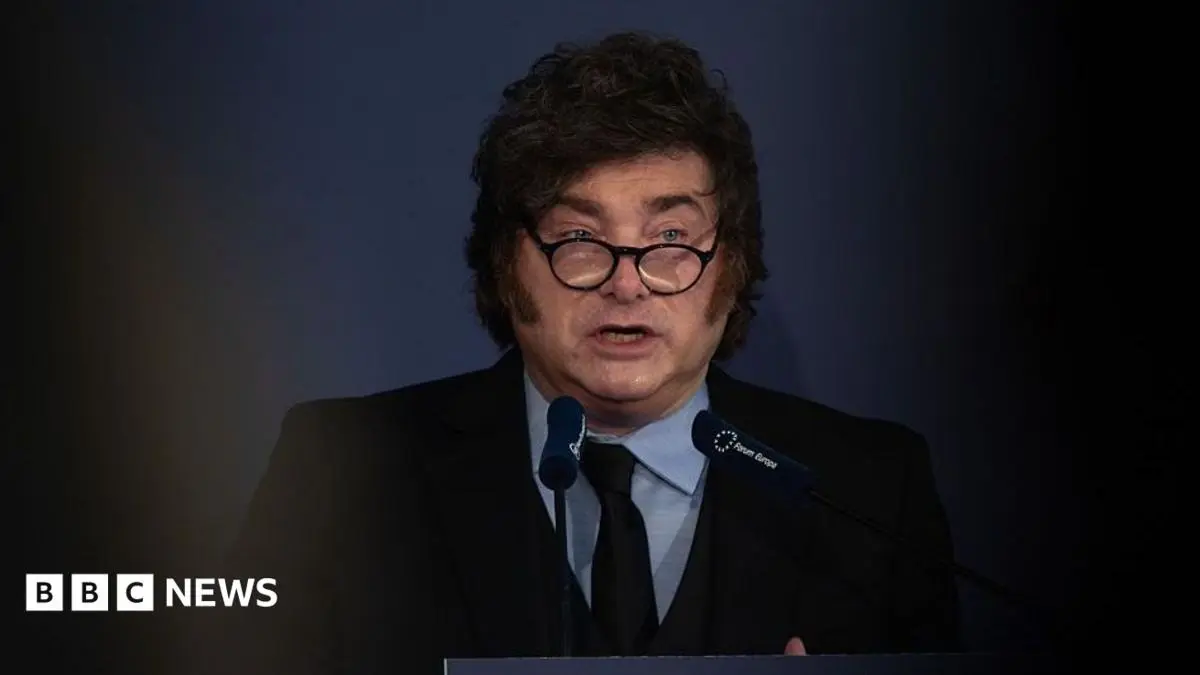
A federal criminal investigation into Argentine President Javier Milei and his sister, Karina Milei, regarding their alleged involvement in a cryptocurrency scandal has been officially dropped. The judicial decision, handed down by federal judge Marcelo Martinez de Giorgi, brings a close to a high-profile legal challenge that had clouded the administration since early 2025. The dismissal came following a formal request by prosecutors, who determined that the evidence did not support the pursuit of criminal charges against the head of state or his close aide.
The controversy centered on the launch of a digital asset known as $Libra, a cryptocurrency that garnered significant attention in February 2025 after President Milei shared a link to the project on his social media account. The asset’s subsequent market performance—a rapid, artificial-looking spike followed by a catastrophic collapse—resulted in substantial financial losses for a broad base of investors. The timing of the President’s social media activity and the subsequent nosedive of the currency led to widespread public outcry and intense political scrutiny from opposition leaders.
In his ruling to dismiss the case, Judge Martinez de Giorgi underscored that the events described in the complaints did not meet the necessary threshold for a criminal offense. The court concluded that no "criminally relevant deception" had been proven, effectively clearing the President and his sister of the accusations of fraud that had been leveled against them. The decision relies on the legal determination that the reported activities, while controversial in the public sphere, did not fall under a legal category that would warrant a trial or further investigation into the President’s conduct.
The origins of the legal battle trace back to a February post on X (formerly Twitter), where President Milei shared information regarding $Libra. At the time, the President touted the coin as a potential tool for financing small businesses and fostering start-ups, a narrative that aligned with his broader platform of economic deregulation and market-driven innovation. Following his endorsement, the value of $Libra surged, drawing in a wave of speculative capital from retail investors eager to capitalize on the presidential seal of approval. However, the momentum was short-lived. Within hours of the initial post, the asset lost the vast majority of its value, leaving many investors with near-total losses.
The backlash was swift. Almost immediately after the currency crashed, the President deleted his post, a move that only served to fuel further suspicion. Some critics and investors accused the administration of orchestrating a "rug pull"—a malicious practice in the cryptocurrency world where project creators or promoters hype an asset to attract buyers, only to abandon the project or liquidate their own holdings, leaving outside investors to bear the brunt of the collapse. The speed at which the coin rose and fell, coupled with the President’s swift deletion of his endorsement, became the central pillar of the accusations brought against him.
Opposition members of the Argentine Congress seized on the incident, initiating discussions about potential impeachment proceedings. The political fallout was intensified by the fact that the President had, at the time, presented himself as a champion of transparency and market integrity. For his detractors, the $Libra incident suggested a lapse in judgment that bordered on complicity, if not active participation, in a fraudulent scheme. The scandal forced the presidential office into a defensive posture, leading to the involvement of the Anti-Corruption Office, which was tasked with determining whether the President had acted improperly in his capacity as a public servant.
Throughout the duration of the investigation, President Milei maintained his innocence, consistently denying that he had promoted the coin in a professional or official capacity. In an interview with local media outlet Todo Noticias, he sought to clarify his actions, stating, "I didn’t promote it, I merely shared it." He argued that his social media activity was not a calculated endorsement but rather a reflection of his own initial, albeit incomplete, understanding of the project at the time of the post.
The President’s defense centered on the concept of "good faith." He claimed that his interest in the project was motivated by the purported goal of supporting small businesses and that he was unaware of the underlying mechanics or the risks associated with $Libra at the moment he shared the link. Once he became aware of the nature of the project and its sudden volatility, he claimed, he immediately removed the post to distance himself from the venture. He asserted that his actions were not intended to mislead the public but were instead a mistake born of a lack of detail regarding the specific project, which he sought to rectify by deleting the content.
Beyond the legal arguments regarding his intent, the President also addressed the nature of the investment itself. In a subsequent television interview, he adopted a more libertarian stance, insisting that those who chose to invest in $Libra did so "voluntarily" and were, or should have been, fully aware of the inherent risks associated with the highly volatile cryptocurrency market. By framing the losses as the result of individual market participants making risky choices, the President attempted to shift the focus away from his own endorsement and toward the broader, often unregulated, nature of the crypto-asset sector.
The office of the presidency consistently maintained that Milei was in no way involved in the development, technical architecture, or management of the $Libra token. By distancing himself from the creators of the coin, the President aimed to dismantle the narrative that he had acted as an architect of a financial scheme. The administration’s stance was that while the optics of the situation were unfortunate, they did not constitute a breach of the law.
The decision by Judge Martinez de Giorgi serves as a significant turning point in the affair. By determining that the events did not constitute a criminal offense, the court has effectively halted the momentum of the political attacks that were threatening to destabilize the presidency. The ruling underscores the difficulty in establishing criminal intent in the digital age, particularly when public figures engage with nascent and highly speculative technologies. For the judiciary, the focus remained strictly on whether the President’s actions met the legal definition of deception or fraud, and in this instance, the evidence was found to be lacking.
While the legal proceedings have concluded, the incident remains a notable chapter in the intersection of politics, social media, and digital finance. The case highlighted the massive influence that political leaders now wield over market sentiment, particularly in the realm of decentralized finance, where a single post can dictate the fortunes of thousands of investors. It also raised questions about the responsibilities of public officials when they interact with emerging technologies that carry high risks for the general public.
As of the current reporting, President Milei has yet to issue an official statement following the dismissal of the case. Having maintained throughout the investigation that he acted in good faith and that the accusations were without merit, the President’s silence may be viewed as a signal that he considers the matter closed. For his political allies, the judge’s ruling is a vindication of his insistence that his social media activity was not a criminal act. For the opposition, the episode remains a point of contention regarding the standards of conduct expected of the nation’s highest office.
Ultimately, the closure of this criminal investigation removes a significant legal hurdle for the administration. By concluding that no criminally relevant deception occurred, the federal court has provided a definitive end to the formal legal inquiry. The case will likely be remembered as a cautionary tale regarding the speed of social media influence and the volatility of the cryptocurrency market, even as the legal system declines to categorize the President’s involvement as anything other than a non-criminal, if controversial, series of events. The dismissal serves as a final, decisive chapter in a saga that dominated the national discourse for months, leaving the President to return his full focus to his broader political and economic agenda.