When evaluating what makes police cars different from their everyday civilian counterparts, automotive enthusiasts often look past the motor itself. While police cruisers feature heavy-duty alternators, upgraded cooling systems, specialized wiring harnesses, and reinforced chassis components, they typically do not rely on exotic, high-output race engines. Yet, as the Michigan State Police (MSP) demonstrated during their rigorous autumn evaluation program, standard-issue law enforcement motors can still deliver impressively effective performance.
The MSP testing program has served as an industry benchmark since its inception in 1975, providing police departments across North America with vital, objective performance data. This year, the evaluation put 13 cars and five motorcycles through a demanding gauntlet across two separate, highly specialized testing facilities in Michigan.
Vehicle top speed, acceleration, and braking capabilities were evaluated at the Chelsea Proving Ground, a sprawling facility located in Chelsea, Michigan, and owned by Stellantis. Meanwhile, vehicle dynamics and handling were tested at the historic Grattan Raceway in Belding, Michigan—a challenging road course that, fittingly, was listed for sale at a price of $15 million during the testing period.
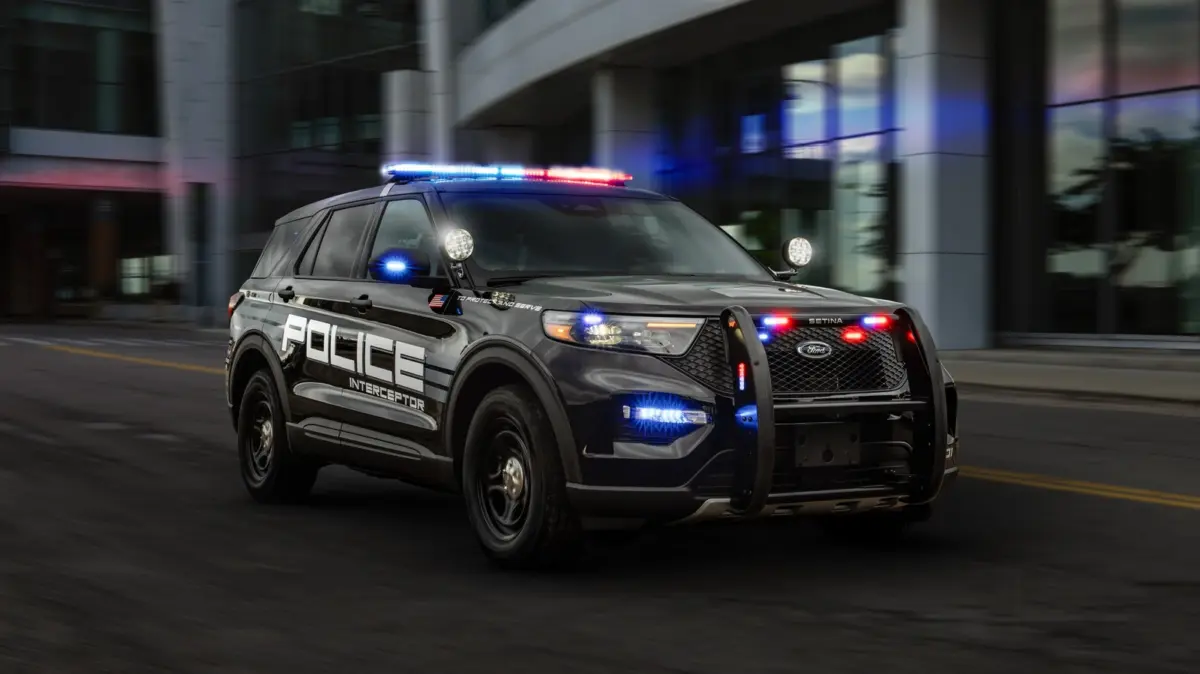
When the dust settled on the high-speed oval, the crown for top velocity went to the all-wheel-drive Ford Police Interceptor Utility. Leveraging its potent 3.0-liter EcoBoost V6 engine, which pumps out 400 horsepower and 415 pound-feet of torque, the rugged SUV managed to hit an electronically limited top speed of 148 mph. Notably, that made the patrol SUV faster than any of the police motorcycles evaluated in the program. On the two-wheeled side of the ledger, the leader was the standard-setup BMW R 1300 RT-P, which achieved a maximum velocity of 141 mph before hitting its manufacturer-imposed electronic limit. In fact, every single vehicle in the MSP testing program featured a top speed that was electronically capped by its manufacturer.
The dominance of the Blue Oval’s utility vehicle comes as little surprise to fleet managers. The Ford Police Interceptor Utility has reigned as the fastest vehicle in the Michigan State Police ranks since it shared the honor with the Dodge Charger back in 2020. Rounding out the top tier for top speed in the 2026 evaluation were several familiar contenders: the AWD Ford Police Interceptor Utility with both hybrid and gas-only powertrains, both clocking in at 136 mph, followed by a trio of vehicles that hit 130 mph—the rear-wheel-drive Chevrolet Tahoe PPV equipped with the 5.3-liter V8, the all-electric Chevrolet Blazer PPV EV with AWD, and the Dodge Durango Pursuit featuring a 5.7-liter V8 and AWD.
What was the quickest police car?
While top speed remains a critical data point for highway interdiction, it represents only one facet of law enforcement performance. Recognizing this, the MSP measured the vehicles’ 0-to-60 mph sprint times, adding essential context to how these machines leap off the line, even if tracking a car from 5 to 60 mph is often considered a superior real-world performance metric by industry testers.
The results of the acceleration trials unfolded largely as expected once observers noted the presence of two battery-electric vehicles on the test roster. The nearly instant torque delivered by the Chevrolet Blazer EV and the all-wheel-drive Ford Mustang Mach-E GT helped them set a formidable pace for straight-line acceleration. The Blazer EV recorded a brisk time of 5.14 seconds, while the Mustang Mach-E GT led the charge among closed-wheel vehicles with a blistering 4.03-second sprint.
Among internal combustion options, Ford’s Police Interceptor Utility with the 3.0-liter EcoBoost and the Ford F-150 Police Responder—which steps up to a larger 3.5-liter EcoBoost engine—were the only other four-wheeled, non-motorcycle vehicles to dip below the six-second threshold. The quickest internal-combustion police cars accomplished the feat in 5.95 and 5.68 seconds, respectively. However, the absolute quickest acceleration across the entire testing program belonged to a motorcycle: the BMW R 1300 RT-P equipped with the Dynamic Pack and AutoShift. It stood out as the sole vehicle to break the four-second barrier, completing the 0-to-60 mph sprint in just 3.61 seconds.
The MSP also tracked 0-to-100 mph times, yielding a remarkably consistent hierarchy. The quickest electric vehicle remained the Mustang Mach-E, the two quickest gas-powered cars were again the Ford Police Interceptor Utility and the F-150 Police Responder, and the quickest motorcycle honors went to the identically equipped BMW.
Details about their braking and dynamics
Given the inherent risks associated with high-speed police pursuits, reliable braking systems and superior vehicle dynamics are just as critical as raw horsepower. To evaluate stopping power, the MSP subjected the test fleet to multiple 60-to-0 mph full ABS maximum deceleration stops, calculating a projected stopping distance from that speed.
The Mustang Mach-E emerged victorious in the braking evaluations, aided by an impressive projected stopping distance of 122.45 feet. No other vehicle tested managed to drop below the 130-foot mark. In fact, during one particularly strong run, the electric crossover managed to haul itself down from a true 59.7 mph to a complete halt in just 116.75 feet.
By comparison, the overall speed champion of the testing program—the Ford Police Interceptor Utility with the 3.0-liter EcoBoost—recorded the seventh-shortest projected stopping distance at 137.24 feet. To provide real-world context for the fleet testing, a heavy-duty 2026 Ram 2500 equipped with four-wheel drive and a 6.4-liter V8 was also evaluated, yielding a projected stopping distance of 170.13 feet, which stood as the longest in the MSP testing group.
Overall vehicle dynamics and handling characteristics were put to the ultimate test at Grattan Raceway. During this portion of the evaluation, four professional drivers completed eight laps each in all 13 participating vehicles, accumulating a demanding total of 32 laps per vehicle. The primary metric used to judge handling was average lap time, as the track’s challenging two-mile layout features a complex mix of tight curves and significant elevation changes designed to faithfully simulate actual conditions encountered during emergency response and pursuit driving.
When the lap times were tallied, the Ford Police Interceptor Utility with the 3.0-liter EcoBoost added another victory to its resume, claiming the best handling score of the test. While the Michigan State Police did not subject the five participating motorcycles to the rigorous dynamics circuit, the pursuit-rated Ford SUV proved its overall competence by securing an average lap time of 1:35.09, besting all of its four-wheeled competitors by a margin of at least 2.9 seconds.