Depreciation remains the single largest hidden cost of vehicle ownership, acting as a double-edged sword that rewards patient sellers while punishing buyers who drive brand-new cars off dealership lots. Yet, amid shifting economic conditions and fluctuating inventory across the broader automotive landscape, one brand consistently dominates industry metrics for retaining value over a five-year ownership cycle: Toyota.
According to comprehensive market tracking from CarEdge, Toyota models retain an average of 64.9% of their original value after five years on the road, placing the Japanese automaker comfortably ahead of competitors like Subaru, which trails in second place with an average residual value of 61.2%. To put that benchmark into perspective, the average new car in the modern marketplace typically sheds roughly 30% of its manufacturer’s suggested retail price within the first two years alone. By contrast, it takes a typical Toyota nearly half a decade to experience a similar percentage drop.
Industry analysts emphasize that this residual value figure represents a portfolio-wide average, meaning individual nameplates within Toyota’s lineup perform even more remarkably. Data aggregated from both CarEdge and iSeeCars highlights a select group of Toyota vehicles that boast extraordinary five-year valuation track records. Leading this elite tier are the Tacoma, Corolla Hatchback, GR Supra, Tundra, RAV4, 4Runner, and the conventional Corolla sedan. While newer additions to the showroom floor, such as the Corolla Cross and Grand Highlander, also exhibit below-average depreciation rates, they lack the multi-year statistical history required to match the established tracking of their stablemates.
To ground these statistical projections in current economic reality, market researchers cross-referenced active retail listings found on Autotrader to determine how these theoretical valuations translate into actual transactions. All baseline figures include mandatory factory destination charges, while used-vehicle pricing benchmarks reflect examples featuring near-average mileage for their age—typically around 68,000 miles for a five-year-old vehicle—maintained in good condition with clean vehicle history reports free of prior accidents or branded titles.
Toyota Tacoma: 79.5%
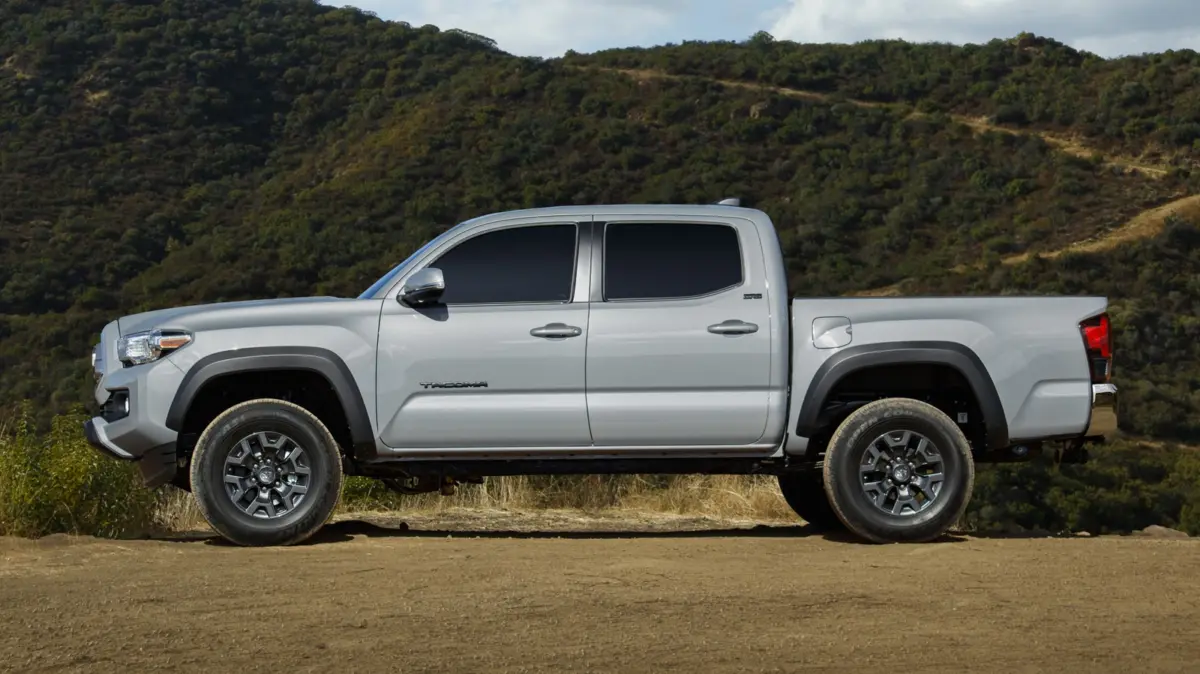
While automotive enthusiasts frequently debate the merits of various generations of the Toyota Tacoma, the empirical data surrounding its financial performance is virtually indisputable. A five-year-old Tacoma stands uncontested as the residual-value champion among similarly aged Toyota models. CarEdge data indicates that a typical Tacoma retains approximately 79% of its original purchase price after five years, while iSeeCars figures are even more optimistic at 80.1%, yielding a combined retained-value average of 79.5%.
Expressed differently, the Tacoma sheds a negligible 4% of its initial value annually. Furthermore, broader industry studies from iSeeCars position the Tacoma near the absolute summit of the entire automotive market for low depreciation, trailing only exotic or niche performance machines like the Porsche Cayman, Porsche 911, and Chevrolet Corvette.
Real-world marketplace listings corroborate these stellar retention figures. A 2021 Tacoma configured in the mid-tier SR5 trim, featuring rear-wheel drive and a spacious double cab, commands an average asking price of roughly $29,500 on Autotrader. Given that its original MSRP when new stood at $33,405, the five-year depreciation hit is remarkably modest at just 11.7%. This translates to an actual residual value of 88.3%, performing substantially higher than the combined statistical averages compiled by CarEdge and iSeeCars.
Toyota GR Supra: 77.2%
Although automotive industry announcements indicate that the BMW-engineered GR Supra is slated to leave Toyota’s active lineup following the 2026 model year, the sports car continues to demonstrate remarkable health and resilience within the secondary market. CarEdge tracking points to a five-year residual value of 78.4% for the sports coupe, with iSeeCars reporting a close 76%, resulting in a combined average of 77.2%.
The GR Supra originally debuted for the 2020 model year, with the subsequent 2021 edition expanding the lineup by introducing a more accessible four-cylinder variant alongside the more powerful inline-six engine, which received a notable 47-horsepower performance increase. Despite the four-cylinder model carrying a more affordable initial base price of $43,985, a pre-owned 2021 GR Supra frequently trades at a higher price point on the used market than a brand-new Toyota GR86.
Current marketplace pricing for the base four-cylinder model hovers around $37,000, establishing a retained value of 84.1% that easily surpasses standard industry projections. Stepping up to the six-cylinder variants elevates valuations even further. Due to constrained supply and steady enthusiast demand, the mid-grade 3.0 Premium trim—which originally carried a window sticker starting at $55,485—commands an average used listing price of $47,000 on Autotrader, reflecting an impressive 84.7% residual value.
Toyota Tundra: 77.2%
Toyota’s full-size pickup truck, the Tundra, also secures a strong position among vehicles that successfully resist rapid depreciation. However, five-year resale value estimates reveal a noticeable gap between major tracking agencies, with CarEdge projecting a 75.5% residual value and iSeeCars estimating 78.8%. This 3.3-percentage-point divergence can translate into a variance of $1,200 or more for prospective used truck buyers navigating the open market.
The 2021 model year represents the final iteration of the truck’s second generation, prior to the introduction of an all-new redesigned platform that subsequently faced well-documented mechanical recalls involving its turbocharged V6 engines.
An examination of marketplace inventory reveals that the lower-tier SR5 trim, equipped with the CrewMax configuration and rear-wheel drive, originally carried an MSRP of $39,565 in 2021. Comparable units currently listed for sale average approximately $36,000, yielding a staggering 91% resale value that outperforms CarEdge’s baseline projections by roughly 15.5 percentage points. Moving up to the Limited grade, which originally started at $45,850 for a rear-wheel-drive CrewMax configuration, used examples command an average price of around $41,000, preserving approximately 89.4% of their original factory value.
Toyota Corolla Hatchback: 76.4%
While many domestic automotive manufacturers steadily dismantled their small-car portfolios, Toyota doubled down on compact versatility by introducing a sleek hatchback variant to the modern Corolla family for the 2019 model year. This five-door configuration appears to have cultivated particularly robust secondary market demand compared to its traditional four-door sibling, though both body styles perform exceptionally well.
CarEdge reports that a five-year-old Corolla Hatchback retains 78.2% of its original MSRP, while iSeeCars estimates a slightly more conservative 74.5%, combining for an average value retention of 76.4%.
When paired with a continuously variable transmission, a 2021 Corolla Hatchback commanded a base MSRP of $22,560 when new. While secondary market inventory remains relatively lean, available units change hands at an average price of approximately $20,000, pushing the five-year value retention even higher to 88.7%.
Historical availability also included a six-speed manual transmission variant—a configuration Toyota ultimately dropped from the lineup in 2023. In 2021, the base manual-equipped trim started at $21,460. Although these particular models are increasingly difficult to locate on dealer lots, trading values hovering near $20,000 indicate an extraordinarily minimal depreciation rate of just 6.8% over half a decade.
Toyota RAV4: 75.7%
Describing the Toyota RAV4 as popular significantly understates its market dominance. In 2021 alone, Toyota retailed more than 400,000 units across the United States, securing its status as the best-selling non-truck vehicle of that year. While this immense production volume ensures a plentiful supply of used models, buyers should not mistake widespread availability for bargain pricing.
Valuations compiled by CarEdge (76.5%) and iSeeCars (74.8%) average out to a robust 75.7% retention rate, though finding a well-maintained, five-year-old RAV4 that has actually depreciated by the textbook 24.3% is increasingly difficult.
Real-world dealer listings indicate a much tighter pricing structure. A base RAV4 LE equipped with front-wheel drive originally retailed for $27,045 in 2021. Five years later, pre-owned retail examples command an average price of approximately $23,500, representing an 86.9% residual value.
Stepping up to the mid-tier XLE Premium trim reveals slightly higher depreciation, with average dealer asking prices reaching nearly $26,300 against an original MSRP of $31,045, translating to an 84.7% retained value. These figures mirror broader economic trends documented by CarGurus, which notes that pre-owned RAV4 values actually appreciated by 3.3% over a recent 90-day window, defying a general 1.7% contraction across the broader used vehicle market during the same timeframe.
Toyota 4Runner: 75.4%
Among Toyota’s SUV portfolio, the rugged 4Runner stands as the highest-ranking utility vehicle for preserving its original sticker price over a five-year period. CarEdge and iSeeCars report remarkably consistent resale value projections of 76.3% and 74.5% respectively for the 2021 model year, averaging out to 75.4%.
This generation of the 4Runner belongs to the long-standing fifth generation that populated showrooms from 2010 through 2024, relying exclusively on a dependable 4.0-liter V6 engine before subsequent redesigns transitioned the model line toward turbocharged four-cylinder and hybrid powertrains.
An analysis of entry-level SR5 models equipped with standard rear-wheel drive shows a 2021 4Runner commanding an average listing price of approximately $31,600, compared to an original MSRP of $37,940. This financial math delivers a remaining value of 83.3%, outperforming combined industry estimates by roughly eight percentage points.
Meanwhile, the mid-grade TRD Off-Road Premium, which originally opened at a window sticker price of $44,225, currently trades at an average of nearly $40,000 on the pre-owned market. This reflects an exceptionally low depreciation rate of just 10.1% over a five-year span, leaving owners with a staggering 90.4% of the vehicle’s initial value intact.
Toyota Corolla Sedan: 70.6%
While the four-door Corolla sedan may not match the staggering sales volume of its stablemate, the RAV4, Toyota successfully moved nearly 250,000 units of the compact sedan in the United States during the 2021 model year, ensuring an ample supply for buyers searching dealer lots.
Independent tracking from CarEdge indicates that Corollas of this vintage retain 68.8% of their original value, while iSeeCars records a slightly higher 72.4% residual value. However, similar to other nameplates across Toyota’s portfolio, the combined average value retention of 70.6% fails to capture the realities of the active marketplace.
Contributing factors include steady upward pressure on used Corolla prices—with CarGurus tracking a 1.9% valuation increase over a recent 90-day period—alongside rising MSRPs for brand-new models, where the cheapest 2026 Corolla commands a starting price of $24,420, marking a 17.3% increase over 2021 pricing.
The near-entry-level LE trim for the 2021 Corolla debuted with an MSRP of $21,270, yet current pre-owned examples command an average listing price of approximately $19,200. This equates to an extraordinary 90.3% residual value, representing a 19.8-percentage-point divergence from baseline industry projections.
Conversely, the previously higher-priced SE grade, which carried a 2021 MSRP of $23,270, now trades at an average market price of roughly $19,100 on Autotrader, offering used vehicle shoppers a relatively advantageous entry point with an 82.1% residual value.