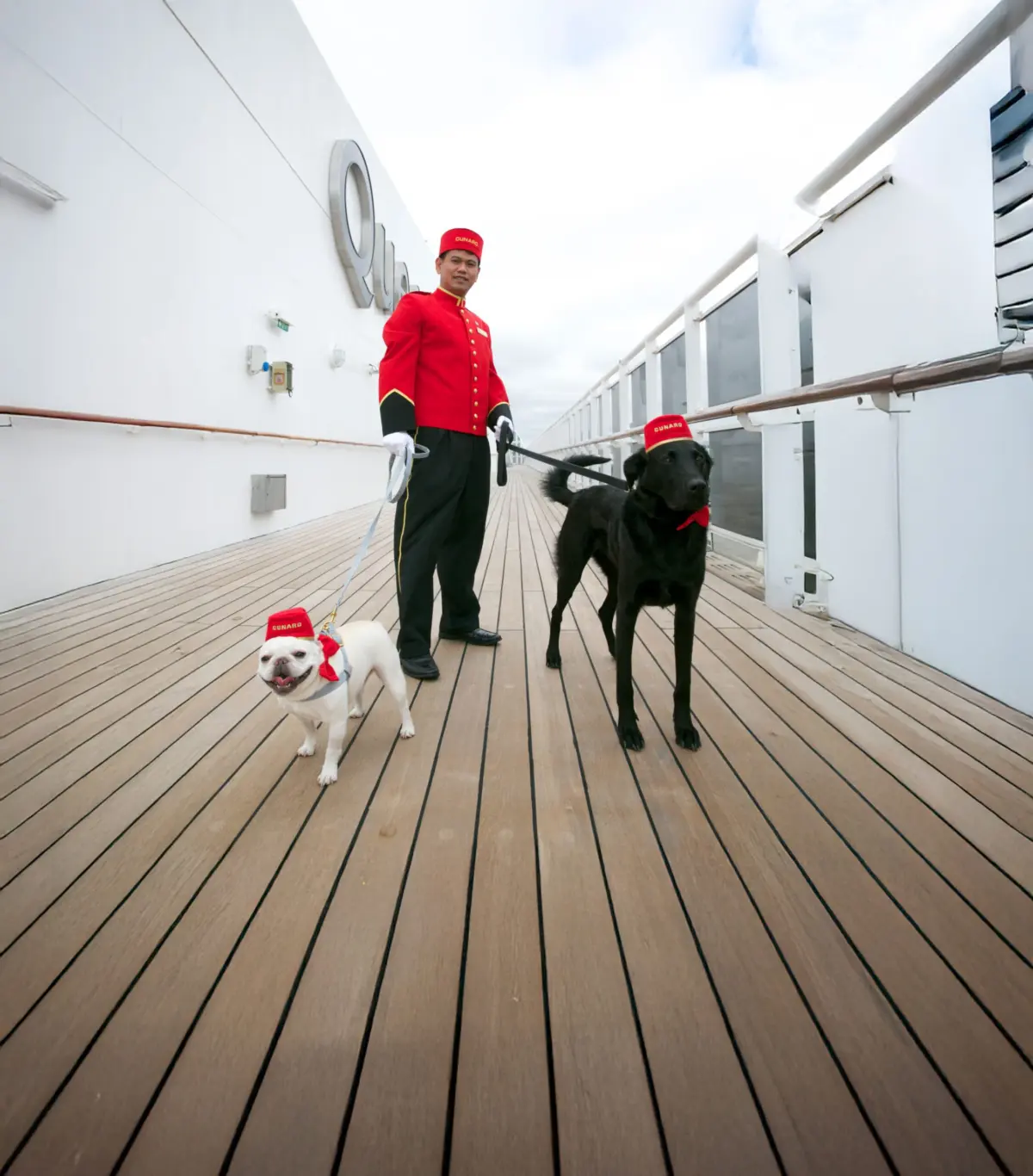
In the vast, shifting world of maritime travel, where the roles of captains, engineers, and cruise directors are well-documented, there exists a unique and highly specialized position that few travelers ever witness. Deep within the steel heart of the Queen Mary 2, the world’s only true ocean liner, resides a sanctuary that defies the typical expectations of a luxury voyage. This is the ship’s kennel, and it is under the watchful, compassionate, and firm guidance of Oliver Cruz, the ship’s dedicated kennel master.
As part of the ongoing Crews on Cruise series, which highlights the indispensable figures working behind the scenes of the world’s most iconic voyages, we turn our attention to the man responsible for the comfort and safety of the ship’s four-legged passengers. The Queen Mary 2, a titan of the seas that has been performing transatlantic crossings between Southampton and New York since 2004, maintains a unique tradition. It is the only cruise ship in the world to offer dedicated kennels, providing 24 climate-controlled spaces for dogs and cats whose owners refuse to travel without their companions.
Oliver Cruz’s journey to this singular role began in 2011. Initially hired as a spa attendant, his path changed dramatically when the ship’s housekeeping department discovered his extensive professional background. Before his life at sea, Cruz spent eight years in the Philippines working as a zoo guide and animal handler, gaining experience with a diverse array of creatures ranging from domestic animals to exotic wildlife like crocodiles and snakes. Recognizing his unique skill set, the cruise line moved him to the kennel department, where he has remained ever since.
For Cruz, the job is not merely a task of labor; it is a vocation rooted in a profound affinity for animals. "Dogs are angels," he says, with the quiet conviction of someone who spends his days in their company. "Not all angels have wings. Some of them have fur." This sentiment is reflected in his own life, as he maintains a home with 15 dogs and serves as an active member of the Philippine Animal Welfare Society.
The clientele at the Queen Mary 2 kennel is as diverse as the humans who roam the ship’s decks. Cruz has cared for everything from delicate teacup Yorkies to massive Bernese mountain dogs. One such giant, a frequent passenger, required a meticulously curated diet involving three daily meals, each composed of roughly three pounds of minced meat and more than 10 specific ingredients. For many of these animals, the ship is a familiar environment; Cruz has cared for some dogs across 32 separate crossings. He has developed a repository of institutional memory, capable of recalling the specific names, temperaments, dietary requirements, and even the exact "house" or kennel stall a repeat guest occupied on previous voyages.
However, the role is not without its perils. Cruz estimates that he has sustained over 50 dog bites throughout his tenure, though he is quick to clarify that none were malicious. These injuries are almost exclusively the result of his intervention in canine conflicts. "Nobody bites me intentionally," he explains. He has learned that management of these animals requires a nuanced approach, noting that "the way you treat a husky is not the same way you treat a Shih Tzu."
The daily operations of the kennel are a study in precision and empathy. On embarkation day, the work begins in the terminal with the rigorous cross-checking of paperwork. International travel, particularly into the United Kingdom, carries complex veterinary requirements, and Cruz must ensure every vaccination stamp and timeline is perfectly compliant with maritime law. Once the guests are brought aboard, he sets the tone for the journey, briefing owners on visitation protocols.
The kennel features an outdoor space colloquially known as the "poop deck," which has been thoughtfully designed to accommodate international guests. It is outfitted with both an American fire hydrant and a British lamppost. Cruz allows the dogs to experience both, ensuring that the animals feel a sense of familiarity regardless of their origin. To further ease the transition to life at sea, owners are encouraged to leave toys, blankets, and even unwashed pajamas or socks in the kennels, providing a scent-based comfort that helps the dogs acclimate to the unfamiliar environment of the ship. When two dogs arrive from the same home and share a bond, Cruz often removes the partition between their stalls so they can sleep together.
Dietary management is another cornerstone of his daily routine. Each meal is prepared in the same kitchen that services the human guests, but Cruz maintains a strict, salt-and-pepper-free policy. The menu is expansive, spanning boiled chicken breast, grilled steak, steamed salmon, Cumberland sausage, and a variety of fruits and vegetables, all portioned to the specific needs of the animal.
While the dogs are clearly the priority, managing the humans is often the more demanding aspect of the position. Cruz frequently has to act as a firm advocate for the animals’ health, particularly when well-meaning owners attempt to sneak restricted treats, such as bacon or oily table scraps, into the kennels. "Sometimes I tell the owners, ‘No treats,’" he says, "but I can see them secretly feeding their dog oily food. I have to say, ‘Mama, I’m not so happy seeing you do this.’"
The job also requires managing the expectations of other passengers. Because the kennel is a point of curiosity, many guests who are not traveling with pets attempt to visit the area just to see the animals. Cruz must maintain a strict boundary, explaining that the dogs are already adjusting to a new environment and do not need the added stress of strangers visiting.
His dedication extends to the emotional well-being of his charges. One of his most memorable interactions involved a dog named Paisley, who arrived at the ship with a history of mistreatment at a shelter. The dog was initially aggressive and struggled to adapt. Through patience and isolation, Cruz worked with her, establishing a clear hierarchy. "Paisley, you are not the boss. I am the boss," he would tell her. Over time, the relationship transformed. When the owner eventually found Paisley sitting on Cruz’s lap, licking his face, she was moved to tears.
Despite the challenges—such as the time a guest removed their dog from the kennel without authorization, causing Cruz to search the ship in a state of distress during a storm—he considers the role profoundly rewarding. "Meeting all the new dogs on the first day and making my family bigger" remains the highlight of his work. Conversely, the end of each crossing is the most difficult. "After seven days of bonding, playing, and running around together, saying goodbye is the saddest part."
Life on board the Queen Mary 2 has become more than just a job for Cruz; it has become his life. He is an active member of the ship’s community, playing drums and guitar in the Filipino crew band, which performs in the crew bar. He even recounts a surreal moment when he performed with musician Travis Barker during a filming session on the ship. Yet, when asked about his favorite place to spend time, he does not choose the bandstand or the luxury lounges of the liner. He chooses the kennels.
When he travels ashore, he finds solace in his personal passions, particularly in Liverpool, where his admiration for The Beatles is reflected in his John Lennon-themed tattoos. He spends his time visiting the legendary sites of the city, such as the Cavern Club, before returning to the ship. "The weirdest thing," he admits, "is that when I’m home, I feel strange. When I’m here, I feel at home."
For those embarking on their first cruise with a pet, Cruz offers simple advice: stay calm. Because dogs and cats are sensitive to the emotional states of their owners, he believes that a calm, happy human leads to a calm, happy animal. As for cats, he advises patience, noting that they are the ones who ultimately decide when a relationship begins. For Cruz, it is a matter of both professional knowledge and personal heart, a philosophy that ensures the most pampered passengers on the Queen Mary 2 are in the safest hands possible.