New York — Stepping out of a classic caged elevator on the seventh floor, guests arriving at the newly opened Wang Contemporary found themselves plunged into the moody atmosphere of dark, curtained tableaux populated by silent mannequins. This immersive setting provided the backdrop for designer Alexander Wang’s latest resort collection, staged in a grand, domed former landmarked bank building hovering over Canal Street at the edge of bustling Chinatown.
Purchased last spring by the designer and his mother, the building has spent the subsequent year undergoing extensive refurbishment. Now, it serves as a hybrid gallery and showroom, marking a permanent and expansive physical home for the brand in lower Manhattan. Just past the presentation space, the facility will soon host private omokase dinners, signaling a broader lifestyle vision for the destination. Yet for this evening, the focus remained squarely on the garments, which bridged a newfound appreciation for opulence with Wang’s signature downtown edge.
Last season, despite expressing a clear affinity for opulence, Wang presented a relatively spare and streamlined collection that leaned into fun, youthful, flirty, and undeniably sexy territory. However, that underlying interest in the lavish and ornate has not dissipated; if anything, it has only grown stronger. For this resort outing, those opulent impulses were far more fully realized. The designer took his primary visual and conceptual cues from traditional Peking opera, masterfully marrying its rich theatricality with what he envisioned as a contemporary, wearable wardrobe.
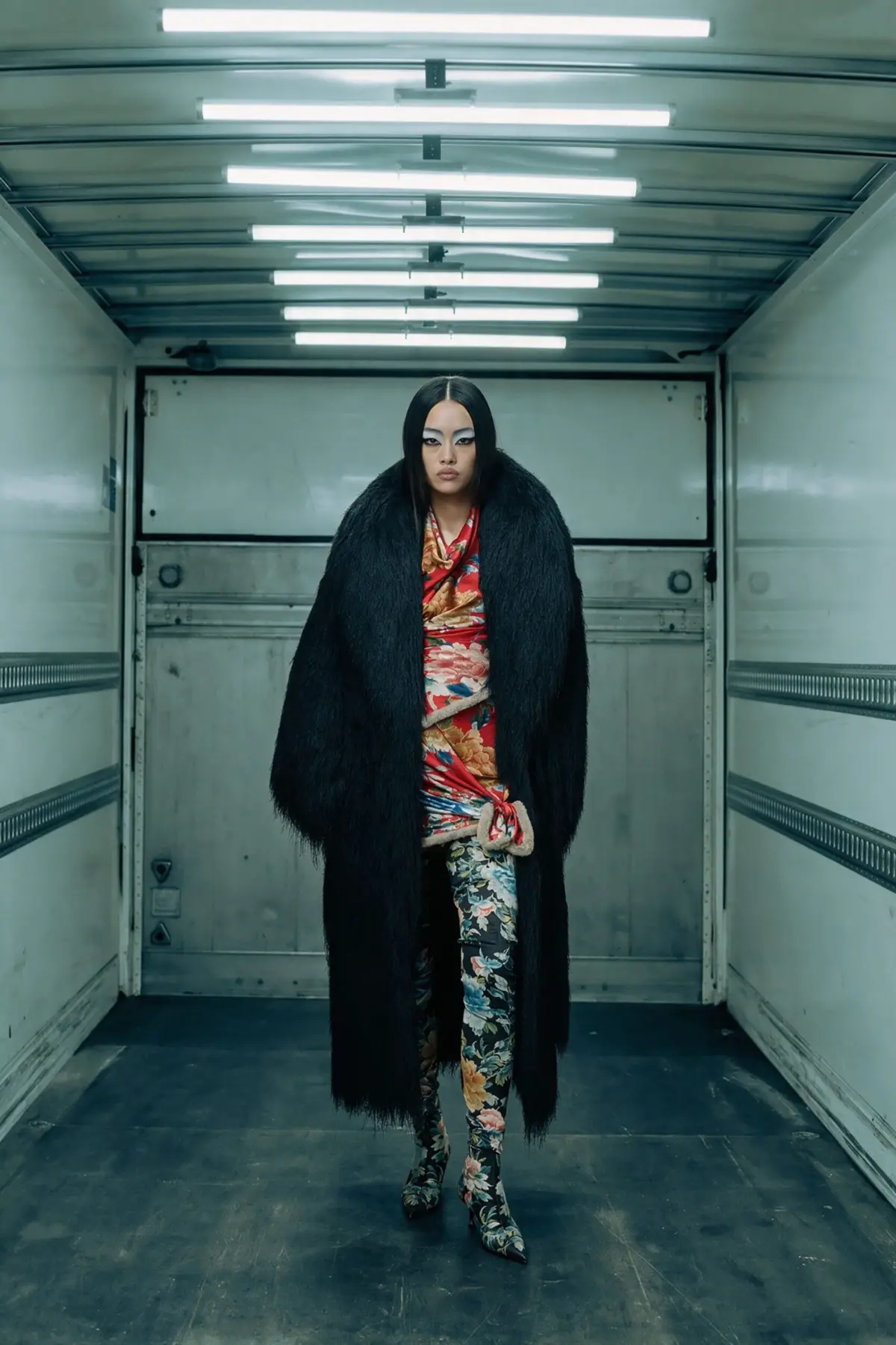
This cross-cultural synthesis was immediately visible in the intricate textiles and silhouettes. Richly drawn floral motifs executed in the traditional huaniaohua style appeared across draped tops, structured skirts, and wrapped bandeaus. Each of these pieces was sharply edged in fake fur, adding a tactile, luxurious contrast. The motif also extended downward, appearing dramatically on high-heeled boots that reached well north of the thigh, creating an unbroken line of ornate print and texture.
Another dominant theme running through the collection was silk twill fringe. This dense, fluid material was used to heavily cover cocooning evening coats featuring beefy, architectural shawl lapels that added a sense of protective volume. The fringe also defined a floor-length strapless dress, engineered with just a hint of a subtle hourglass shape built into its clean lines. A mod-ish, straight-line skirt-and-top set utilized the same treatment, demonstrating the versatility of the textile.
Tailoring also received an inventive, avant-garde overhaul. A classic tuxedo jacket was entirely reimagined as a sort of mini wrap dress, its traditional vented back elongated and swept out into something resembling a sleek fishtail. This striking piece was shown alongside a lustrous two-piece evening gown anchored by a cropped, boxy top whose structural inspiration was drawn quite literally from a simple pillowcase. Taken together, these designs revealed a rare level of elegance and refined maturity—an old-world glamour that fashion enthusiasts do not always associate with Wang, who is historically known for his casual, effortless cool-girl aesthetic.
Despite the elevated grandeur of these pieces, those more familiar, street-smart threads were far from forgotten. They re-emerged forcefully in the second half of the collection, which was titled “Hybrid State.” This portion of the lineup was built around witty concepts of pre-styled garments executed with a slight wink toward fashion irony.
A jean jacket and matching skirt, for instance, were ingeniously designed to look as though they had been twisted completely upside down, challenging conventional perceptions of everyday denim. The pre-styled concept also manifested in a clever single piece engineered to look precisely like a delicate camisole layered effortlessly over a long-sleeve T-shirt, sparing the wearer the task of coordinating separates.
Other standout items brought the collection right back to Wang’s unmistakable downtown element. A pair of dark, roomy trousers featured a loose, cascading ruffle running down the side, introducing movement and unexpected softness to utilitarian tailoring. A nerdy, academic-style cardigan was given a high-fashion jolt by being spiffed up with an argyle print painstakingly picked out in crystals. Meanwhile, simple T-shirts were printed with airbrushed graphics depicting Peking opera performers, finished with a subtle smattering of sparkle that tied back to the collection’s theatrical roots. These hybrids of high and low happened to rank among the most successful and cohesive pieces in the entire lineup.
Reflecting on the creative journey that led to this diverse and ambitious body of work, Wang pointed to a deliberate exploration of unfamiliar cultural touchstones.
“It’s an evolution of the last collection,” Wang explained, discussing the underlying philosophy of the resort line. “And thinking about rituals, traditionalism, these things we haven’t really explored before as a visual language. I wanted to think, ‘How do we approach these?’ I’m always interested in things that feel foreign to us and then bringing it in. Even though these things can look very dressed-up, is there a way we can bring them into the everyday?”
By successfully merging the centuries-old theatricality of Peking opera with the relaxed, contemporary rhythms of New York City street style, Wang has answered his own question. Within the echoing, domed expanse of the newly minted Wang Contemporary, the designer charted a confident path forward, proving that the worlds of traditional opulence and downtown cool are not mutually exclusive, but rather part of an ongoing, compelling evolution.