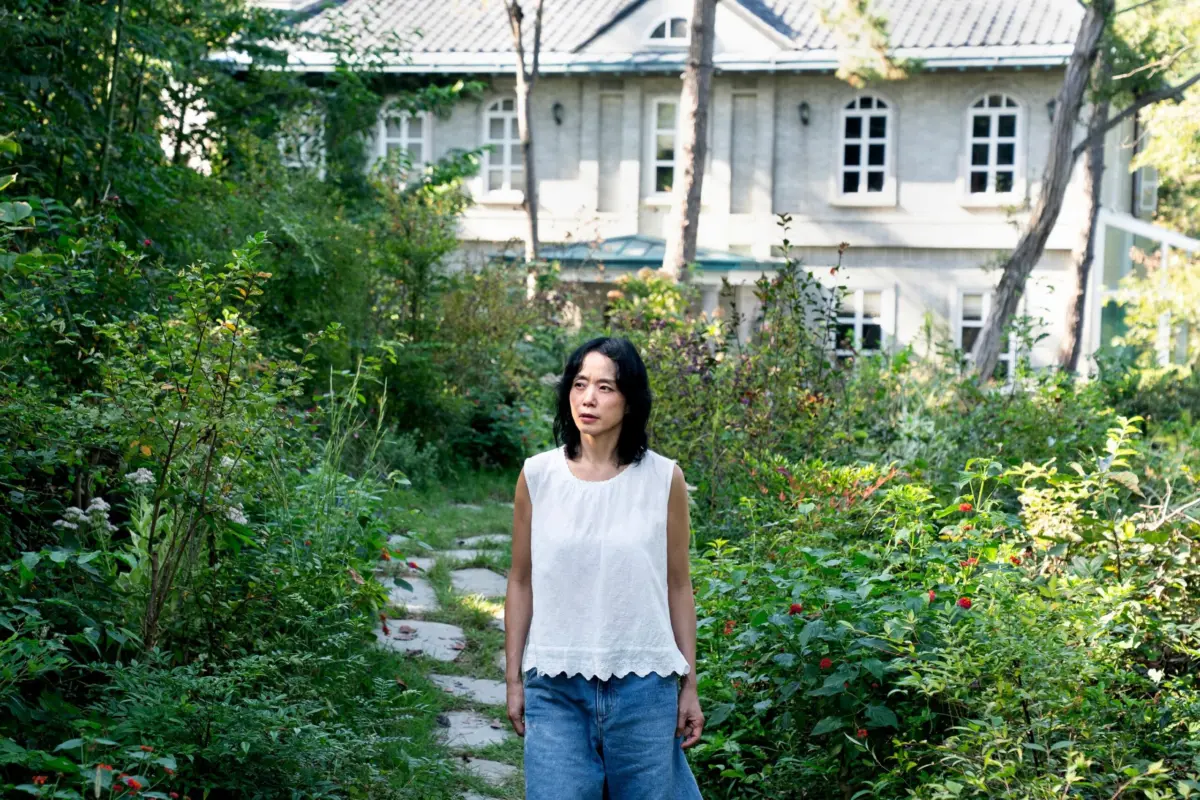
In the nearly three decades since she made her memorable big-screen debut in 1997’s The Contact, Jeon Do-yeon has earned a richly deserved reputation in South Korea and far beyond as an actor who inhabits her characters so completely that the performance ceases to feel like acting at all. International audiences likely know her best for her tour de force in 2007’s Secret Sunshine, a wrenching, unforgettable portrait of a grieving mother that made her the first Korean performer ever to win a prestigious acting prize at the Cannes Film Festival.
Critics frequently reach for the word “fearless” to describe her unwavering commitment to difficult emotional territory, but when speaking via Zoom at the tail end of a marathon press day in Seoul, Jeon quickly waves that notion away.
“I’m always scared, and I’m full of fear, especially in front of the camera,” she says with a light laugh. “I’ve been working as an actor for quite some time, but it’s an ongoing process.” In fact, it remains deeply important to her artistic integrity that she never allows herself to get too comfortable in her craft. “I actually enjoy having that fear and anxiety, and trying my best to work through it, because sometimes something completely new comes out of that struggle.”

That profound willingness to sit in discomfort is vividly and devastatingly evident in Possible Love, which is out now on Netflix following a theatrical run last October and has recently been selected as South Korea’s official submission for the 2027 Academy Awards. The film marks the long-awaited return of legendary auteur Lee Chang-dong—arguably best known for his hypnotic 2018 masterpiece Burning, which became the first Korean movie ever shortlisted for the best international feature Oscar and topped critics’ year-end lists across the West—after an eight-year hiatus. It also serves as a poignant reunion for Jeon and Lee nearly 20 years after their historic collaboration on Secret Sunshine.
Constructed with Lee’s signature novelistic sweep, Possible Love centers on the complicated, fraught dynamic between two married couples from starkly different strata of contemporary Korean society. Jeon stars as Mi-ok, a pragmatic mask-factory worker living quietly with her young son and her husband, Ho-seok, who is portrayed by Jeon’s frequent screen partner Sul Kyung-gu. Years after a devastating mass factory layoff and a violently suppressed labor strike, Ho-seok remains deeply haunted by the physical and psychological trauma. When the funeral of a former co-worker brings them into the unexpected orbit of Ye-ji, played by Cho Yeo-jeong—best known as the wealthy mother in Bong Joon-ho’s Oscar-winning Parasite—and her wealthy
, enigmatic husband Sang-woo, played by Zo In-sung, Mi-ok reluctantly agrees to let Ye-ji film their daily lives for a documentary chronicling laid-off laborers.
Yet what begins as a traditional study of liberal empathy and a moving portrait of across-the-divide solidarity gradually warps into something far stranger and more ambiguous. The narrative meticulously explores the hidden fault lines of privilege, suppressed desire, and the uncomfortable ethics of voyeurism.

Oscar buzz has swirled around Jeon’s performance—a stunning, powerfully subtle tightrope walk of stoicism and simmering longing—since the film premiered at the Venice Film Festival in September. However, Jeon remains pragmatic about what all this international fanfare actually signifies for her career and personal life.
“When I won the award at Cannes 20 years ago, I remember thinking, Is this going to change my life? Probably not. Am I going to change as an actor because I have a Cannes award?” she reflects. “I’m very happy that we’re competing at the Oscars, and it’s wonderful that people are talking about the film, but I don’t think it will change me or the way I perform in any way.”
Reflecting on the journey of bringing the film to global audiences via Netflix, Jeon shares her thoughts on the immediate aftermath of its streaming release. “I watched the movie once again as soon as it was on Netflix,” she notes. “I think Possible Love is a type of movie that leaves a different afterglow for different people, and people can analyze it differently and interpret it in endless ways. Now that it’s on Netflix, I feel like people are finding their own ways to think about the movie—it leaves a lot of food for thought. I’m very proud that people are talking a lot about it.”
Discussing the origins of the project, Jeon sheds light on the immense gestation period behind the script. Director Lee Chang-dong worked on the project for a remarkably long time, holding the core concept in his mind for more than a decade. Ten years ago, his initial focus was on exploring the lives of a laid-off worker and his wife. Over the years, that narrative sometimes diverged into different paths or was temporarily scrapped, resulting in numerous different versions along the way. For Jeon, simply knowing that Lee was finally committing the story to a finished script made the anticipation palpable.

When she finally read the screenplay, the decades of thought and effort poured into it by the director were immediately tangible. Recognizing the unmistakable artistic fingerprint of a Chang-dong film, Jeon was immediately drawn to her character, Mi-ok. She observed that beneath Mi-ok’s seemingly fragile or weak exterior lies a well of deep inner strength, driven primarily by an underlying anxiety that stems from her fierce desire to protect the people and things she loves.
One of the most striking elements of Jeon’s performance is its physical precision—the specific, guarded way Mi-ok holds herself, which communicates volumes about her internal state without the need for excessive exposition. Working with Lee, however, required unlearning conventional preparation habits. Knowing Lee’s collaborative style, Jeon understood that the director consistently stresses emptying the mind as an actor, encouraging performers not to intellectually express a character, but to genuinely feel them from within. Her preparation process was largely focused on becoming deeply accustomed to her character’s dialogue so that it felt entirely natural, as if Mi-ok were speaking directly through her.
The film also relies heavily on the profound, long-standing creative partnership between Jeon and Sul Kyung-gu. Having worked together more frequently than with any other actor in her career, Jeon notes that their real-life friendship and mutual trust provided a sturdy foundation for portraying the complexities of a long-term marriage. Even with their deep familiarity, Sul’s transformation into Ho-seok continually revealed surprising new facets of his artistry on set, eliminating the need to force the chemistry of a weary married couple.
In contrast, Possible Love marked Jeon’s first time working with Cho Yeo-jeong. The intricate dynamic between Mi-ok and Ye-ji—oscillating delicately between genuine sisterhood and a transactional arrangement—was intentionally left unexplored prior to production. True to Lee Chang-dong’s directing philosophy, the actors entered the set without rigid biases, prejudices, or overly rehearsed interpretations of their characters. Lee actively avoids excessive rehearsals or rigid pre-planning, preferring instead to capture the raw, unscripted chemistry and lively conversations that emerge organically when actors encounter a scene for the very first time. In Possible Love, Mi-ok initially views Ye-ji’s documentary camera as a protective shield and a source of hope for her family, only to find a widening, insurmountable wall growing between them as their lives intertwine.

While Korean cinema has experienced an unprecedented explosion in global popularity over the past decade, Jeon maintains a grounded perspective on her place within this international wave. She harbors no deliberate ambitions of "going global" as a personal career strategy, yet she expresses profound joy in the ability of Korean storytelling to transcend linguistic and cultural borders, connecting emotionally with audiences worldwide.
That universal resonance is particularly striking given the hyper-local inspiration behind Possible Love. Rooted in a specific Korean labor tragedy, the narrative deals with the hollowing out of industrial working-class communities—a painful economic reality recognized by people all over the world. During production, the cast and crew occasionally wondered whether a story devoid of dramatic action-movie catalysts, focusing purely on the quiet emotions of four individuals, would successfully translate for an international audience on a platform like Netflix.
However, international screenings quickly put those initial concerns to rest. Jeon realized that the plight of laid-off workers is a universal human struggle still unfolding across many parts of the globe, allowing non-Korean viewers to deeply resonate with the film’s core themes. Pointing to the lingering image of the moon at the very conclusion of the film, Jeon notes a simple, unifying truth that anchors the entire project: it is an image accessible to anyone, anywhere in the world.