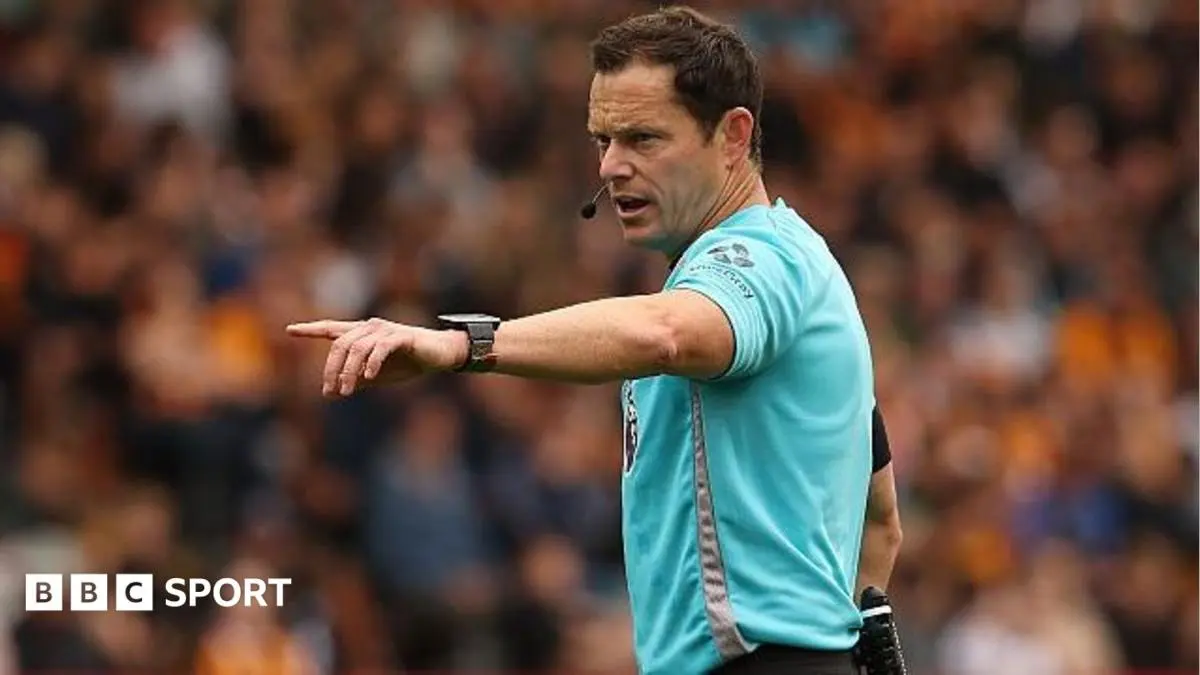
If anyone can truly speak to the visceral, high-stakes nature of modern professional refereeing—with all its agonizing lows and exhilarating highs—it is Darren England. To understand the 40-year-old official’s current standing in the game, one must look back three years to a moment of professional crisis that would have derailed the career of a less resilient individual. In 2021, while serving as the Video Assistant Referee (VAR) during a high-profile clash between Tottenham Hotspur and Liverpool, England became the face of one of the most infamous officiating blunders in Premier League history.
The incident involved a goal scored by Liverpool’s Luis Diaz, which was incorrectly flagged for offside. Despite the technological clarity provided by the VAR imaging—which clearly showed Diaz was onside—a lapse in concentration led England to communicate the fateful words: "check complete." The error stood, the goal remained disallowed, and the fallout was immediate. Suddenly, the South Yorkshire official found himself thrust into the white-hot glare of intense media scrutiny, a spotlight that did not stop at the touchline but extended to his private life and his family.
"Refereeing is about low points and high points," England tells BBC Sport, reflecting on the cyclical nature of his profession. "It’s a rollercoaster of emotions. That was a low point. The lowest point, of course."
Today, however, that narrative has been rewritten. England has successfully navigated the long, arduous road to redemption, emerging as one of the most trusted officials in the Premier League. His technical proficiency on the field and his ability to navigate the complex demands of the VAR booth have seen him consistently appointed to English football’s most prestigious fixtures. Most notably, he was chosen to officiate the 2026 FA Cup final, where he oversaw Manchester City’s 1-0 victory over Chelsea. For England, that afternoon at Wembley was not just another assignment; it was the ultimate vindication. "We flip it," England says, referencing the contrast between his darkest hour and his recent triumph. "That was a huge high for me, the pinnacle as a referee."
The momentum of his resurgence continues this week, as England prepares to take his expertise to the European stage. On Tuesday, he will serve as a VAR for the first time in the UEFA Champions League, officiating the encounter between Galatasaray and Stuttgart. It is a promotion that signals his complete return to the upper echelons of the sport.
The landscape of football officiating has shifted dramatically in the 11 years since England transitioned from an assistant referee with a flag to a central official with a whistle. He describes the modern referee as being "dressed like RoboCop," a nod to the sophisticated array of communication equipment and biometric tracking devices now integrated into their match-day kits. Yet, the most profound disruption has been the arrival of VAR, a technology that was still in its infancy when England refereed his first Premier League match—a Southampton versus Wolves fixture in January 2020.
Despite the controversies that often trail the technology, England maintains a pragmatic view of his role. "It’s certainly not changed the way I make decisions," he insists. "If I play on on a penalty decision, some people think the perception is ‘oh you’re waiting for VAR to get involved.’ No, I’ve played on because I don’t think it’s a penalty. But I would rather be driving home from a game now thinking, ‘OK, I misread it live, I’ve had the opportunity to go to the screen and we’ve corrected it.’"
England is quick to dismantle the pervasive myth that referees are detached, unfeeling bureaucrats who lack passion for the game. He argues that the emotional weight of a bad call is often underestimated by the public. "It couldn’t be further away from the truth," he says. "It’s a myth that we go home, we switch off. It spoils your weekend if you make a decision that’s had a big impact in the game. It can spoil it for longer, of course."
He speaks from experience. During the infamous Liverpool-Tottenham incident, the VAR audio revealed that England and his assistant, Dan Cook, realized the gravity of their mistake almost immediately. Yet, with only 34 minutes elapsed, they were forced to endure another hour of officiating under immense psychological strain. "Once I realized I’d made the error, it’s a really difficult place to try to forget that and move on," England admits. "I can’t just physically stand up and walk out and leave it alone. A lot of resilience was needed—a lot of experience as well."
The VAR environment itself is a crucible of pressure. England describes the hub as a "sanitized" and high-intensity space where "mental fatigue" is a constant adversary. Without the natural buffer of the crowd’s atmosphere, officials are left in a clinical, pressurized silence. "You don’t have the atmosphere of the crowd," England explains. "You hear some of the crowd sometimes, but it’s just a noise. When you’ve had a busy match, you’re constantly checking everything. You can come out of the hub sometimes and mentally you’re exhausted."
The aftermath of the Diaz error was a period of severe professional and personal turbulence. The story dominated headlines, radio phone-ins, and social media for days, with Liverpool publicly stating that the "sporting integrity" of the game had been "undermined." For England, the invasion of his privacy was the most painful consequence. Photographers camped outside his children’s school, details about his home were published, and personal family photographs were lifted from social media accounts.
"The aftermath obviously was really difficult to deal with," he says. "It was challenging because it’s the goldfish bowl of the Premier League. But when mistakes happen, then you’re in the public eye and criticism’s inevitably going to come your way. That was difficult because it affected my family as well. We had people outside my girls’ school, journalists and things like that. That then affects you not as a referee, but as a human being."
Following the incident, England was removed from active duty, beginning a slow and deliberate process of rehabilitation. He did not referee in the top flight for three months, and it was over six months before he returned to the VAR room. Throughout this period, he leaned heavily on support from the Professional Game Match Officials Limited (PGMOL), his family, and a sports psychologist. "I did a lot of work with a sports psychologist," he notes. "The support, not just from Pro Ref but more importantly family and friends, was really crucial. It’s about perspective as well. There’s a danger that we can think we’re saving lives at times, but we also realize how important it is."
This period of reflection allowed him to regain his footing. He remained focused on his fundamental competence, reminding himself that for all the noise surrounding one catastrophic error, he had successfully navigated hundreds of other high-pressure decisions correctly. That focus has seen him return to the center of the biggest calls in the game, including the controversial stoppage-time decision that saw a West Ham equalizer against Arsenal disallowed in May—a moment widely cited as one of the most significant VAR interventions in recent memory. England handled the situation with the calm, methodical approach that has become his hallmark.
His peers have noticed. At a recent training camp at Loughborough University, Hugh Dallas, the Professional Referee Group director, interrupted a session to highlight England’s progress. Describing him as a "role model," Dallas presented England with a commemorative plaque and medal for reaching 100 top-flight appearances. The room erupted in applause, a clear signal of the respect he has reclaimed among his colleagues.
England’s path to the top is rooted in a deep, lifelong connection to the game. Growing up in Royston, near Barnsley, he qualified as a referee at 15. Before his career took off, he worked in the Barnsley academy, balancing coaching duties with refereeing. Eventually, he had to choose between a career in coaching or officiating; he chose the whistle. After initially making the Premier League as an assistant, he made the bold decision in 2015 to start over as a central referee in the National League, betting on his own potential. Within four and a half years, he was back in the Premier League.
Now, with his Champions League debut approaching, England is looking toward the future. He acknowledges that the scrutiny of the modern game is unrelenting—even at the school run, he finds himself questioned by parents about officiating decisions. Yet, he remains grounded, having made the personal choice to avoid social media to protect his mental headspace.
"When I don’t have targets, that’s probably time to come off the field," England says. With his sights set on further honors—including the Carabao Cup and the Championship play-off final—the official who once faced the prospect of a career-ending crisis is now firmly in command of his own destiny. Having weathered the storm, England is proving that the mark of a true professional is not in avoiding mistakes, but in the capacity to rebuild, learn, and return to the highest level.