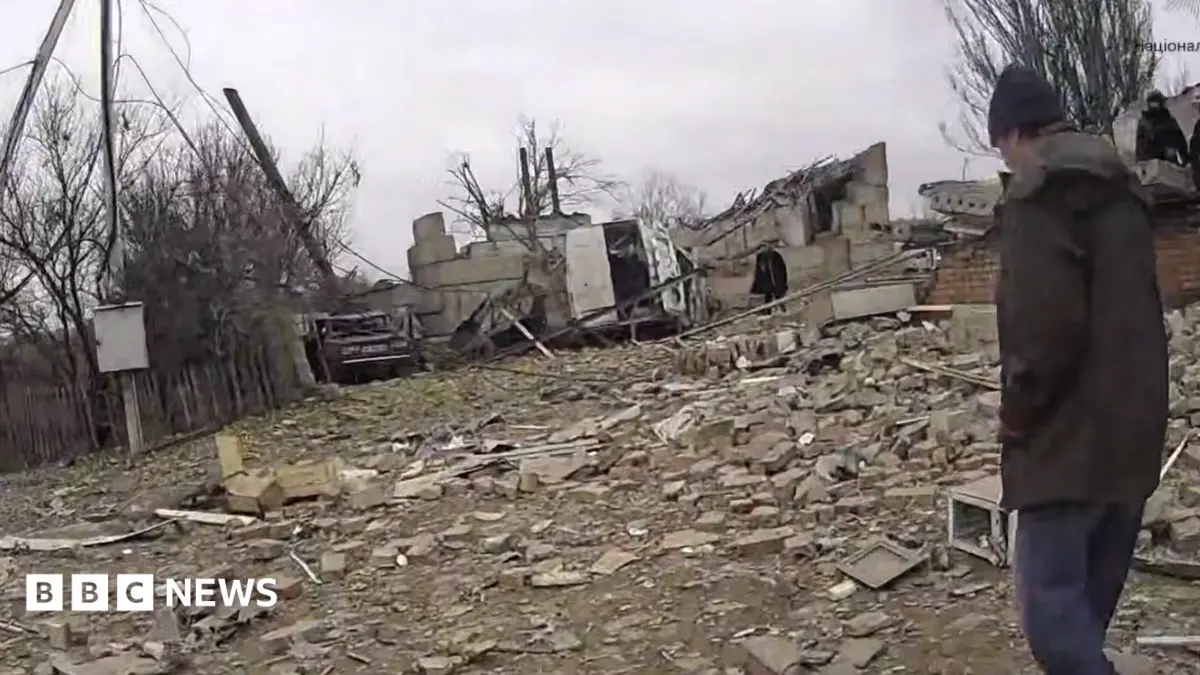
Newly released bodycam footage from Ukraine’s national police has provided a harrowing, first-person perspective of the brutal reality facing civilians in the Zaporizhzhia region. The video, published by authorities on Wednesday, captures the immediate aftermath of a Russian aerial bombardment in the village of Kamyshuvakha, offering a stark visual record of what Ukrainian officials are characterizing as a calculated war crime.
The footage begins amidst scenes of total devastation. Following an initial bomb strike, the camera pans across a landscape of mangled wreckage and shattered infrastructure. Shocked local residents are seen standing amidst the rubble, their faces reflecting the trauma of an attack that struck the heart of their community. In the background, severely damaged buildings—many of which once served as essential community hubs—stand as skeletal reminders of the strike’s intensity.
The atmosphere in the video shifts rapidly from stunned recovery to frantic survival as the audio captures a voice over a two-way radio. A military official, monitoring the situation, delivers a chilling warning to the police officers on the ground: more glide bombs are currently inbound toward the village.
The urgency of the situation is palpable as a police officer, realizing the imminent danger, begins shouting instructions to the civilians nearby. "Quickly, to the shelter!" he commands. The footage shows residents rushing toward safety, descending into a bunker located at least two floors underground. However, the respite is cruelly short-lived. Seconds after the civilians and officers disappear into the subterranean structure, the facility is struck directly. The recording cuts to black abruptly, leaving the fate of those inside to the harrowing silence that follows the blast.
Ukrainian authorities have confirmed that the shelter was located in the immediate vicinity of a local school, which had been repurposed as a distribution point for humanitarian aid. This detail adds a grim layer to the incident, as the location was specifically serving the needs of the vulnerable population. BBC Verify has independently corroborated the location of the footage, confirming it aligns with visual evidence previously released by the Ukrainian State Emergency Service (DSNS) regarding the aftermath of the attack, which occurred on Monday.
The scale of the Russian assault was underscored by Ukrainian President Volodymyr Zelensky in a social media statement released on Wednesday. Zelensky reported that a total of nine aerial bombs were deployed by Russian forces during the offensive. According to the president, the tactical approach appeared to be a “double-tap” strategy: the first strike targeted civilians gathered to receive humanitarian aid, while the subsequent strikes were aimed at the rescuers and police officers who had arrived at the scene to provide emergency assistance.
In his remarks, Zelensky expressed deep frustration over the lack of international outrage regarding the incident. "Unfortunately, there has been very little reaction from the world to this insane attack," he noted, categorizing the event as another entry in a catalog of thousands of alleged war crimes committed since the Russian invasion began. The DSNS also released separate imagery showing the massive crater left in the wake of the bombardment, illustrating the sheer destructive power of the munitions used against the village.
As of Wednesday, the Russian military has provided no public comment regarding the attack on Kamyshuvakha. The silence from Moscow follows the established pattern observed since President Vladimir Putin ordered the full-scale invasion of Ukraine in February 2022, a conflict that has transformed entire swaths of the country into active battlegrounds.
While the situation on the front lines remains dire, diplomatic efforts are moving in parallel, albeit under a cloud of uncertainty. On Wednesday, President Zelensky disclosed that he had engaged in an extensive, hour-and-a-half-long conversation with peace envoys representing US President-elect Donald Trump, specifically Steve Witkoff and Jared Kushner. This dialogue serves as a precursor to high-stakes trilateral negotiations involving Ukraine, Russia, and the United States, which are scheduled to take place in Abu Dhabi on November 10–11.
Zelensky, who is currently conducting a surprise visit to Spain, also reported that his team had engaged in "meaningful" meetings in Brussels. These discussions involved representatives from the United States, the European Union, France, Britain, Germany, as well as NATO and the World Bank. The primary focus of these talks was the complex logistics of post-war reconstruction. Zelensky indicated that the deliberations in the Belgian capital were set to continue through Thursday, with a particular emphasis on establishing robust "security guarantees" for Ukraine.
The diplomatic landscape remains fragile. Since the previous iteration of trilateral talks aimed at ending the hostilities was suspended in February, the intensity of the conflict has surged. Moscow has aggressively escalated its offensive operations, a move that coincides with reports that Kyiv’s stockpiles of Western-supplied missile interceptors have reached critical lows. This shortage has left Ukraine’s air defenses increasingly strained, making cities and villages more vulnerable to the types of aerial bombardment seen in Kamyshuvakha.
Security analysts and diplomats alike are exercising caution regarding the upcoming summit in the United Arab Emirates. With deep-seated animosity between Kyiv and Moscow and the shifting priorities of international partners, few observers expect a major breakthrough when the talks resume. The gulf between the parties—defined by conflicting visions of sovereignty and security—remains as wide as it was when the talks were initially paused.
For the residents of villages like Kamyshuvakha, the high-level diplomacy in Abu Dhabi and Brussels remains a distant reality compared to the immediate, visceral threat of falling munitions. As the war enters this latest, volatile phase, the footage released by the national police serves as a stark reminder of the human cost that continues to mount in the absence of a viable peace. The imagery of civilians fleeing to an underground shelter, only to be met with further destruction, encapsulates the precarious nature of life for those living under the shadow of the ongoing Russian invasion.
As the international community watches, the dual tracks of war and diplomacy continue to move at disparate speeds. While Kyiv works to secure the financial and defensive support necessary to survive the coming winter, the tactical realities on the ground—characterized by the use of glide bombs against civilian aid centers—continue to challenge the prospect of a near-term resolution. The reports from Kamyshuvakha are expected to be raised in various international forums, yet whether such documentation of the conflict’s toll will shift the diplomatic needle remains an open question as the November negotiations draw near.