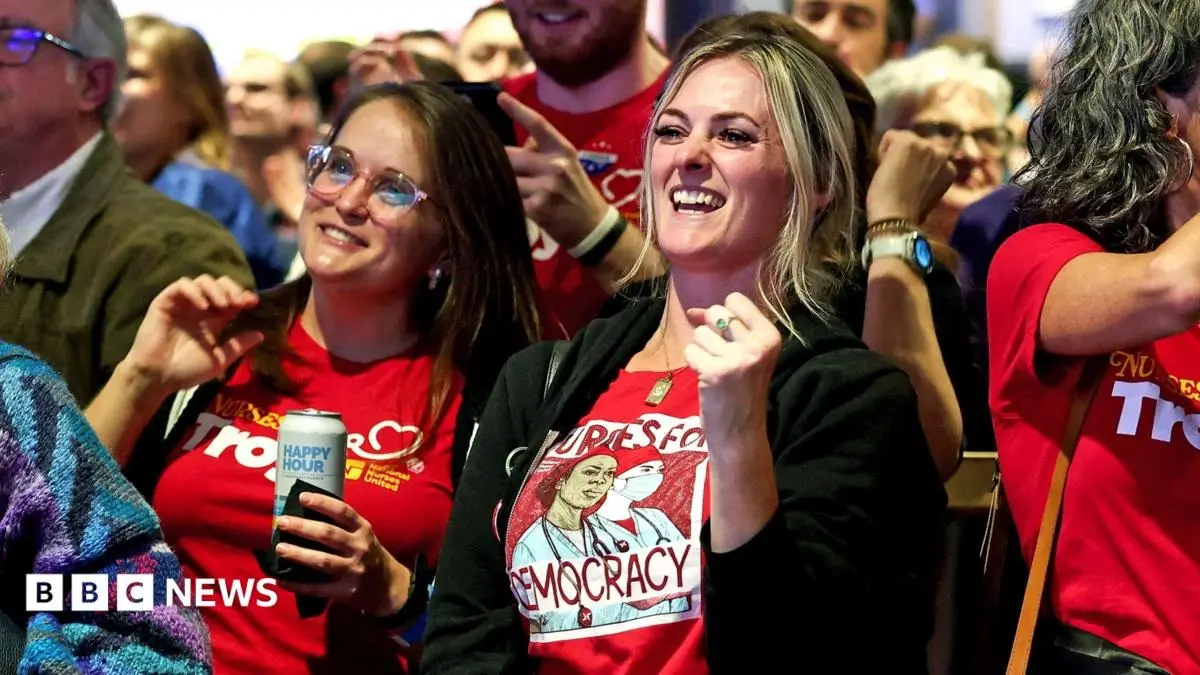
In a seismic shift that will reverberate through the corridors of power for years to come, the Democratic Party has effectively dismantled Donald Trump’s political map. On a night defined by historic upsets and a sweeping rejection of the status quo, a "blue tidal wave" crashed across the United States, dismantling the Republican grip on Congress and signaling a profound realignment of the American electorate.
Halfway through the second term of President Donald Trump’s presidency, the political landscape has been fundamentally altered. Democrats have secured decisive control of the House of Representatives and have successfully wrestled a majority back in the Senate. This shift provides the opposition party with the legislative machinery to aggressively challenge the president’s agenda, initiate sweeping investigations into the administration’s conduct, and potentially revive the specter of a historic third impeachment attempt.
The scale of this outcome was largely unforeseen just months ago. Following President Trump’s return to the White House in January 2025, the Republican Party enjoyed unified control of Congress, an era that supporters expected would cement a conservative legacy for a generation. Yet, as the public mood soured amidst concerns over trade policies, immigration, and an escalating conflict in Iran, the political winds shifted. While Democrats entered the cycle with high hopes of retaking the House, the Senate map had appeared dauntingly unfriendly, populated by states that had comfortably backed Donald Trump only two years prior.
Instead, the reality of election night defied every conventional political equation. Democrats secured victories in states that had been reliably Republican for decades—and in the case of Kansas, nearly a century. The results in Texas, Maine, Kansas, Ohio, Iowa, and both Carolinas suggest a national repudiation of the president’s governing style.
A Tense Relationship with the White House
In the immediate aftermath of the results, the tone from the White House was notably mixed. In comments provided to the BBC’s US partner, CBS, President Trump struck a surprisingly conciliatory note, suggesting he was prepared to strike deals with congressional Democrats. He remarked that he hoped to avoid the legislative gridlock that would force him to spend the final two years of his term vetoing the opposition’s bills.
However, that spirit of cooperation evaporated almost as quickly as it had appeared. Shortly after his initial remarks, the President took to Truth Social, posting an image of his iconic red "Make America Great Again" baseball hat, this time emblazoned with the word "Veto." In subsequent commentary, Trump attempted to distance himself from the electoral fallout, asserting that because his name was not on the ballot, the results were not a direct reflection of his personal popularity. He insisted that had he been running for re-election, Republicans would have achieved a decisive victory. This claim, however, ignored the reality that the President had been the central figure of the campaign, personally elevating many of the Republican candidates who fell on Tuesday and urging voters to treat the midterms as a referendum on his leadership.
The Senate Reconfigured
The Senate outcome represents the most significant blow to the Republican agenda. Democrats flipped at least six seats, moving from a position of relative weakness to one of firm control. The geographic breadth of these victories was particularly striking.
In Kansas, Adam Hamilton secured a victory in a state that had not sent a Democrat to the U.S. Senate since the Great Depression. This result alone serves as a barometer for the national mood. Meanwhile, in Texas, James Talarico defeated Republican incumbent Ken Paxton, putting an end to a 38-year losing streak for Democrats in statewide races within the Lone Star State.
The electoral carnage extended to states that had long been considered Republican strongholds. In South Carolina, Annie Andrews defeated Darline Graham, who had been appointed to the seat following the death of her brother, Senator Lindsey Graham. Analysts had largely written off the seat as a safe Republican hold only months prior. In Maine, five-term Republican Senator Susan Collins conceded her seat to Democrat Troy Jackson, a major loss for the moderate wing of the GOP.
The Midwest also proved to be a hotbed for Democratic gains. Paralympic athlete Josh Turek successfully flipped the Iowa Senate seat vacated by the retiring Senator Joni Ernst. In Ohio, Sherrod Brown staged a remarkable comeback, defeating Jon Husted. As of late Tuesday, Democrat Abdul El-Sayed appeared to be on a clear path to victory over Republican Mike Rogers in the fiercely contested Michigan Senate race, further padding the Democratic majority.
A Seismic Shift at the State Level
The disruption was not confined to the halls of the federal government; the gubernatorial races saw a similar overturning of established power. Texas, often cited as a bastion of conservative politics, witnessed a major upset as Democratic challenger Gina Hinojosa ousted incumbent Greg Abbott, a man who had been viewed as the prohibitive favorite as recently as the spring.
Beyond Texas, the trend of Democratic governors winning in competitive states continued in Iowa, Ohio, and Georgia. The victory in Georgia was particularly historic, as the state elected the nation’s first Black woman to the office of governor. These gubernatorial wins suggest that the Democratic surge was driven by a deep-seated desire for change that transcended specific legislative contests.
The House Majority and the Demographic Shift
The House of Representatives will see a new power dynamic when the next session convenes, with Democrats projected to hold 245 seats compared to the Republicans’ 166. This is the first time since 2022 that Democrats have held a majority in the lower chamber.
The reasons for this victory are found in the shifting loyalties of key demographic groups. The strategy of focusing on mobilization paid off, as Black voters in Southern states turned out in record numbers to support Democratic candidates. Perhaps more surprising was the reversal of trends among Hispanic voters. While these voters had played a significant role in securing Donald Trump’s presidential victory in 2024, they swung back toward the Democrats in this cycle.
Democrats achieved a clean sweep in all three House races situated along the overwhelmingly Hispanic congressional districts of the Texas-Mexico border. Furthermore, these voters proved instrumental in allowing Democrats to retain House seats in Florida—districts that Republican strategists had specifically targeted by redrawing district lines to favor their party.
Ultimately, the aggressive redistricting efforts undertaken by Republicans in the lead-up to the election failed to deliver the expected gains. In Texas, where Republicans had hoped their map would net them five additional seats, the party actually faced a net loss.
A Rare Silver Lining and the Path Forward
If there is any comfort for the Republican Party, it remains in the "Sunshine State." Florida continued to tilt to the right, with Senator Ashley Moody narrowly winning re-election and Byron Donalds securing a victory to become the state’s first Black governor. Additionally, embattled Republican incumbents were able to hold onto the governorships in Vermont and New Hampshire. However, in the context of the national results, these were isolated bright spots in an otherwise bleak evening for the party.
Just two years ago, Donald Trump won the presidency with 48% of the popular vote. He interpreted that result as a firm mandate to pursue a robust, conservative agenda. He pushed through contentious trade policies, implemented stringent immigration measures, and navigated a foreign policy centered on an escalating confrontation with Iran—a move that remained deeply unpopular with a majority of the American public.
On Tuesday, the electorate delivered its verdict. It was a stinging, comprehensive rebuke that has effectively halted the momentum of the Trump administration. As the dust settles, the Republican Party faces the daunting task of soul-searching in the shadow of a political map that has been decisively torn up, leaving the Democrats in control of the legislative agenda and the future of the nation’s political discourse.