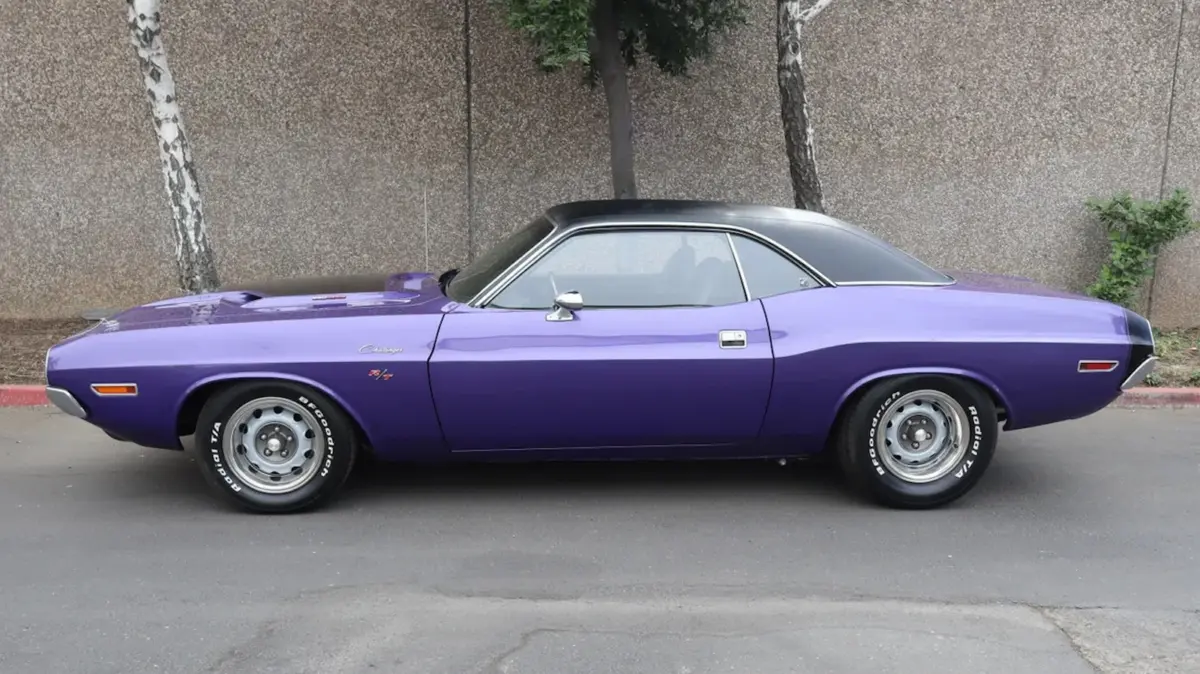
It was not all that long ago that a different, remarkably clean, Plum Crazy 1970 Dodge Charger caught the attention of automotive enthusiasts on the used market. Now, a Challenger R/T from the very same model year and wearing the exact same iconic high-impact paint code has surfaced for sale, proving that striking purple hues and classic Mopar muscle never truly go out of style.
Spotted recently on Hemmings Classifieds, a 1970 Dodge Challenger R/T has appeared with 96,199 miles indicated on its odometer. The vehicle is currently being offered by Ryle’s Rides, a dealership located in Sacramento, California, which has attached an asking price of $69,995 to the classic coupe. For collectors and enthusiasts tracking the valuation of vintage American performance cars, this particular E-body presents an intriguing mix of factory heritage and period-correct mechanical updates.
According to the official factory fender tag affixed to the vehicle, this Challenger R/T was not born with the engine it currently sports beneath its hood. Out of the assembly plant, the car was originally powered by a 383-cubic-inch Magnum V8 engine, which was mated to a four-speed manual transmission. However, somewhere along the timeline of its nearly fifty-five-year existence, someone elected to pull the original powerplant and drop in a larger 440-cubic-inch big-block V8 sourced from a 1969 model.
This larger displacement motor brings several tasteful enhancements to the engine bay. The power plant is equipped with an aluminum intake manifold, a four-barrel carburetor, and polished chrome valve covers that add a traditional custom touch under the hood. Additionally, the cooling system has been upgraded with a modern aluminum radiator, a sensible modification designed to help keep the big-block V8 operating at safe temperatures whether it is navigating modern traffic or cruising on warm summer days.
Despite the engine swap, the vehicle retains its driver-focused character through the inclusion of the original four-speed manual gearbox, which is now topped with a classic pistol-grip shifter that remains a favorite tactile feature for muscle car purists.
Visually, the car embraces its aggressive R/T persona with a striking exterior presentation. It features a contrasting black vinyl roof that complements the matching black center stripe painted across the hood. Authentic R/T badges adorn the bodywork, while the stance is anchored by traditional Rallye-style wheels wrapped in classic BFGoodrich Radial T/A tires with raised white letters. Inside the cabin, occupants are greeted by supportive bucket seats facing a classic wood-rim steering wheel, maintaining the authentic vintage atmosphere of early-1970s Chrysler interior design.
Worth 70 Grand?
To understand the context of this specific vehicle and its current market pricing, it helps to look back at the origins of the nameplate. The year 1970 marked the very first model year for the Dodge Challenger. This meant that Dodge entered the pony car market slightly later than some of its cross-town rivals, introducing the vehicle right as the broader muscle and pony car craze was reaching its historical zenith.
Upon its debut, the Challenger shared a notable family resemblance with the existing Plymouth Barracuda. This design overlap was far from accidental, as both iconic vehicles were constructed utilizing Chrysler’s newly developed E-body platform. Back in the showrooms of 1970, a base-model Challenger offered an affordable entry point into the segment with a starting price of just $2,850, whereas the more potent, performance-oriented R/T variant commanded a starting price of $3,266.
Translating those historical figures into modern economic terms through a standard inflation calculator yields roughly $25,000 for the base model and about $28,000 for the R/T specification in today’s money. To provide yet another contemporary reference point for how drastically vehicle manufacturing costs and market values have shifted over the decades, a modern spiritual equivalent—such as a two-door 2027 Dodge Charger Scat Pack—commands a base price starting at around $50,000, excluding destination charges and optional equipment. For perspective on the broader automotive market, even the least expensive compact passenger car that Kia offers in 2026 carries a starting sticker price of $27,075.
When measured against the landscape of modern vehicle pricing and the specialized nature of vintage collector cars, an asking price of nearly $70,000 for a clean, driver-quality classic Dodge Challenger R/T with a desirable big-block swap and iconic Plum Crazy paint might not be quite as extreme as it initially sounds. It reflects the enduring desirability of first-generation E-body Mopars, particularly those finished in Chrysler’s most famous High-Impact exterior
colors.