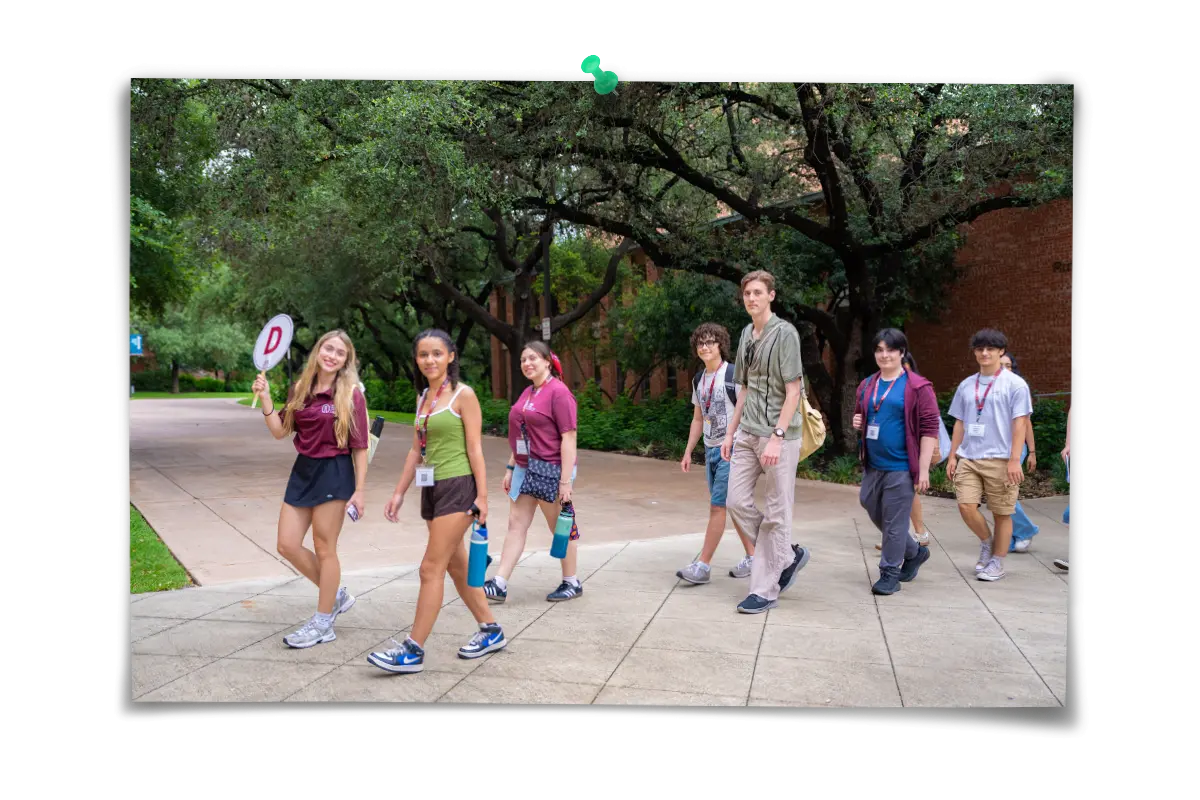
Rides in shiny, branded shuttles. Personalized parking spots and goodie bags. Free flights and hotel rooms across the country. Multithousand-dollar scholarships, and multimillion-dollar welcome centers.
These are some of the ways colleges and universities are investing heavily in campus tours and visits, operating under the shared conviction that new and improved experiences will successfully convince more prospective students who visit to eventually enroll.
Campus tours have long served as a vital mechanism for higher education institutions looking to capture the interest and loyalty of prospective students and their parents. However, during the height of the COVID-19 pandemic, when Americans broadly halted nonessential travel and avoided in-person events, some campuses launched virtual versions of their tours. This digital pivot raised pressing questions across the academic landscape about whether traditional, in-person campus tours might ultimately become obsolete.
Six years on from those early pandemic disruptions, families and higher education institutions alike appear to be in firm agreement: In-person campus visits are not only surviving, but they are more important than ever. Today’s high school juniors and seniors were sitting in elementary school classrooms when COVID-19 abruptly shut down schools nationwide, leaving much of their generation grappling with social deficits and, in various cases, mental health challenges whose impacts continue to linger. Consequently, the amorphous concept of the campus vibe—the pure, unfiltered energy of a normal day on campus that every standard tour seeks to capture—carries a profound and unique weight for modern college seekers.
“As a high school student, their knowledge and their perspective is really oftentimes limited to that which they can find—guides, rankings, U.S. News reports,” said Matthew Lysne, an Oregon-based lawyer who accompanied his daughter, now a freshman at a small liberal arts institution, on a rigorous cross-country college tour last year. His daughter certainly had preconceived notions about where she wanted to go, he noted, but “the thing that she thought would matter most ended up not being [as important]. And it was tours that ended up revealing that.”
Extensive studies have consistently found that whether or not a student physically visits a campus is one of the single strongest predictors of their eventual matriculation. Tours prove to be even more indispensable for smaller campuses striving to hit their targets. In a summer 2026 survey conducted by Niche, a prominent college rankings and insights company, a striking 92 percent of enrollment leaders at small colleges cited the campus visit as the single most important strategy for securing an incoming class.
Recognizing this high stakes environment, institutions across the country are intensely focused on jazzing up their tour experiences to stand out in a crowded market.
Take Hofstra University as a prime example. When admissions and enrollment leaders realized that it was logistically impossible to showcase their entire 244-acre New York campus in a single walking tour, they made a strategic investment in an old-fashioned trolley. Complete with authentic wooden seats and decked out vibrantly in Hofstra’s signature blue-and-gold color scheme, the trolley takes prospective visitors on a scenic, memorable trip through the grounds at the start of every tour. This innovation was designed as much to save prospective students’ feet from getting sore as it is to effectively convey Hofstra’s unique brand identity.
“The trolley is as charming as all of the trees—we are an arboretum—and that trolley kind of reflects the charm of our campus,” explained Jessica Eads, senior vice president for student enrollment, engagement, and success at Hofstra.
Enrollment leaders at several different campuses told Inside Higher Ed that these concerted efforts to improve their tour programs have significantly fueled student interest and generated major year-over-year increases in the sheer volume of tours they conduct annually. At Albion College, a small liberal arts institution located in Michigan, campus tours have increased by approximately 23 percent since 2022, marking the first year following the pandemic when in-person tour numbers returned to normal levels. Meanwhile, at John Carroll University, a Jesuit institution based in Ohio, tour volume has surged by an impressive 46 percent over that same comparative period.

“When you’re trying to make the decision about the institution that’s right for you, you can read asampunk as you want about it, or you can see that big school football game day atmosphere on TV,” said Mandy Konkle, vice president of enrollment management at Albion. “लेकिन actually being on campus, surrounded by the people that are going to be in classes with you, that are going to be teaching you—that gives you that feeling in your gut that tells you it’s the right place.”
Changing Priorities
Campus tours as structured institutional offerings have a history stretching back to the Vietnam War era, when four-year colleges began competing in earnest with the rapid growth of community colleges. Prior to that period, according to historical accounts, students occasionally visited college campuses, but rarely in an organized or systematic way.
Still, the campus tour of 60 years ago—or even 20 years ago—bears little resemblance to the sophisticated operations seen today. For one thing, modern students require vastly different information than they did at the turn of the 21st century. In the pre-internet era, students relied heavily on campus information sessions to learn baseline details like student-to-faculty ratios, the overall cost of attendance, and specific majors offered. Today, that data is readily available online within seconds, meaning students utilize the physical visit primarily to absorb an intangible sense of the campus community and environment. Furthermore, academic and financial priorities are shifting significantly; students and their families are more concerned than ever before about the return on investment of a college degree.
This raises a central question: What exactly do today’s students want out of their campus visits?
One major trend that a wide swath of institutions has settled upon is deep personalization. This extends far beyond promotional swag emblazoned with a visitor’s name—though that certainly remains a standard practice. Trinity University in Texas informed Inside Higher Ed that visiting students are provided with VIP parking spots specifically reserved for them by name. Simultaneously, when a student initiates a tour at Baylor University, a prominent spire located within the welcome center lobby lights up dynamically with their name, accompanied by their stated career aspirations.
In many cases, personalization takes the form of tailored, individualized itineraries focused squarely on what a given student wants to see, breaking away from rigid, predetermined routes. Institutions including the University of Dayton and Albion offer dedicated one-on-one experiences where each visiting student is intentionally paired with a tour guide who shares their prospective major, a mutual extracurricular interest, or even a hometown connection.
Establishing a genuine connection between the tour guide and the prospective student is viewed as critical by enrollment leaders. It grants the visitor the freedom to ask highly specific questions about student life and academic rigor that generic guides might lack the context to answer fully.
Tour guides at Marquette University in Wisconsin are provided with a concise fact sheet regarding upcoming visitors ahead of time, allowing them to self-select the best matches for their expertise. Zachary End, a student guide at Marquette, explained that he leads tours not only for visitors interested in any of his three distinct majors—psychology, cognitive science, and economics—but also for undecided students. Because he began his own Marquette journey unsure of his academic path, he feels uniquely positioned to assist them.
“I tend to relate to those students better,” End said. “I think being able to talk about how, when you come here, you don’t have to have that figured out, and I didn’t have that figured out, and I’m in a really good space—it’s something that puts not just the students on tour at ease, but it also really puts the families at ease.”
While one-on-one tours are not entirely new to Marquette, the rising demand for campus visits has required the university to actively hire and train a larger cohort of student tour guides to preserve that favorable staffing ratio, according to Kate Bracciano, director of admissions visits and special programs.

The Rise of Add-Ons
Colleges are concurrently expanding the scope of what they include in a standard tour package. Some institutions, such as Trinity University, allow prospective students and their accompanying family members to curate custom “add-ons” for their visits. These supplemental experiences include sitting in on live classes, sharing lunch with a current undergraduate student, or scheduling a direct meeting with a specific faculty or staff member.
It was tours featuring these kinds of specialized add-ons that made the most profound impression on Matthew Lysne and his daughter during their college search journey.
“The ability to have a specialized experience on the tours … helped my daughter visualize what her life would really be like,” Lysne said. “So, at one school, she [got] the chance to see the honors college and honors dorm, and a student going to that school in the honors college is going to have a drastically different college experience than someone who’s not … and that was really helpful for her, and it [was] a very big selling point for her on that college.”
Marquette University has similarly begun offering prospective students opportunities to dive deeper into their targeted academic interests via specialized departmental visits. These sessions allow students to interact directly with faculty members, many of whom have undergone specialized training regarding how to effectively communicate the university’s value proposition to visiting families, Bracciano noted.
“We shared with them some high-level information from different reports of, here are the things that Gen Z is looking for in a campus visit. Here are the questions that families are going to come with that you should be prepared for. You should have someone ready to greet the family—really trying to help them build a structure around those visits and understand strategies or practices to really engage that family in the visit,” she explained.
To bridge geographical and financial gaps, several colleges are actively sponsoring visits for talented students who might otherwise lack the financial means to travel long distances. Mount Saint Mary’s University in Los Angeles covers the cost of flights and lodging for out-of-town students attending major events like scholarship interviews and Admitted Students Day. Marquette has flown in admitted students and their families from markets well beyond the Midwest since 2022, watching the program expand steadily each year to include 318 participating families last spring. Meanwhile, John Carroll University dispatches dedicated buses to transport local high school students directly to campus for special programming.
Hofstra University approaches recruitment outreach from a slightly different angle, opting to fly in high school college counselors from across the nation for an intensive overnight visit so they can experience the institution firsthand and better advise their students.
As an additional financial incentive designed to convert casual tour attendees into committed enrollees, select colleges are implementing application fee waivers or dedicated visit scholarships. Albion College, for instance, provides a $2,000 annual scholarship—totaling $8,000 over four years—to any incoming student who completed an official campus tour prior to enrolling.
“We decided to do this because we know that students aren’t going to choose us if they don’t see us, and so it’s important to get as many students to campus as possible,” Konkle said. “So while $2,000 may not seem like a lot to some families for one year, $8,000 over the course of four years is important.”
Back to Basics

In an effort to craft a stellar first impression from the moment a visitor steps foot on grounds, numerous colleges are redesigning existing spaces or constructing brand-new welcome centers. John Carroll University, as part of this broader trend, is developing a brand-new welcome center situated directly within its main administrative building, transforming what once felt like a sterile, large conference room into a vibrant community space.
The goal was to create a hybrid environment reminiscent of a coffee shop meeting a museum, featuring comfortable soft seating and high-end furniture, according to Mike Andelbradt, assistant vice president for enrollment and director of admission. The room itself occupies a historic space that once served as a Jesuit dining hall when the campus was originally founded.
Trinity University is similarly launching a new welcome center designed to serve as a grand architectural front door for the university, according to Dean of Admissions Justin Doty, who noted that the ambitious project was first conceptualized a decade ago. Opening in November, the facility is tailored specifically to prospective students and will house the institution’s core admissions offices, while simultaneously functioning as a bustling hub for the broader campus community. This dual-purpose design was entirely intentional, Doty emphasized.
“Any time you put food and drink in any space, it’s going to be activated with current students. So, I think the synergy is actually going to be really cool, to have prospective students and our current Trinity students kind of bumping into each other.”
However, campus leaders stress that not every impactful tour innovation requires a massive capital expenditure. Attention to basic operational details—such as pristine cleanliness, immaculate landscaping, and the comprehensive expertise of tour guides—plays an equally monumental role in shaping a prospective student’s perception. Institutions have increasingly taken targeted steps to elevate their visual appeal specifically to benefit tour routes. At Southern Illinois University Edwardsville, for instance, the university’s chancellor personally took a campus tour to identify structural flaws and aesthetic imperfections firsthand, according to Alicia Taylor, SIUE’s associate director of admissions.
Following that exploratory tour, university leadership completely overhauled the central quad area, introducing extensive brand signage and vibrant floral displays across the grounds. The resulting space feels vastly more cohesive and thoughtful, Taylor noted.
Colleges are also dedicating significant resources to cultivating high-performing customer service teams, ranging from front desk personnel in the admissions suite to the student tour guides themselves. At Trinity University, working as a tour guide ranks among the best-paid student jobs on campus, an investment administrators believe directly supports their ability to recruit the most knowledgeable, charismatic ambassadors.
Faced with mounting pressures to stabilize and grow student enrollment in a competitive higher education market, college leaders remain closely aligned on a singular philosophy: Few expenses are considered too large, and no minor detail is viewed as too small, when the ultimate goal is crafting a flawless campus visit.
“You want the visit to feel effortless, for there to be no hiccups, no issues,” Taylor said. “People don’t realize on the back end all of the work that went into making it appear effortless.”