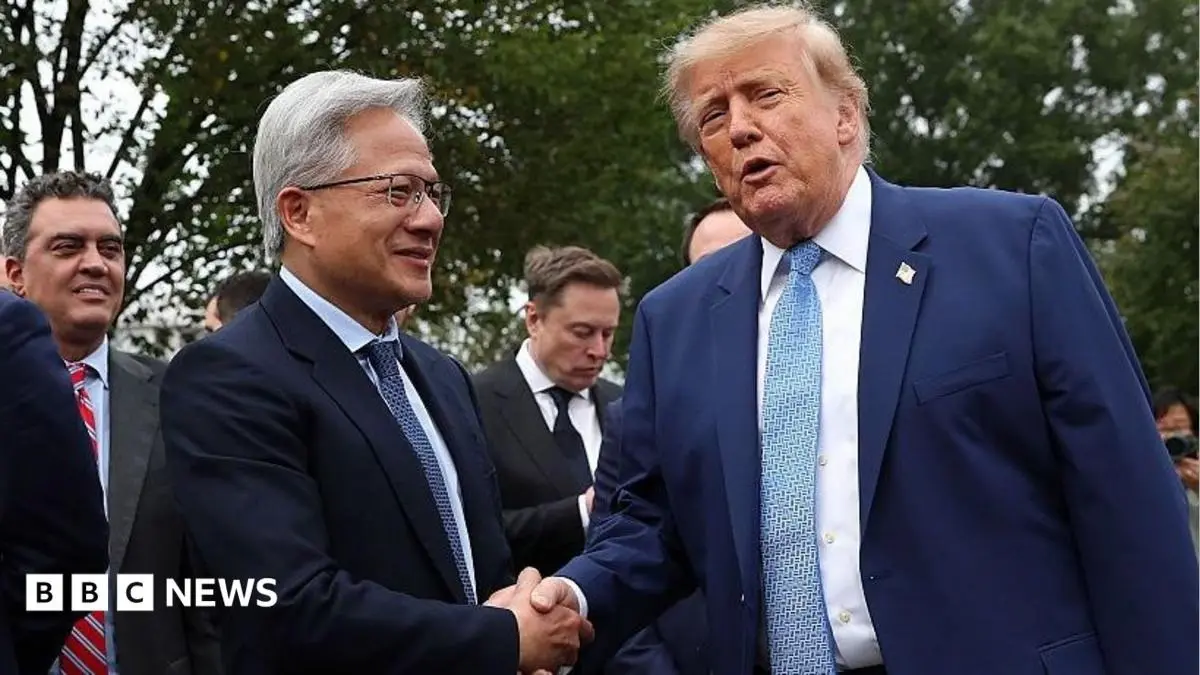
Nvidia has formally dismissed a mounting campaign calling for the reinstatement of former CEO Jensen Huang, signaling that the board of the AI chip giant has no intention of bringing him back. This decision comes despite a wave of high-profile support for the former executive, including an endorsement from US President Donald Trump, as the company grapples with the fallout from a scandal that has sent shockwaves through the global technology sector.
The board’s firm stance arrives just one week after Huang’s resignation, which followed the emergence of reports detailing two separate extra-marital affairs. The situation took a particularly volatile turn when it was revealed that one of the individuals involved was allegedly a Chinese intelligence operative. These disclosures triggered a crisis for Nvidia, a firm currently valued at approximately $3.87 trillion and arguably the most pivotal company in the ongoing global competition for artificial intelligence dominance.
A Campaign for Reinstatement
In the wake of Huang’s departure, a "Stand with Jensen" campaign was launched by a coalition of current and former Nvidia employees, corporate partners, and shareholders. The movement argues that the board removed Huang without "meaningful due process." The campaign has rapidly gained traction, with an open letter to the board already gathering more than 175,000 signatures.
High-profile tech industry figures have joined the chorus of supporters. Elon Musk, the CEO of SpaceX and Tesla, and Tim Sweeney, the head of Epic Games, are among the prominent names calling for the board to reinstate Huang while a formal internal investigation is conducted. Musk, in particular, has expressed concerns regarding the operational stability of the company in the absence of its former leader.
"Jensen drove supply chain brilliantly at Nvidia but many of those deals were a handshake with Jensen, not a written contract," Musk noted in a recent post on the social media platform X. "Without Jensen, at least some of those critical deals will be lost."
The campaign has also drawn attention from political circles. Lord Sarfraz, a member of the UK’s House of Lords, has formally written to Nvidia’s new chair, Harvey Jones, urging the board to give "serious consideration" to bringing Huang back once the internal probe is concluded. Similarly, investment heavyweights, including Brad Gerstner of Altimeter Capital and Gavin Baker of Atreides Management, have publicly called for the board to keep all options open, including a potential return for the former chief executive.
Presidential Intervention and Geopolitical Tensions
The debate over Nvidia’s leadership has reached the highest levels of the US government. On Monday, President Donald Trump publicly stated that he "would certainly not mind" seeing Huang return to his position. Speaking to reporters as he departed the White House, the President offered a measured but clear endorsement, noting, "I guess maybe one lesson is more important than another, but I would certainly not mind seeing that."
This perspective, however, highlights a growing divide within the administration. While the President has spoken in glowing terms about the former executive—even stating that he believed Huang’s claim that he was unaware of the woman’s alleged status as a foreign spy—other officials have adopted a more cautious approach. Treasury Secretary Scott Bessent has reportedly advocated for the company to look outside its current ranks for a new permanent CEO, reflecting concerns about the optics and security implications of the scandal.
The timing of the crisis could not be more sensitive. The US government is currently engaged in a high-stakes effort to restrict China’s access to the advanced semiconductors required to train large-scale AI models. On Monday, the Trump administration announced a further tightening of export restrictions. The new rules mandate that companies in Singapore, Thailand, Malaysia, Indonesia, and Brazil must now apply for specific US export licenses to receive the most advanced Nvidia chips. This move is designed to prevent the illegal diversion of technology to Chinese entities, a concern that has been amplified by the recent reports regarding Alice Huang, the woman at the center of the controversy who is alleged to have ties to Chinese intelligence. China has formally denied these allegations.
Security Concerns and Congressional Scrutiny
The controversy has drawn scrutiny from Capitol Hill, with Jensen Huang having already agreed to testify before the House Select Committee on China. The hearings are expected to investigate whether the former CEO’s personal conduct—specifically his relationship with an individual alleged to be a foreign intelligence asset—compromised national security.
When asked about the security implications, President Trump remained dismissive of the potential for a breach. "They say she’s a spy. I don’t know that she was a spy at all," the President said. "I mean, I really don’t, I don’t know that. You know, China plays games with us. So we play games with China."
The FBI is also reportedly conducting its own investigation into the nature of the relationship between Huang and Alice Huang. The ambiguity surrounding these events has created significant friction between the US Treasury and Commerce departments, as officials weigh the necessity of maintaining a technological edge against the risk of industrial espionage.
Internal Turmoil and Market Impact
While the "war room" of supporters continues to lobby for his return, reports from the Financial Times suggest that Huang has been consulting with confidants about a possible comeback. However, internal sources have confirmed to the BBC that the Nvidia board remains unmoved. The board’s refusal to engage in negotiations with the former CEO suggests a determination to move past the scandal and stabilize the company’s governance.
The instability has taken a clear toll on the market. In recent days, hundreds of billions of pounds in market capitalization have been erased from Nvidia’s valuation. Despite this, the company remains a behemoth of the tech industry, and investors are looking to the firm’s upcoming financial results for signs of stability.
For the moment, the company’s operations are being managed by Chief Financial Officer Colette Kress, who is expected to lead the presentation of the company’s quarterly results on Tuesday. The presentation will serve as a critical test for the firm, as analysts look for evidence that the loss of its long-time visionary leader has not disrupted the company’s momentum.
Other industry leaders have been more hesitant to weigh in on the drama. Sam Altman, the CEO of OpenAI, declined to take a definitive stance when asked about the situation at a recent conference, stating, "I don’t think I know enough to answer that question." Altman, who experienced his own highly publicized, short-lived ousting from OpenAI in 2023, did, however, refer to Huang as a "hero of mine," underscoring the high regard in which the former Nvidia leader is held by his peers.
As the internal investigation proceeds and the company prepares to address its shareholders, the "Stand with Jensen" campaign continues to press its case. For now, however, the board’s position remains clear: the era of Jensen Huang at Nvidia has come to an abrupt and controversial end, leaving the world’s most valuable AI chipmaker to navigate a precarious future under new leadership.