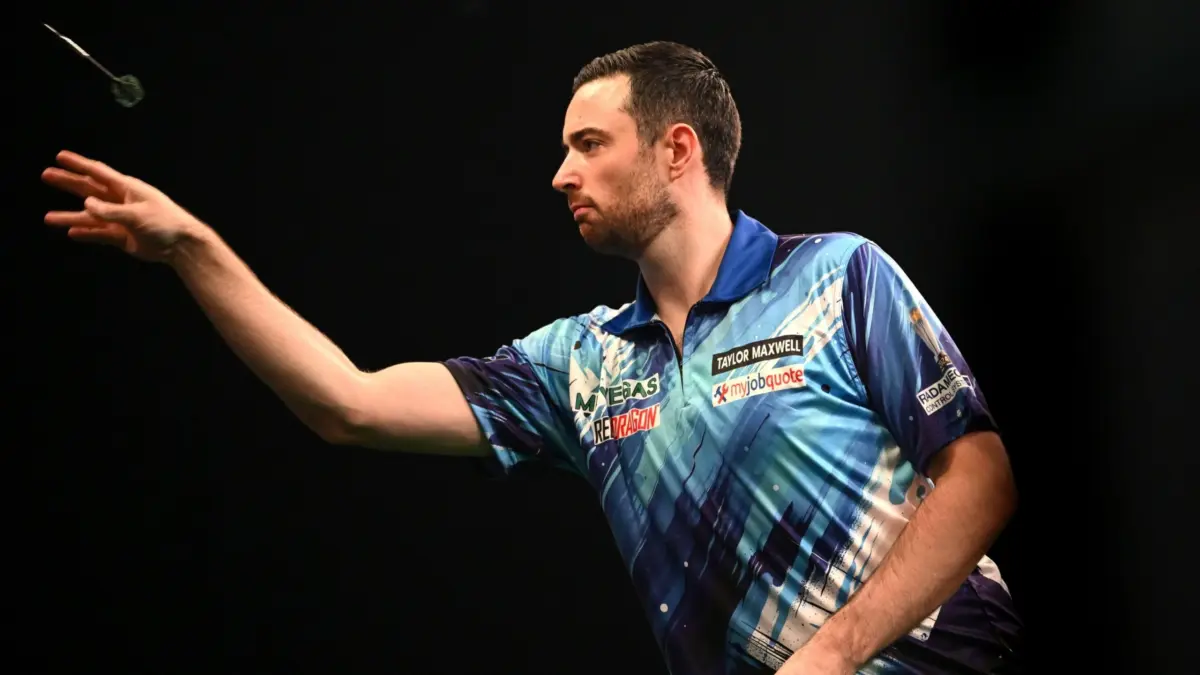
The race for the prestigious Grand Slam of Darts title intensified on Tuesday night as tournament heavyweights Luke Humphries and Michael van Gerwen successfully navigated their final group stage encounters to book their places in the last 16. With the group phase drawing to a dramatic close, the high-stakes nature of the tournament was on full display in Wolverhampton, where composure under pressure proved to be the ultimate decider between progress and elimination.
Luke Humphries, currently the second seed and a former world champion, continued his steady march through the tournament by overcoming Joe Cullen in a tense Group I showdown. While the final scoreline of 5-2 might suggest a comfortable evening for the world-class star, the statistical breakdown of the match painted a more complex picture. Cullen, known for his prolific scoring power, actually outperformed Humphries in the averages, posting a formidable 103.22 compared to the winner’s 98.67. Despite the statistical discrepancy, it was the clinical finishing of Humphries that ultimately paved the way for his progression, proving once again that in the high-pressure environment of the Grand Slam, experience and accuracy on the outer ring are often more valuable than raw scoring volume.
Humphries now turns his attention to the knockout stage, where he faces a compelling challenge against Tom Sykes. Sykes, who has effectively become the "dark horse" of the tournament, secured his spot in the last 16 by topping Group J following a dominant 5-1 victory over Krzysztof Ratajski. As the lowest-ranked player remaining in the field, Sykes enters the match against the second seed with the pressure largely off his shoulders, though the magnitude of the challenge ahead of him cannot be overstated.
While Humphries navigated his match with relative tactical efficiency, the evening was far more precarious for three-time Grand Slam champion Michael van Gerwen. The Dutchman, whose name is synonymous with dominance in the sport, found himself pushed to the absolute limit by Sweden’s Jeffrey de Graaf in a Group L decider that saw momentum shift back and forth until the final dart.
Van Gerwen’s performance was notably uncharacteristic, a fact the player was quick to acknowledge in his post-match assessment. The match hung in the balance throughout, and at 4-3 in his favor, Van Gerwen appeared poised to close out the contest. However, a series of missed opportunities at the double allowed De Graaf to force a deciding leg, creating an atmosphere of palpable tension in the arena. Van Gerwen, relying on his extensive experience in high-stakes situations, managed to compose himself in the final leg to secure the win and avoid a premature exit.
"It wasn’t a good game at all," a candid Van Gerwen admitted shortly after the match. "We were both under pressure and that didn’t do us any favours. Sometimes you don’t do what you want to do. That’s frustrating because I know I am capable of a lot more."

His reward for surviving the scare is a blockbuster last-16 clash against James Wade. Wade, often referred to as "The Machine" for his methodical and clinical approach to the game, looked in ominous form on Tuesday. He breezed past Ricky Evans with a commanding 5-0 victory, signaling his intent to go deep into the tournament. The upcoming encounter between Van Gerwen and Wade is widely viewed as one of the most anticipated fixtures of the second round, pitting the raw, often volatile talent of the Dutchman against the seasoned, unflappable precision of one of the sport’s most enduring figures.
The evening was marked by a series of decisive victories that underscored the quality of the remaining field. Alongside Wade’s demolition of Evans, Nathan Aspinall showcased his credentials as a title contender with a clinical 5-0 dismantling of Karel Sedlacek in Group P. Similarly, Gian van Veen, who has been a standout performer throughout the group stages, maintained his high standards by securing a 5-2 victory over Bradley Brooks to solidify his place in the next phase.
As the tournament transitions into the knockout format, the level of competition is expected to ramp up significantly. Every match from this point forward is a direct elimination, leaving no room for the kind of lapses in concentration that were visible on Tuesday night.
The full slate of Tuesday results provided a clear picture of the form leading into the round of 16. In addition to the aforementioned matches, Martin Schindler edged past Chris Dobey with a 5-3 win in Group N, while Gabriel Clemens secured a hard-fought 5-3 victory over Rusty-Jake Rodriguez in Group O. These results have finalized the bracket, setting the stage for what promises to be a gripping few days of darts.
The second-round ties have thrown up a fascinating mix of generational clashes and established rivalries. The current world number one, Luke Littler, is set to face Jermaine Wattimena, a tie that will test the young prodigy’s ability to handle the intensity of the knockout stages. Elsewhere, Kevin Doets will square off against Cameron Menzies, while the experienced Gerwyn Price faces a stern test in Ryan Searle. Rob Cross is scheduled to meet Niko Springer, and Gian van Veen—fresh off his impressive group stage—will take on Martin Schindler. Finally, the match between Gabriel Clemens and Nathan Aspinall promises to be a tactical battle, adding to the variety of styles on display.
As the Grand Slam of Darts moves into its most critical phase, the focus shifts to whether the established favorites like Humphries and Van Gerwen can find their absolute best form when it matters most, or if the current momentum of players like Wade and the relative newcomers will lead to further upsets. The tournament, known for its unique group-to-knockout format, has once again proven its ability to provide high-stakes drama, setting the stage for a compelling conclusion in the coming days. The players now have a brief opportunity to reflect on their group stage performances and calibrate their games for the intensity of the single-elimination format, where the margin for error effectively disappears. The road to the title in Wolverhampton has narrowed, and for those remaining, the ultimate prize is now firmly within sight.