Reagan was president, corporate ambition celebrated the philosophy that greed was good, and trousers looked as though they had been tailored from surplus parachutes. Yet, the 1980s also gifted automotive enthusiasts with a true cultural and mechanical touchstone: the Chevrolet Camaro IROC-Z, an absolute icon that defined an entire generation of American performance culture. Inspired directly by the high-stakes thrills of the International Race of Champions, the IROC-Z sat proudly at the very top of the Camaro food chain from its introduction in 1985 through the conclusion of its run in 1990. While its fierce horsepower wars with the rival Ford Mustang GT often meant enduring a bitter rivalry on both street and strip, the IROC-Z carved out a permanent, glowing legacy in the hearts of car enthusiasts.
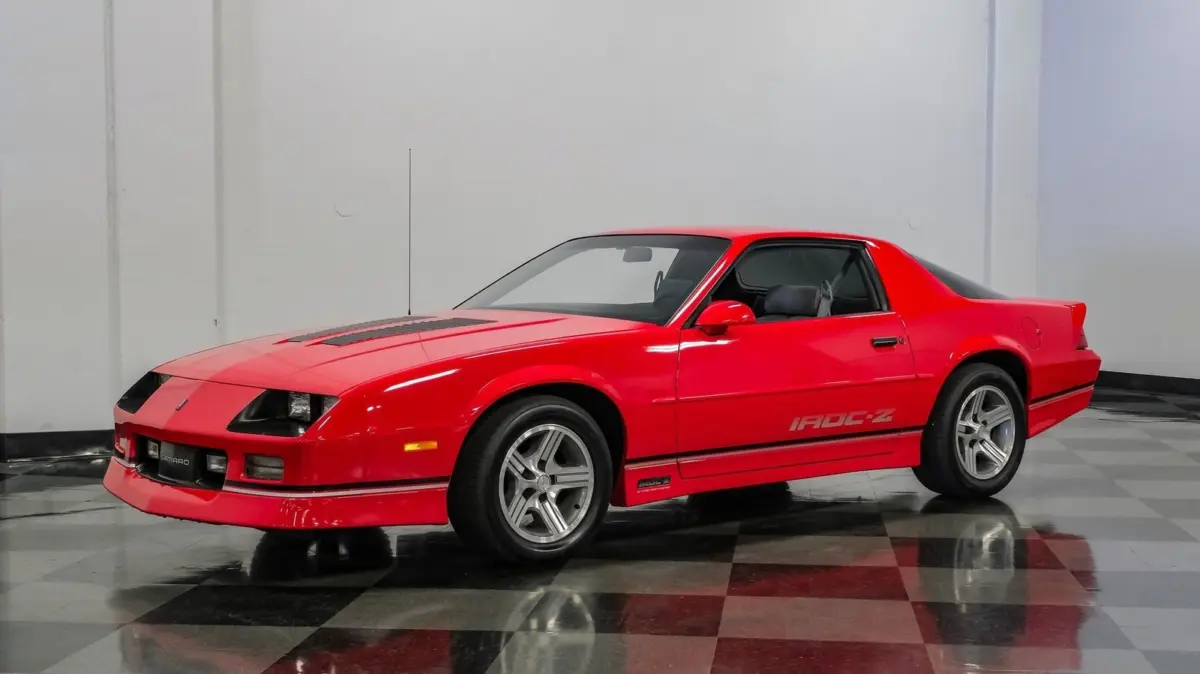
Today, those with an enduring hunger for a remarkably preserved muscle car from the golden age of the Radwood era have a rare opportunity to step back in time. Streetside Classics currently features a pristine 1990 Chevrolet Camaro IROC-Z listed for sale, sitting ready for the open highway with a cassette deck primed for your favorite 1980s synth-pop soundtrack.
This striking Bright Red beast—complete with the unmistakably bold and classic 1980s-style IROC-Z door graphics that defined bedroom posters across the globe—features a fuel-injected 5.7-liter, 350-cubic-inch L98 V8 engine lurking under the louvered hood, churning out 245 horsepower. Unfortunately for traditionalists seeking total driver engagement, that muscular output is routed exclusively through a four-speed automatic transmission. Inside, the Medium Dark Gray cabin is remarkably well-stocked and preserved for its vintage. Highlights of the interior comfort and convenience package include functional air conditioning, durable cloth upholstery, a tilt-adjustable steering wheel, a factory AM/FM/cassette stereo system, power steering, power brakes, power windows, power door locks, and power-adjustable exterior mirrors.
Perhaps most astonishingly, this particular example displays a mere 13,166 miles on the odometer, which are believed by sellers to be entirely original to the vehicle. Prospective buyers can drive this piece of automotive history home for an asking price of $58,995. That figure sits quite close to its Hemmings-sourced market valuation, which sits at approximately $55,000 on the high end before factoring in a customary 10% to 20% premium commanded by the more desirable 350-cubic-inch V8 engine option. For market context, a similar third-generation Camaro with roughly 14,000 miles on the clock managed to fetch $28,500 when it crossed the auction block at Bring a Trailer in 2025, illustrating the shifting and often passionate collector appetite for these late-eighties icons.
When did Chevy build the first IROC Camaro for production?
The lineage of the legendary badge traces back to the minds of legendary figures in motorsport. Noted motorsports figure Roger Penske helped launch the International Race of Champions back in 1973 with a clear and compelling objective: to definitively settle the ongoing debate over who truly was the best racing driver in the world. The organizing method was wonderfully egalitarian yet intensely competitive, relying on invitations extended to top-tier racers hailing from multiple distinct motorsports disciplines to compete directly against one another in identically prepared racing cars.
During the inaugural year of competition, organizers utilized Porsche Carrera RSR sports cars. However, keeping those sophisticated German machines running and properly maintained on the track proved to be prohibitively expensive. Interestingly, Porsche maintains a modern reputation today for sustaining among the highest five-year maintenance costs across the entire automotive industry, a financial reality that echoed even in the high-budget world of professional racing decades ago.
The practical solution for the racing series was to pivot toward American muscle, selecting the Chevrolet Camaro. The racing versions fielded in 1974 were kept relatively close to their showroom-stock roots. Naturally, their cabins were heavily reconfigured specifically for the rigors of motorsports, outfitted with specialized racing seats, robust roll cages, specialized racing instrumentation, essential fire-safety equipment, and very little else to compromise lap times.
Even so, these track-ready competition models retained the exact same steel bodywork and rode upon the same basic suspension configuration found on dealer lots. Despite this strong promotional alignment, Chevrolet did not offer an immediately available production tie-in model for everyday consumers to purchase.
That absence of a showroom connection persisted through 1976, when Penske and his associates turned to Banjo Matthews, a legendary NASCAR builder, to engineer and construct an entirely new generation of IROC Camaro race cars. These subsequent racers featured sophisticated tube-frame chassis structures wrapped in lightweight fiberglass body panels, moving them further away from their assembly-line origins.
Following a brief hiatus for the racing series from 1980 through 1983, the IROC competition returned with a vengeance in 1984. By this time, the competing IROC Camaros were—with the sole exception of their exterior sheet metal silhouettes—practically identical to the heavy-hitting NASCAR Winston Cup stock cars tearing up ovals across America.
The pivotal turning point for consumers arrived when Chevrolet successfully negotiated and secured the legal rights to license the coveted "IROC" name directly from the racing organization. As a direct result, a full decade after the Camaro first became the undisputed star car of the prestigious racing series, Chevrolet was finally in a position to manufacture and sell an authentic, factory-authorized IROC-branded Camaro to the general public. This triumphant commercial rollout ultimately paved the way for the very same 1990 production model currently waiting for its next custodian at Streetside Classics.