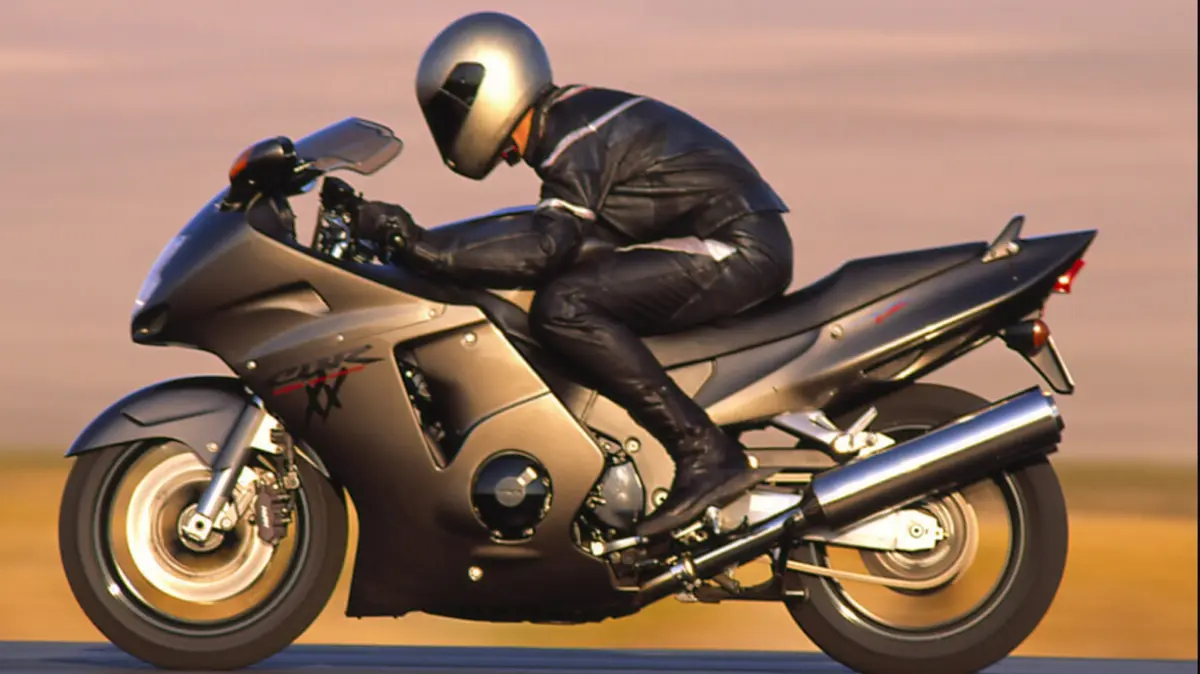
When Honda introduced the revolutionary CBR1100XX, a 178-mile-per-hour superbike colloquially nicknamed the "Super Blackbird" after the Lockheed SR-71 spy plane, it fundamentally altered the trajectory of the global motorcycle industry. Particularly in Japan, motorcycle manufacturers shifted their engineering focus, suddenly targeting outright top speed as the definitive metric of high performance. Compared to everything that had come before it, the CBR1100XX pushed the absolute envelope of motorcycle aerodynamics, handling, and acceleration.
The Blackbird proved to be an instant commercial success, moving more than 17,000 units on the strength of its high-speed stability. It was not long before competing manufacturers wanted in on the action. Packing 149 horsepower from a 1,137cc four-cylinder engine, Honda’s flagship speed machine had everything required to travel at immense velocities in a sleek and stable package.
Remarkably, this was not only the fastest motorcycle commercially available at the time of its release, but it was also the fastest vehicle Honda had ever sold to the public, easily exceeding the top speed of the contemporary NSX sports car by 10 mph. In the late 1990s, very few sports cars on the market could outpace the Blackbird, and all of them commanded significantly higher price tags.
It took several years for the Blackbird’s top speed benchmark to be surpassed, and few motorcycles have possessed the raw power required to top it in the decades since. For several years following its debut, the industry even observed an unofficial "gentleman’s agreement" among major manufacturers to tone down the escalating top-speed competition out of a shared fear that governments would step in with restrictive speed limiter legislation. Despite this informal treaty, however, a small handful of motorcycles eventually shattered the threshold, with some managing to crack the elusive 200-mph barrier straight from the factory floor.
1999 Suzuki Hayabusa — 194 MPH
Just three years after Honda unveiled the Super Blackbird, Suzuki escalated the rivalry by introducing an even faster and more powerful 1.3-liter motorcycle: the GSX-1300R Hayabusa. The name itself was a deliberate nod to nature, as "Hayabusa" is the Japanese word for the falcon, a predatory bird known for hunting blackbirds. Equipped with a robust 175 horsepower and exceptionally smooth, fluid aerodynamics, the Hayabusa launched a direct assault on the top-speed crown and dominated the segment almost exclusively for nearly two decades, claiming a staggering top speed of 194 mph.
Writing for Cycle World, automotive journalist Mark Hoyer once captured the otherworldly aura of the machine, noting that while Suzuki’s soul drew its divine light from the GSX-R, the Hayabusa was where engineering managed to put supernatural powers, complete with lights and a license plate, directly into the hands of riders.
The sheer velocity of the Hayabusa alarmed industry executives who worried that the top-speed arms race was spinning out of control. With European lawmakers increasingly vocal about the inherent dangers of faster and faster superbikes, Japan’s "big four" manufacturers collectively decided to rein themselves in. They instituted a voluntary, self-imposed cap on motorcycle top speeds of 300 kilometers per hour, which translates to roughly 186 mph. Executives at Honda, Yamaha, Suzuki, and Kawasaki reasoned that it was far better to police themselves than to wait for external regulators to do it for them.
To this day, the fastest street-legal motorcycles originating from Japan remain artificially restricted beneath that 300-kph ceiling. Following its explosive 1999 debut, Suzuki dialed back the claimed top speed of the Hayabusa to precisely 300 kph, though this electronic limitation was implemented without sacrificing a single drop of engine power or displacement. The iconic Japanese superbike remains electronically governed to this day.
2007 MV Agusta F4 R 312 — 194 MPH
MV Agusta became the very first European motorcycle manufacturer to shatter the industry’s gentleman’s agreement on top speed. Seven years after the pact was formed, the boutique Italian brand released the 2007 F4 R 312. In this nomenclature, the "312" denoted the exact number of kilometers per hour the motorcycle could achieve when pushed to its absolute limit—equivalent to 194 mph, perfectly matching the figures previously established by Suzuki’s Hayabusa. To MV Agusta’s credit, the company had never been a party to the original agreement and never offered any indication that it intended to abide by the self-imposed limits observed by its Japanese counterparts.
Commanding a steep retail price of $24,995 at launch, the 312 was an expensive proposition. Yet, for buyers drawn to MV Agusta’s exclusive boutique status, the bragging rights of owning the world’s fastest production bike, and the appeal of hand-assembled components, the cost was justified, even if total sales numbers remained relatively low. The machine was built upon the foundation of the existing F4 1000 R model, trading away some low-end torque in exchange for a nine-horsepower boost achieved through titanium valves, larger throttle bodies, and shorter intake trumpets. Beyond the revised powerplant, the 312 shared nearly every component with its F4 1000 R siblings, from the chassis and forks down to the brakes and the iconic Massimo Tamburini-sculpted design.
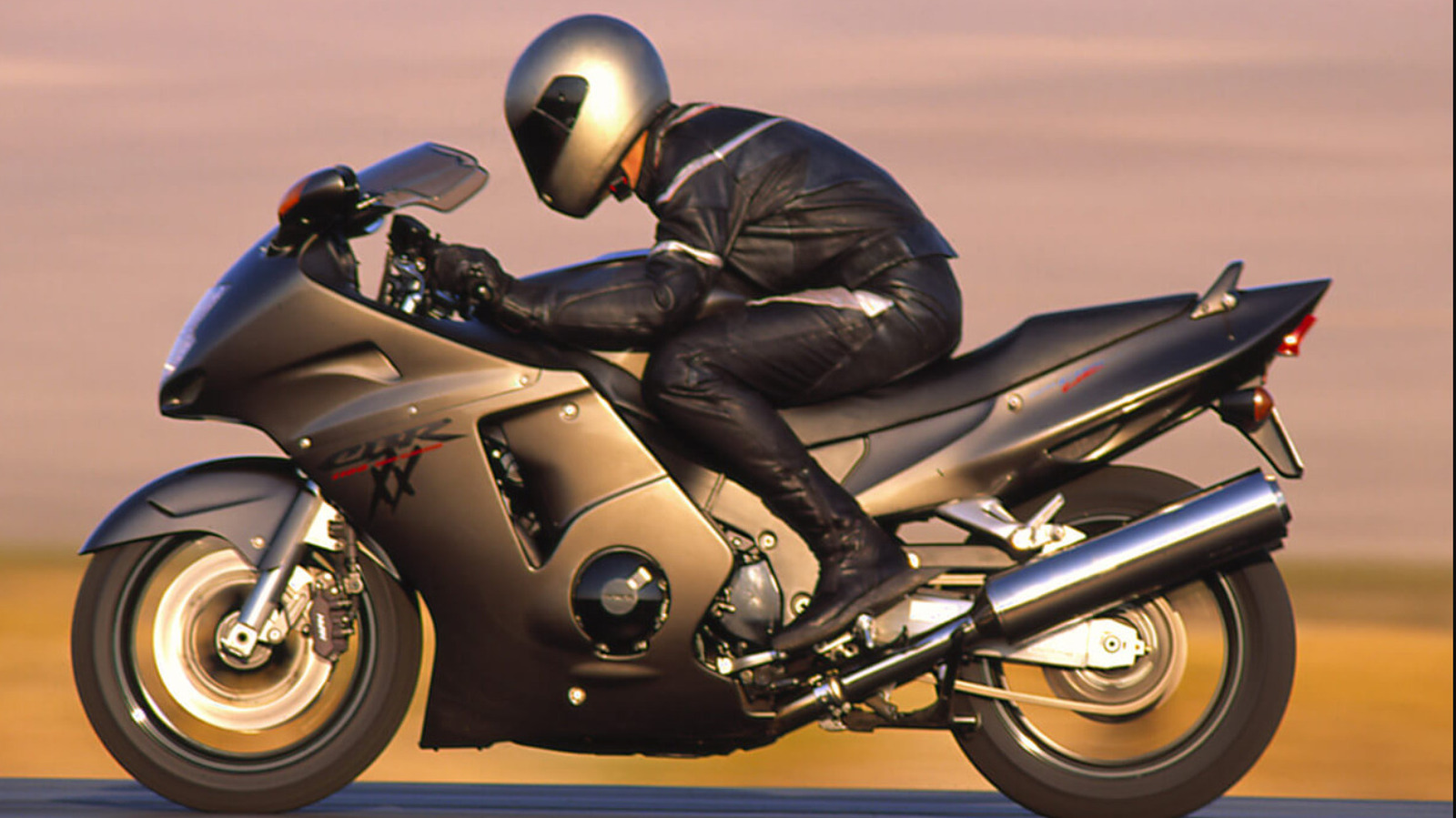
Boasting a claimed 183 horsepower and a dry weight of just 423 pounds, the MV Agusta was both more powerful and significantly lighter than the Hayabusa it was challenging at the top of the performance ladder. The Italian flyweight was also widely considered far more aesthetically pleasing than the Suzuki, which Cycle World memorably likened to a "copper-colored cosmic suppository." Even so, the Hayabusa maintained a massive advantage in affordability.
2021 BMW M 1000 RR — 195 MPH
Before the introduction of the M 1000 RR, BMW Motorrad and the brand’s high-performance M division had never collaborated toward a shared vehicular goal. Conceived as an aggressive evolution of the already blisteringly fast S 1000 RR, BMW managed to trim the motorcycle’s dry weight down to 423 pounds through the implementation of carbon fiber wheels and a lightweight Akrapovič exhaust system. Simultaneously, engineers juiced the inline-four engine up to 218 horsepower—up from the standard 205 ponies—by incorporating lighter pistons, titanium connecting rods, and updated "ShiftCam" technology. Capable of spinning well past 15,000 rpm, the engine delivered ferocious top-end performance.
Unlike many of its predecessors, the M 1000 RR was developed explicitly for race homologation purposes. While BMW was not single-mindedly chasing a top-speed record, the combination of reduced weight and elevated power naturally yielded record-breaking results. Whereas the standard S 1000 RR was already capable of touching the 300-kph threshold, the M-tuned variant bypassed MV Agusta’s 312 mark entirely, establishing a new benchmark of 314 kph, or just over 195 mph.
By 2020, the industry-wide gentleman’s agreement of 1999 had largely faded into the rearview mirror of motorcycling history, making the M 1000 RR the first BMW to officially surpass the 300-kph cap. However, units destined for the U.S. market were electronically throttled to a maximum of 189 mph to comply with strict domestic noise and emissions regulations.
2019 Ducati Panigale V4 R — 197 MPH
It is difficult to dispute that Ducati’s Panigale V4 lineup represents the pinnacle of extreme speed. Shortly after BMW revealed its updated S 1000 RR, Ducati tasked its race division with engineering an even faster machine to maintain dominance. Operating as another World Superbike homologation special, the Panigale V4 R was designed to deliver the absolute highest echelon of street-legal performance possible from the factory in Borgo Panigale.
Outfitted with a street-legal adaptation of the race bike’s Desmosedici Stradale R engine, the V4 R arrived rated at an imposing 221 horsepower and 83 lb-ft of torque. Furthermore, the R model shed 10 pounds compared to the standard Panigale V4. With a claimed top speed of 197 mph, it quickly established a strong claim as the fastest street-legal motorcycle equipped with a license plate holder.
Ducati, however, was not content to stop just shy of the heavily romanticized "double ton" mark. Buyers who opted for the Panigale V4 R could check a box for a factory-developed racing kit that included a lightweight Akrapovič exhaust system. Because this specialized exhaust did not comply with standard noise and emissions regulations, the kit was technically designated as not street-legal. When installed, however, the bike’s output surged to 239 horsepower while shedding more than 10 pounds from the chassis, pushing the top speed of the Panigale V4 R to an astonishing 205 mph.
Prior to the arrival of the V4 R, no production motorcycle had successfully breached the 200-mph barrier in factory configuration. While the Ducati was sold in a compliant street-legal trim, the ease of installing the optional racing kit meant that many owners frequently flirted with speeds well beyond the 200-mph threshold.
2015 Kawasaki Ninja H2R — 248.5 MPH
While rival manufacturers continued to refine traditional superbikes, Kawasaki bypassed the conventional limits of the category and plunged directly into the hyperbike sphere with the introduction of the Ninja H2. The street-legal variant of the Ninja H2 was already exceptionally fast, featuring a 240-horsepower, 998cc supercharged inline-four engine paired with the standard 186-mph speed governor shared by its peers. When unlocked of its factory restrictions, the standard H2 proved fully capable of exceeding 200 mph, though Kawasaki refused to sell the street-legal model in that configuration, precluding it from claiming the outright speed crown based strictly on stock showroom specifications.
Much like Ducati, however, Kawasaki offered a dedicated, non-street-legal track variant for a limited window each year with a price tag exceeding $62,000: the Ninja H2R. The track-only machine produced an earth-shattering 322 peak horsepower alongside 121.5 lb-ft of torque. Tipping the scales at 476 pounds in ready-to-ride condition, it was slightly heavier than the featherweight homologation specials arriving from Europe, but its forced-induction engine more than made up for the extra mass.
Operating a machine with power figures exceeding 300 horsepower invariably yields blistering acceleration. Piloting the H2 R on the Izmit Bay Bridge in Turkey, WorldSSP Challenge rider Kenan Sofuoğlu pushed the supercharged hyperbike to an incredible top speed of 400 kph, the direct equivalent of 248.5 mph. While Kawasaki officially asserted that the stock version of the H2 R topped out at a conservative 380 kph, Sofuoğlu maintained that he made only minor aerodynamic adjustments rather than internal engine modifications. Reaching a hair’s breadth from 250 mph on a production-based motorcycle demonstrated a level of performance that fundamentally redefined what was possible on two wheels.