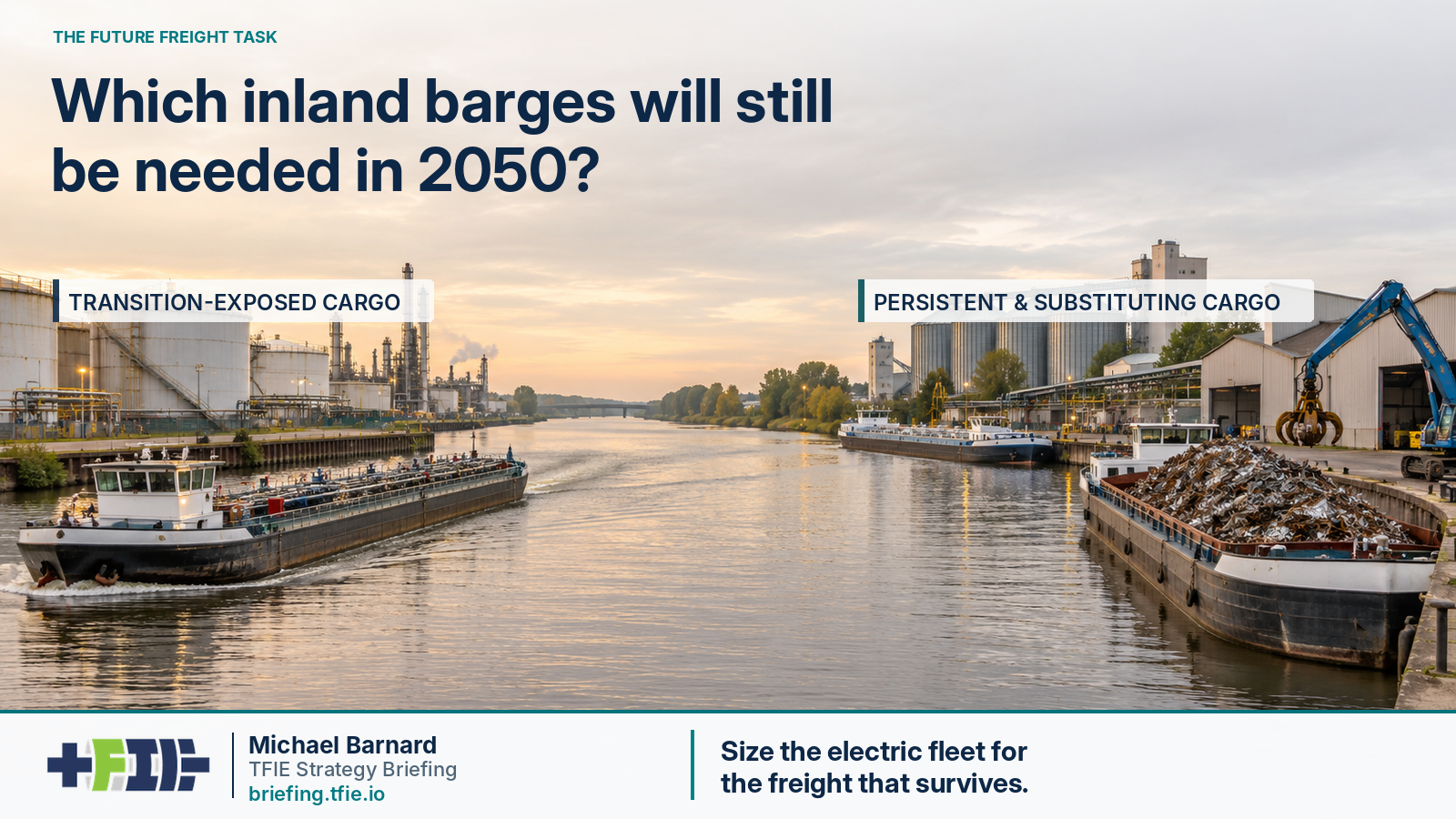
At first glance, the short-term cargo data coming out of Europe’s major logistics hubs can easily create a misleading sense of permanence. Recent reports from the Port of Rotterdam indicate that coal throughput rose by 15.3% over the first nine months of the year, driven by recovering coking-coal movements, elevated natural gas prices, and shifting power-market conditions. Crude oil and petroleum-product volumes also registered increases during the same period. For an inland vessel operator focused exclusively on today’s spot market, the data might suggest decades of stable, continuous work ahead, replicating the traditional fossil-fuel-driven patterns of the past.
However, looking past immediate market fluctuations reveals a different reality. An engine, a battery conversion package, or a brand-new replacement vessel purchased on the market today could easily still be in active operation by the year 2050. By that time, the fundamental mix of cargo travelling through European ports and inland waterways will look drastically different from what we see on the water today.
Data from the European Union statistical office, Eurostat, highlights that EU inland-waterway freight fell by 3% down to 118 billion tonne-kilometres. While specific segments like coal and crude petroleum experienced temporary bumps, agricultural freight contracted. These underlying shifts are quietly reshaping the entire matrix of services that ports, vessel owners, and industrial customers will need to buy in the coming decades. Fleet dynamics are already responding to these economic currents. According to figures compiled by the Central Commission for the Navigation of the Rhine, the number of dry-cargo vessels operating across Rhine countries dropped from 6,410 in 2023 to 6,224 by 2025, with smaller vessels driving the majority of the decline. Meanwhile, tanker fleets moved in the opposite direction, ticking upward from 1,400 vessels in 2022 to 1,477 in 2025. These figures demonstrate that the fleet is already beginning to adapt to changing cargo profiles and operating economics, even if a comprehensive transition remains ahead.
For vessel owners and maritime investors, capital allocation decisions involve two deeply interconnected questions. The first is whether a specific freight service will actually still have paying customers throughout the anticipated useful life of the asset. The second is determining which propulsion and charging systems can perform that specific service economically. Putting the cart before the horse—by acquiring equipment first and attempting to find a market for it afterward—runs the risk of sinking scarce investment capital into the wrong kinds of vessels entirely.
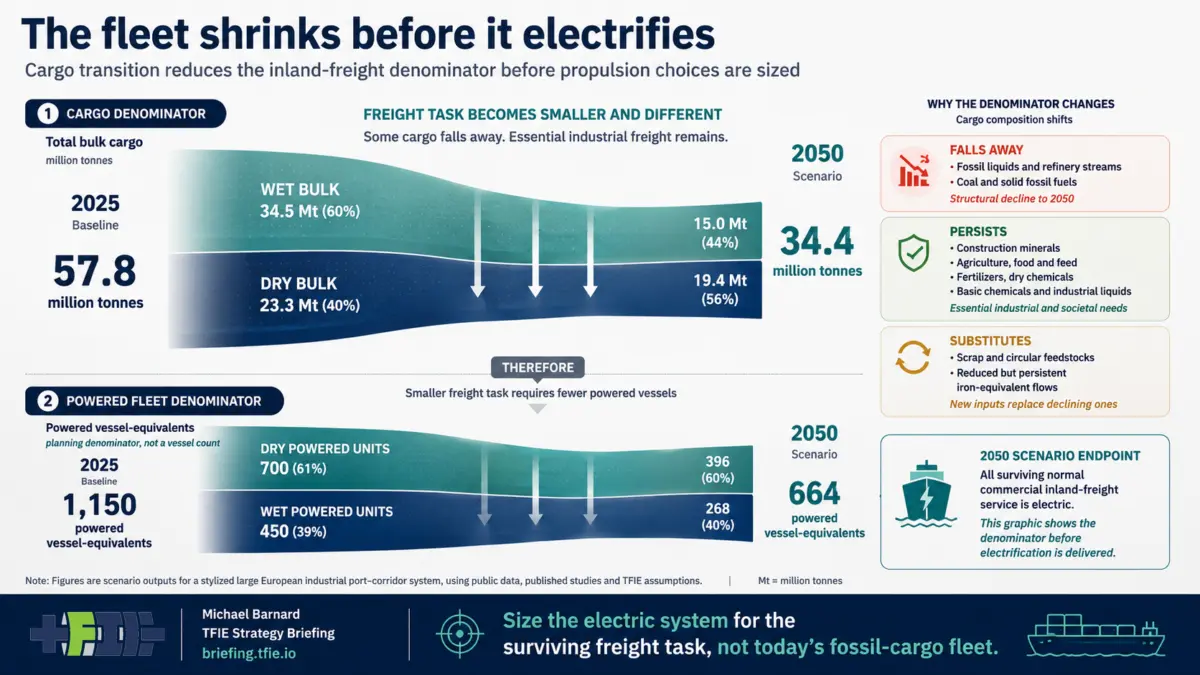
To explore these long-term dynamics, strategic transportation modelling of a large European industrial port corridor from a 2025 baseline out to 2050 provides a clear analytical framework. In the central scenario generated by this modelling, total bulk cargo through the corridor drops significantly, falling from 57.8 million tonnes down to 34.4 million tonnes, representing a contraction of roughly 40%. Wet bulk accounts for a substantial share of this volume loss, plunging from 34.5 million tonnes to 15.0 million tonnes. Dry bulk experiences a more moderate decline, moving from 23.3 million tonnes down to 19.4 million tonnes. Rather than serving as an exact, deterministic forecast of Rotterdam’s future cargo volume, this model acts as a transparent scenario to guide strategic investment decisions across industrial corridors facing similar decarbonization pressures.
The most profound transformations are concentrated in fossil-linked cargo streams. In the modelled corridor, fossil fuels and refinery streams plummet from 19.0 million tonnes down to just 1.5 million tonnes, while coal and other solid fossil fuels drop from 2.5 million tonnes entirely down to zero. Combined, these reductions account for roughly 20 million tonnes of the scenario’s total 23.4-million-tonne net decline. Consequently, any vessel operator whose principal revenue depends on moving coal or petroleum faces an entirely different asset replacement calculus compared to an operator carrying grain, construction minerals, chemicals, or industrial scrap.
The evolution of the steel industry offers a prime example of what cargo substitution means for inland navigation. In the corridor model, imported iron ore and other virgin iron units decline from 4.5 million tonnes to 3.0 million tonnes. Simultaneously, scrap metal and circular feedstocks climb from 1.8 million tonnes to 3.5 million tonnes. The foundational industrial function of steel production continues, but the actual materials moving to and from the factories change dramatically. Existing barges and terminal facilities may find vital new work in this circular economy, though parcel sizes, loading configurations, and shipping routes will inevitably shift.
Biofuel feedstocks create a separate, unique trap for unwary investors. Within the central scenario, movements of biofuel feedstocks experience a temporary peak near 5 million tonnes around the year 2030, before sharply declining to 1.5 million tonnes by 2050. A temporary freight boom of this nature can easily support profitable short-term operations, but it cannot justify a brand-new vessel or terminal investment designed for a thirty-year operational lifespan. In an evolving regulatory and industrial landscape, the long-term durability of the freight contract matters just as much as the sheer volume carried in any given year.
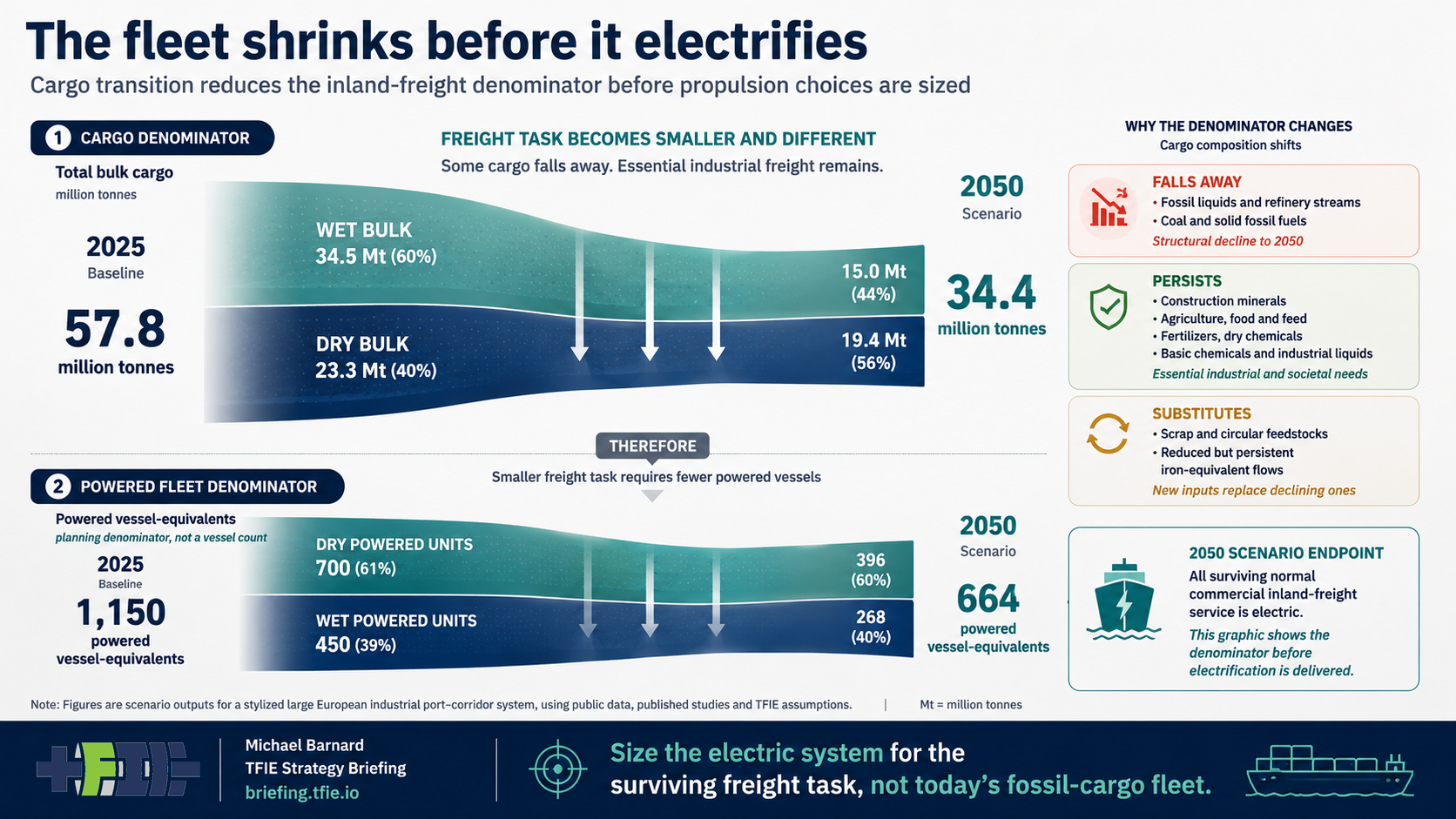
Relying on cargo tonnage alone is insufficient when attempting to size a zero-emission or electric fleet. To address this, economic models must translate raw commodities into powered vessel-equivalents by factoring in parcel sizes, specific routes, loaded port calls, and operational productivity. In the modelled corridor, the fleet transitions from roughly 1,150 powered vessel-equivalents down to 664, representing a reduction of 42%. Interestingly, dry cargo tonnage falls by 17%, but the required powered vessel-equivalents drop by 43%, illustrating how the underlying freight service requirements are changing beneath the surface. The starting figure of 1,150 powered equivalents corresponds to approximately 1,234 physical hulls once unpowered barges moved by pushers are fully accounted for. Decisions regarding battery conversions primarily affect these powered units, whereas terminal and cargo-handling investments must account for the broader pool of unpowered hulls.
This distinction holds critical importance for pushed formations, where a single powerful tug or pusher vessel provides propulsion for multiple cargo barges. Converting one powered unit to electric propulsion does not automatically require replacing every physical hull in the formation. Counting every individual hull as a standalone propulsion conversion would artificially inflate equipment and financing requirements.
At the same time, environmental constraints such as low Rhine water levels introduce entirely different operational hurdles into the equation. When river draught is restricted, a barge may remain officially active on the register while carrying significantly less freight per journey. Under these conditions, cargo owners may be forced to purchase additional voyages, deploy alternative hulls, or shift a portion of their freight to rail and road networks. Consequently, route depth, seasonal load factors, and terminal access must be integrated directly into service models alongside traditional long-term cargo demand.
To navigate this transition successfully, ports must establish living cargo and route registers that clearly map out which freight streams are declining, which remain stable, and which are undergoing material substitution. Vessel owners can then connect these registers directly to remaining hull life, annual asset utilization, existing cargo contracts, and the capital costs associated with electric conversion. Armed with this data, utilities and terminal operators can accurately size grid connections, charging infrastructure, and battery-container pools to support vessels operating on bankable, long-term routes. Infrastructure developed around dependable, future-proofed freight customers has a substantially stronger prospect of earning a sustainable financial return.

Europe possesses compelling reasons to accelerate the electrification of established, high-utilization inland freight routes today. Battery-powered vessels are already proving their operational viability on container and bulk routes across the continent. The primary commercial opportunity lies in investing specifically in trade lanes with surviving, long-term customers and electrifying the services those customers will continue to buy. Expanding an electric fleet prematurely without accurately measuring the underlying freight task puts the entire investment decision-making process backward. By grounding fleet modernization strategies in rigorous cargo-first modelling, the inland navigation sector can successfully transition toward a sustainable, zero-emission future without stranding capital on the riverbanks of 2050.