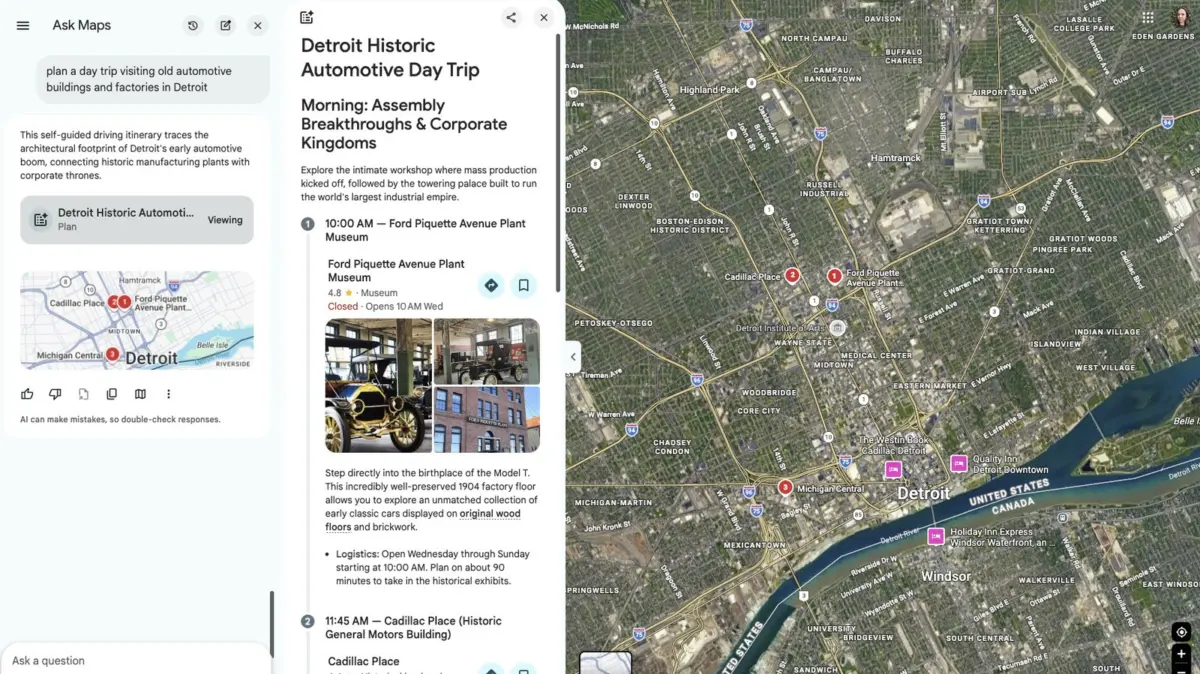
If planning that next day trip or holiday getaway has become a burdensome task, technology companies are ready to step in with another automated solution. Google has announced its latest and most ambitious artificial intelligence integration, introducing a feature designed to take over the heavy lifting of travel planning directly within its widely used mapping application.
The new "Ask Maps" feature harnesses Google’s Gemini artificial intelligence to map out comprehensive itineraries for users. Whether an individual is planning a single day of errands, a weekend excursion, or a multi-day road trip across state lines, the tool is designed to generate a complete schedule instantly. Google timed the announcement strategically to provide travelers with a ready-to-use resource ahead of the busy U.S. holiday travel season. According to forecasts from the American Automobile Association (AAA), approximately 81.5 million people are expected to travel during the Thanksgiving and Black Friday holiday weekend, creating immense logistical pressure for highways, airports, and local commerce alike.
Getting started with the feature requires nothing more than a conversational prompt typed into the search bar or spoken aloud via voice command. Users can simply ask Ask Maps to structure a multi-day journey and suggest specific activities tailored to their preferences. Google describes the capability as a tool that can handle everything from a straightforward day trip focused on holiday shopping to much more complex excursions, such as a multi-day road trip featuring specific waypoints like coastal hikes and oceanfront dining establishments.
Upon submitting a request, users receive a detailed, day-by-day schedule accompanied by insider tips and numbered map pins for each designated stop, allowing travelers to easily visualize their route. Once the itinerary is generated and customized to the traveler’s satisfaction, the schedule can be shared directly with friends and family members or exported to a desktop via Google Docs for further review.
This level of automated assistance could prove particularly useful for long-distance drivers navigating electric vehicles, where finding reliable charging stations along a specific route remains a critical logistical hurdle. Similarly, travelers looking to organize a specialized automotive day trip, such as an architectural tour or a visit to historic manufacturing sites in cities like Detroit, can theoretically have an entire day mapped out in seconds. However, early impressions suggest that while the artificial intelligence provides a solid foundational framework, the generated itineraries often require manual editing to align with realistic timing and personal preferences.
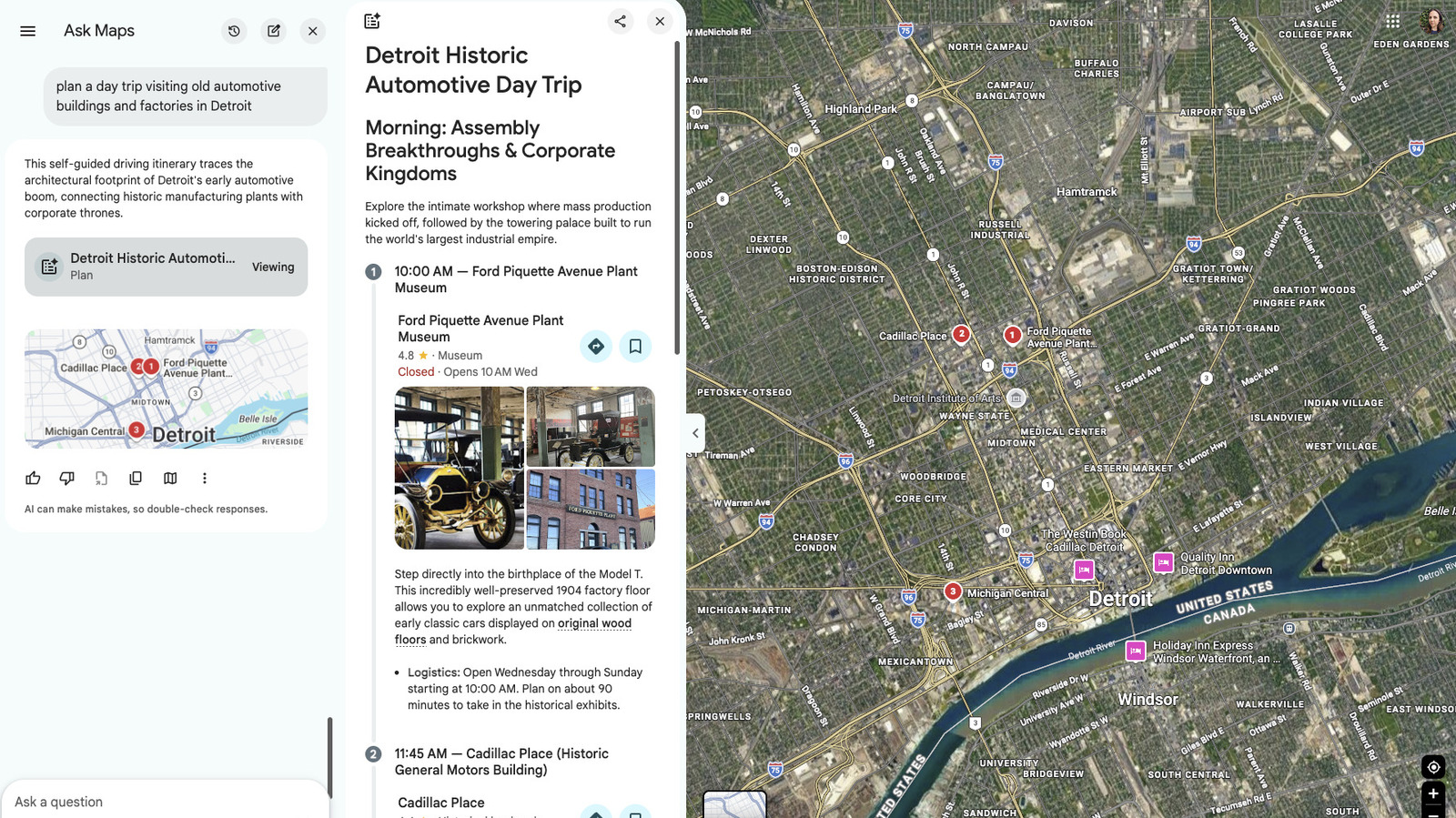
Ask Maps Will Do It All Without You Needing to Lift a Finger
The capabilities of Ask Maps extend far beyond basic route generation. In the United States, the system is designed to allow users to modify their itineraries in real time. If a specific destination ends up being closed, or if unexpected traffic requires a sudden detour or an additional coffee stop, users can simply instruct Ask Maps to adjust the schedule accordingly. The artificial intelligence is also designed to handle appointment scheduling, manage daily errands, and even order takeout food directly, eliminating the need to toggle between multiple standalone delivery applications currently cluttering users’ smartphones.
In practice, the system aims to manage nearly every aspect of daily logistics, meaning the only physical effort required from the user might be the initial prompt typed into the device—or, more likely, a simple voice command issued while multi-tasking.
This deep integration of artificial intelligence into routine decision-making raises broader questions about modern convenience and digital dependency. Beyond the philosophical debate surrounding humanity’s potential loss of self-sufficiency and spontaneous exploration by outsourcing basic choices to an algorithm, industry observers are questioning how long Google will provide these travel recommendations without commercial interference. It remains a prevailing reality of the digital advertising economy that recommendation engines eventually incorporate sponsored placements. Many users are already familiar with standard Google Search and Google Maps results favoring the highest bidder, a monetization strategy that frequently promotes specific fast-food chains or commercial enterprises regardless of user intent or context.
Despite these concerns, Google is pressing forward with a massive global rollout. The Ask Maps feature is expanding to Google Maps users across more than 30 countries in Europe and approximately 200 countries and territories worldwide. This expansive deployment means a global audience will soon have access to an AI assistant capable of guiding their daily routines and travel itineraries.
While proponents praise the convenience of automated planning, skeptics point out that artificial intelligence systems have historically experienced reliability issues when handling complex tasks, ranging from basic mathematical calculations to administrative errors like issuing incorrect parking tickets. Whether the new travel planning tool will operate smoothly at a global scale or introduce new logistical headaches for holiday travelers remains to be seen as millions begin putting the Gemini-powered feature to the test on the road.