For his inaugural London presentation, Oakland-born designer Taylor Thompson chose an atmosphere designed to engage multiple senses, setting the tone for the trans-Atlantic debut of his independent label, 5000. Invited guests were ushered in groups of just fifteen at a time into Devon Turnbull’s intimate OJAS Listening Room, an acoustically optimized sanctuary where the sonic curation was masterminded by Finding Albion author Zakia Sewell. Inside the darkened, high-fidelity space, attendees absorbed Sewell’s ambient, jazz-inflected edit, letting the layered soundscapes wash over them while contemplating the physical manifestations of Thompson’s progressive tailoring and modernist vision.
The presentation marks a major milestone in a pivotal year for the designer. Since April, Thompson has been based in the British capital as the inaugural recipient of the Paul Smith’s Foundation x CFDA Designer-in-Residence program. The prestigious year-long placement provides the Oakland talent with dedicated studio space and high-level mentorship at Studio Smithfield, placing him squarely within the beating heart of London’s historic and creative manufacturing district. Reflecting on the environment that has nurtured his work over the past several months, Thompson expressed genuine enthusiasm for the city’s creative ecosystem.
Working out of London’s equivalent to the Meatpacking District has been an eye-opening experience, he noted, observing that the energy of the neighborhood can occasionally shift into overdrive. "It’s awesome," Thompson said of his time at Studio Smithfield, adding with a smile that "if you’re working a little too late at night, it gets crazy." Beyond the bustling streets and late-night studio hours, the designer has found profound inspiration in the city’s vibrant independent fashion community. "London is full of small labels really trying to make it," he noted. "And there is a different language here for you to absorb into your own."
That process of cross-cultural linguistic and sartorial absorption is vividly apparent in the garments themselves. Thompson operates firmly as a progressive tailor, dedicating his practice to constructing an entirely modernist vocabulary derived from the familiar visual and structural language of traditional menswear. Rather than abandoning historical techniques, he uses them as a baseline for subversion, pushing the boundaries of what a tailored silhouette can actually be.
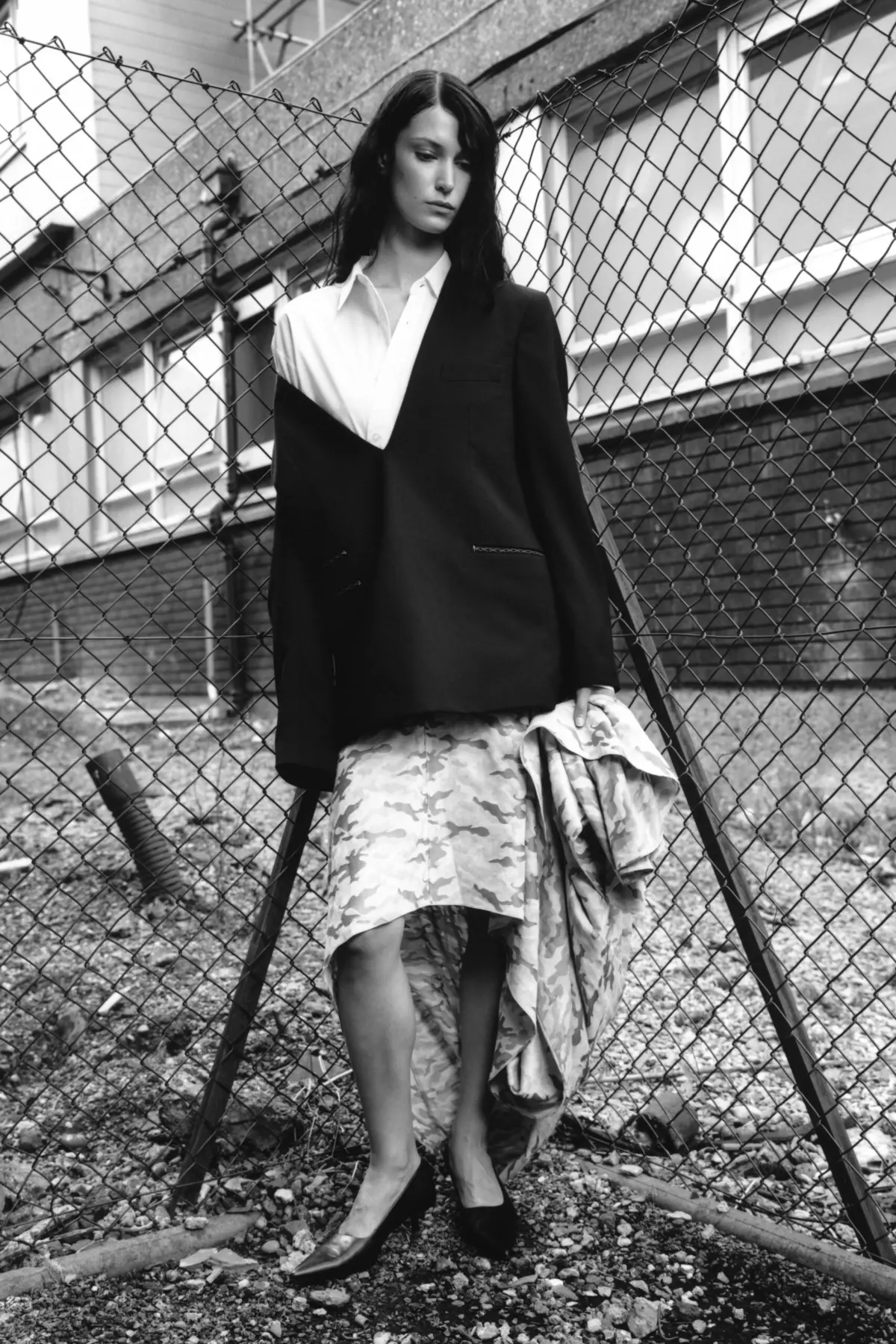
This philosophy was immediately evident in one of the collection’s standout pieces: a long, skirted black double-breasted coat that dramatically reversed conventional volume. The garment heaped its mass backwards, dropping sharply from the shoulder blades into a fluted flourish positioned just above a single vent. Inside, the coat remained a fully canvassed garment equipped with traditional shoulder pads and a structured chest piece, retaining the internal engineering of classic Savile Row tailoring. Yet, it entirely dispensed with lapels and a conventional front fastening. Instead, access to the coat was granted through a hidden zipper integrated seamlessly into the back, creating a clean, unbroken expanse of fabric across the front.
Combined with carefully considered, white-stitched pockets, the result was a garment that felt remarkably akin to a minimalist tuxedo, bridging the gap between classical tailoring and futuristic restraint. Beneath this dramatic outerwear piece, a pale camouflage skirt flared broadly, adding an unexpected textural and patterned counterpoint. The accompanying shirt continued the theme of structural subversion, featuring a button line that curved dynamically around the torso toward the back—a deliberate trajectory that Thompson compared to the very lapel that convention dictated should have been positioned above it on the front of the garment.
Technical fabrics further accented and complicated Thompson’s distinctive tailoring language throughout the presentation. In one striking look, a suit crafted from washed gray nylon served as a structural frame, containing and framing the inserted architecture of an MA-1 bomber jacket. A black variation of the same design housed that very same military-utilitarian template within a silky, subtly camouflaged jacquard fabric. This piece was worn above Thompson’s unique interpretation of the traditional Japanese hakama pant, featuring deep, carefully engineered inverted pleats designed to hold the strict discipline of the silhouette while still allowing for a dramatic, swooshy volume with every step.
The designer’s exploration of form extended fluidly into eveningwear as well, applying the same rigorous structural logic to conventionally feminine silhouettes. A tailored houndstooth gown stretched the boundaries of traditional evening dress, its body constructed around a rigid, full corset that centered sharp, lapel-like breaks of silhouette right at the neckline. Even the suit worn by Zakia Sewell during the event carried this narrative of softened precision, overprinted with a shadowy, eroded check pattern. The motif was deliberately faded to give the cloth a softened quality that was immediately mirrored in its tactile handfeel.
As Thompson’s year-long residency continues to unfold, it will afford him the rare luxury of returning to the city for another London presentation next season, "in one form or another." Given the sharp, cerebral trajectory of his trans-Atlantic debut and the way he seamlessly translates urban grit and sonic ambiance into physical garments, observing how his ongoing London experiences continue to inflect his evolving forms promises to be a fascinating prospect for the industry.