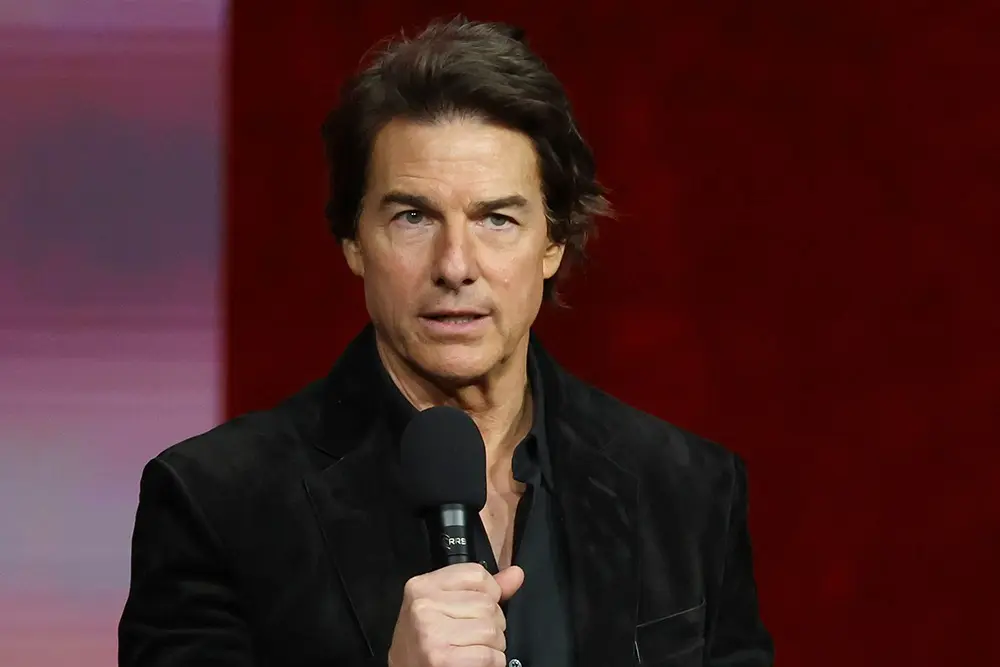
Despite the rapidly evolving landscape of the global film industry and the growing, often existential, concerns surrounding the role of artificial intelligence in cinema, Tom Cruise remains steadfast in his belief that the heart of movies lies in the tangible. During an intimate “Life in Pictures” conversation held at the BAFTA headquarters in London on Monday night, the legendary actor and producer reaffirmed his commitment to the theatrical experience, asserting that audiences possess an innate, enduring desire to witness “real things” on the silver screen.
Cruise’s appearance, which served as a retrospective of his illustrious four-decade career, saw the star reflect on the trajectory of his journey from his breakout roles to his current status as the industry’s most dedicated proponent of the big-screen experience. From the high-flying intensity of Top Gun and the nuanced performances in Jerry Maguire and Magnolia to the death-defying stunts that have come to define the Mission: Impossible franchise, Cruise has consistently pushed the boundaries of what is possible in physical filmmaking. Yet, even as he looks toward the future with his highly anticipated upcoming project Digger, his focus remains on the preservation of the human element in art.
The discussion, moderated by broadcaster Edith Bowman, naturally gravitated toward the technological advancements that have defined the Mission: Impossible series. The franchise has long been at the forefront of cinematic innovation, constantly integrating cutting-edge technology to heighten the realism of its action sequences. However, the stakes have evolved; the upcoming 2025 installment, Mission: Impossible – The Final Reckoning, centers its narrative on the threat of AI itself. This thematic choice provided a poignant backdrop for the conversation, as Bowman asked Cruise to weigh in on the broader implications of AI and its potential to disrupt the traditional filmmaking process.
Cruise did not shy away from the complexity of the subject. “Here’s the thing: There is nothing like human,” he stated, his voice carrying the weight of his extensive experience in front of and behind the camera. For Cruise, the fight to keep the theatrical experience alive is not merely about business or legacy; it is about the fundamental nature of connection. He explained that cinemas serve as unique communal spaces, a shared environment that brings people together in a way that individual viewing cannot replicate.
While Cruise was careful to clarify that he holds no personal animosity toward streaming services or the digital distribution models that have become dominant in the modern era, he made a clear distinction between home viewing and the cinema. “I have nothing against streaming or anything like that,” he noted, emphasizing that seeing a film in a theater is, in his view, an entirely “different art form.” It is a sentiment that reflects his long-standing advocacy for the theatrical window, a position he has championed even during the most challenging periods for the industry.
To support his argument, Cruise pointed to the undeniable resilience of the box office. The most recent summer season was nothing short of historic, shattering all-time industry records by grossing $4.76 billion between May 1 and Labor Day. For Cruise, these figures are not just statistics; they represent a clear mandate from audiences worldwide. He argued that the staggering success of the summer box office serves as definitive proof that the public remains hungry for human-led narratives, authentic craftsmanship, and the visceral experience that only a theater can provide. “People want that experience. They’re going to movie theaters,” Cruise said, adding with a characteristic note of optimism, “I always believe in humanity.”
When pressed on how creatives should navigate a world where generative technology is becoming increasingly sophisticated, Cruise’s advice was simple and direct: they must keep creating. He acknowledged the inevitability of technological progress, admitting that AI is an undeniable force that will continue to shape the future of production, VFX, and screenwriting. “You know, it is coming and it’s going to happen,” he conceded. Yet, he remained unshaken in his conviction that the core of cinema—the human perspective—is irreplaceable. “But people want to see real things,” he reiterated.
This philosophy of authenticity extends to his own work, most notably in his upcoming transformation for the film Digger. Directed by Alejandro G. Iñárritu, the filmmaker behind the gritty, visceral survival drama The Revenant, the project features Cruise in a role that marks a significant departure from his traditional action-hero persona. In Digger, Cruise portrays a wealthy oil tycoon, a role that required an exhaustive physical transformation.
The actor spoke with genuine enthusiasm about the process, describing the use of a heavy fat suit and intricate prosthetics that, as reported, initially took upwards of six hours to apply during the early stages of production. The physical commitment is a testament to the level of immersion Cruise brings to his craft, even after forty years in the business. He described the film not just as another entry in his filmography, but as a unique artistic endeavor. “I’ve never read a movie like this,” he told the audience. “It’s the most original film and one of the most moving films I’ve ever seen.”
The project, which is set to hit theaters on October 2 under the Warner Bros. banner, represents a culmination of the very values Cruise discussed throughout the evening: original storytelling, deep character exploration, and a total commitment to the craft. By immersing himself in a role that defies his public image, Cruise is once again demonstrating his belief that the future of the industry lies not in the automation of the creative process, but in the willingness of artists to take risks and provide audiences with the kind of grounded, human performances that technology cannot replicate.
As the evening at the BAFTA headquarters drew to a close, it was clear that while the industry stands on the precipice of a significant technological shift, the star’s influence remains anchored in the traditions that built modern cinema. Whether he is hanging off the side of a plane or buried under hours of prosthetics to inhabit a complex character, Cruise’s focus remains singular. He is betting on the idea that as long as there are filmmakers willing to tell stories that resonate with the human condition, audiences will continue to show up, popcorn in hand, ready to be moved by the sight of something real.