For authors grappling with the isolating and often frustrating reality of writer’s block, the solution may lie far away from the blinking cursor of a blank document. According to novelist Amy Fusselman, the antidote to creative stagnation can be found by stepping out of the study and into the theater.
In a recent essay featured in Lit Hub’s Craft of Writing newsletter, Fusselman detailed her unconventional writing practice, arguing that regular theatergoing has become an indispensable tool for her own creative output. Far from a mere leisure activity, attending live performances provides a vital disruption to the closed-loop ecosystem in which writers typically operate, offering fresh perspectives on narrative structure, character development, and world-building.
Breaking Out of the Closed System
Fusselman’s creative philosophy begins with an appreciation for art that feels entirely disconnected from contemporary trends—work that seems to arrive from outer space and challenges the audience to decipher its origins. When confronting art of this caliber, the author often reflects on the theories of French otolaryngologist Dr. Alfred Tomatis. Dr. Tomatis posited that the human voice cannot produce what the ear cannot hear, a concept Fusselman believes mirrors the fundamental challenge of artistic creation.
For a writer, breaking past familiar boundaries is notoriously difficult. Creators often find themselves trapped within a closed system, consciously or unconsciously restricted to producing work that falls within the range of their previous exposures. This confinement makes it easy to overlook unexamined ideas—what Fusselman describes as "dead zones" within one’s own creative landscape.
Locating these hidden blind spots requires intentional effort, and for Fusselman, the most effective method has been the rigorous study of an entirely different medium: the theater.
The Efficiency and Structure of the Stage
While Fusselman initially began attending plays simply as an enthusiastic fan, she eventually integrated regular theatergoing into her professional writing practice. Beyond the artistic inspiration it provides, the medium offers a practical advantage for busy creators. Reading a novel from cover to cover can demand days or even weeks of sustained attention. In contrast, a theatrical production delivers a fully realized, compressed masterclass in plot, character, dialogue, and setting in under three hours.
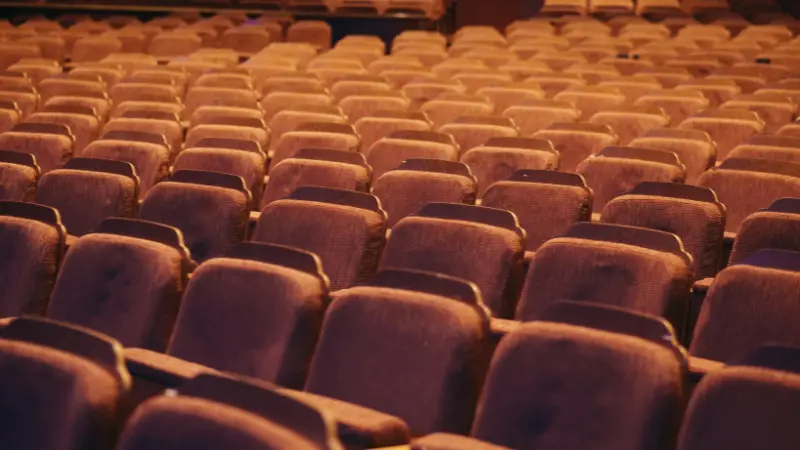
The physical architecture of the theater also plays a crucial role in her routine. Sitting in the dark alongside a room full of strangers creates a shared, communal experience of watching human beings embody a narrative in real-time. This environment offers a unique observational opportunity for narrative makers. When a production fails to hold her attention, Fusselman finds herself studying the audience instead, noting that an audience’s collective reaction is invariably honest. Observing these real-time responses provides valuable insights into how stories are received as they unfold.
Crucially, Fusselman approaches her theatergoing not as an academic studying for an exam, but as a perpetual student. This intentional openness allows her to maintain a sense of curiosity, an attitude she attempts to channel back into her reading habits, which she notes can otherwise be prone to impatience and frustration.

Informing the Page and Cloud Six
Immersing herself in live performance has fundamentally shifted the way Fusselman questions her own creative processes. Exposure to the stage encourages lateral thinking, prompting her to ponder complex intersections between different artistic mediums. She frequently asks herself whether a novel can be considered a performance—a question she answers in the affirmative, even if the precise mechanics are still revealing themselves to her.
This conceptual cross-pollination directly influenced her latest literary project, the novel Cloud Six. Fusselman credits her ongoing engagement with theatrical performance with granting her a greater sense of fearlessness during the intricate world-building phase of her new book.
When a theatrical production successfully translates an abstract idea to the stage, it stretches her imagination regarding what language can achieve on the page. Similarly, emotional moments in live performance expand her comprehension of the emotional boundaries her own prose can cross. In those resonant moments, she experiences the distinct reward of catching a glimpse of creative inspiration that previously hovered just outside her perceptual range.
Embracing Variety and Finding Inspiration Everywhere
Fusselman’s appetite for performance is remarkably broad. While she maintains distinct preferences in her reading material, her approach to the theater is entirely unselective. Her recent viewing schedule spans a wide spectrum of styles and genres, ranging from avant-garde spectacles that left her thoroughly astonished—such as Victory Over the Sun by Nature Theater of Oklahoma and Tanz by Florentina Holzinger—to acclaimed comedic explorations of race, like Race: The Movie: The Play by Bret Raybould and Cristian Duran, and charming one-person clown shows, including The Passion of Mr. Cardboard by Miles Calderon.
To be sure, maintaining this rigorous theatergoing commitment is aided significantly by her geographic circumstances. Residing in New York City, Fusselman lives on a block that remarkably houses three off-off-Broadway theaters, alongside neighborhood fixtures like a Parisian tea room and a repurposed parking lot.
However, she emphasizes that proximity to a bustling metropolitan theater district is not a prerequisite for creative renewal. For writers living in areas without a robust local stage scene, the underlying principle remains the same: the key is to actively study and engage with an art form or medium that one loves, provided it is not writing itself. Ultimately, Fusselman suggests, nearly everything in the world shares elements of theatricality—leaving writing as the sole exception that demands a completely different kind of attention.
Cloud Six by Amy Fusselman is published by Catapult and is currently available through independent bookstores and major retailers.