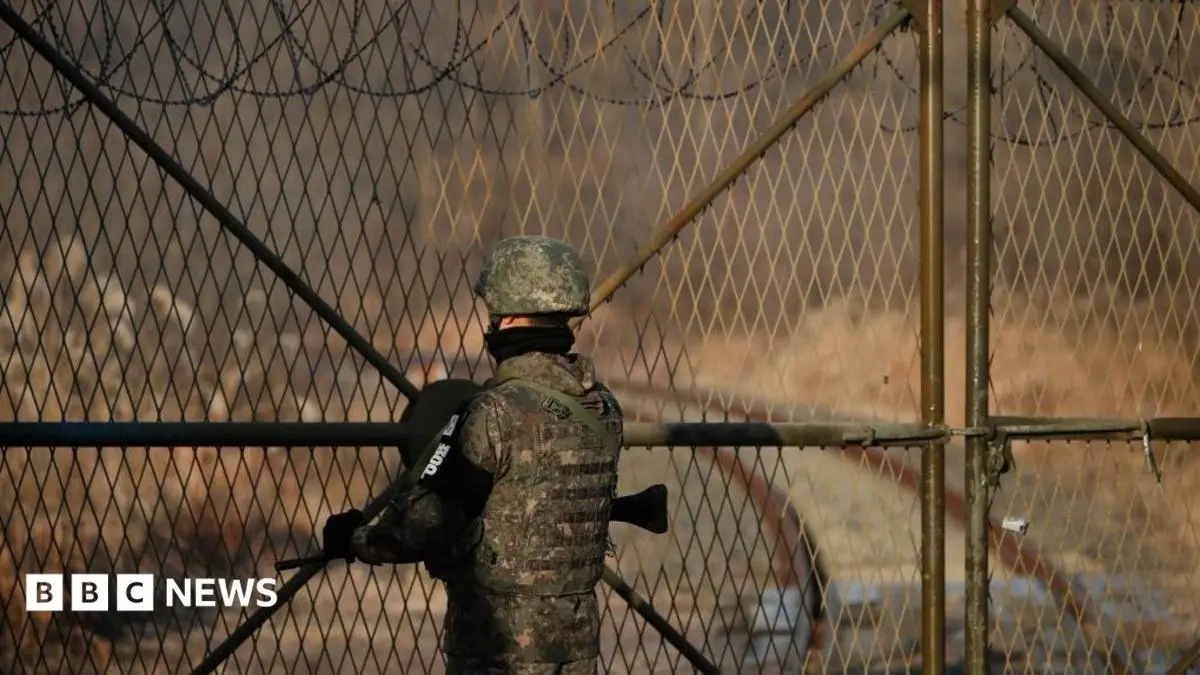
South Korea’s military has issued a stern demand for an official apology from North Korea following a series of landmine explosions within the Demilitarized Zone (DMZ) that left three South Korean personnel wounded earlier this month. The incident, which occurred on September 21, has ignited a fresh diplomatic firestorm, further fraying the already precarious stability of the Korean Peninsula.
The South Korean government stated on Tuesday that, following a thorough investigation, it is "highly likely" the explosions were caused by landmines planted by the North. Seoul has characterized the presence of these mines on its side of the DMZ as a blatant violation of the 1953 armistice agreement that ended the Korean War. In response to the breach, South Korea has vowed to take "corresponding measures," raising concerns about the potential for further military friction in one of the world’s most heavily fortified border regions.
Pyongyang’s Categorical Denial
North Korea has reacted to the accusations with swift and aggressive indignation. Pyongyang categorically denied any responsibility for the blasts, dismissing Seoul’s claims as "groundless" and characterizing the incident as a "farce" deliberately orchestrated by the South to escalate tensions on the peninsula.
The denial was underscored by a scathing statement from Kim Yo Jong, the influential sister of North Korean leader Kim Jong Un. Kim, a key figure in the North’s foreign policy apparatus, accused Seoul of "cooking up" the allegations to serve as a pretext for "political and military provocation." In her statement, published in state media on Wednesday, she explicitly rejected suggestions that North Korean forces had crossed the Military Demarcation Line to plant explosives.
"This is a deliberate and planned strained assertion to shift the responsibility for escalating tension to our side," Kim stated. She further warned the South Korean government that it should be "prepared for paying a price for the farce of their own making."
A Violation of the Armistice
South Korean defense officials maintain that the evidence points to a systematic effort by Pyongyang to fortify its side of the border. According to the South, the mines are part of a broader campaign by the North to solidify its military posture along the DMZ. In a statement released Wednesday, Seoul reiterated its demand for an apology and urged Pyongyang to cease all fortification activities that disrupt the status quo of the buffer zone.
South Korean Defence Minister Kang Shin-chul described the blasts as a "clear" violation of the 1953 armistice. That historic agreement established the 4-kilometer-wide (2.5-mile) DMZ, which serves as a vital buffer strip containing the Military Demarcation Line. While the armistice successfully halted active, large-scale combat, the DMZ has remained a flashpoint for decades, characterized by sporadic clashes, psychological warfare, and the ever-present threat of accidental escalation.
Historical Context and Growing Friction
This is not the first time landmines in the DMZ have become a source of intense conflict between the two neighbors. In 2015, two South Korean soldiers were severely maimed while on a routine patrol in the area. At the time, Seoul concluded that the mines had been surreptitiously planted by North Korean soldiers near a South Korean guard post. Pyongyang denied those allegations as well, and the incident sparked a period of high-intensity military posturing that brought the two sides to the brink of a larger confrontation.
Kim Yo Jong’s recent statement pointedly referenced the 2015 incident, claiming that South Korea had similarly used that event as a "pretext" to manufacture a crisis. She argued that Seoul is currently employing the same playbook to mask its own provocations.
However, security analysts observe that the geopolitical environment has shifted significantly since 2015. Relations between Pyongyang and Seoul have deteriorated markedly, with North Korea increasingly moving toward a policy of complete disengagement and hostility. Christopher Green, a senior consultant with the International Crisis Group, noted that the current climate is fundamentally different from the atmosphere of a decade ago.
"The North Koreans have been willfully attempting to harden the border and eliminate inter-Korean relations," Green told the BBC. He emphasized that the existing communication channels, which once allowed for a low-level dialogue even during times of tension, have effectively evaporated. "Accidental escalation on the Korean Peninsula is always just a few steps away, and it’s fewer steps now than it was in 2015," he added.
The Role of the United Nations Command
As the situation develops, the United Nations Command (UNC), which oversees the armistice agreement, has become centrally involved. The UNC conducted on-site investigations into the September 21 blasts alongside the South Korean military.
In a statement addressing the incident, the UNC affirmed its commitment to holding all parties accountable to the terms of the 1953 agreement. "UNC remains committed to maintaining and enforcing the Armistice Agreement and fulfilling its responsibilities to preserve stability and prevent escalation on the Korean Peninsula," the organization stated. The command noted that it intends to handle the alleged violation of the armistice "through established Armistice mechanisms."
For now, the situation remains tense. While Seoul continues to press for accountability, Pyongyang’s combative rhetoric suggests that it has no intention of de-escalating. The combination of the physical danger posed by the landmines and the complete breakdown in diplomatic communication underscores the precarious nature of the Korean border. As both sides dig in, the international community watches closely, wary that even a minor incident in the DMZ could spiraling into a more significant regional crisis.
The immediate path forward remains uncertain, as South Korea navigates the challenge of responding to what it considers a clear act of provocation, while attempting to avoid a wider conflict that neither side appears prepared to manage. The presence of the UN Command provides a thin veneer of institutional oversight, but as analysts like Green have noted, the loss of direct lines of communication between Pyongyang and Seoul makes the management of such incidents far more difficult than it has been in the recent past. As the aftermath of the September 21 blasts continues to unfold, the DMZ remains a stark reminder of the unfinished business of the Korean War and the enduring fragility of peace on the peninsula.