If you are at all interested in exploring the rich history of Charles Schulz’s iconic creation, Peanuts, investing in Fantagraphics’ The Complete Peanuts is one of the best ways to experience the legendary comic strip. Spanning an impressive 26 volumes, the comprehensive set contains every single daily and Sunday strip that saw publication throughout the comic’s historic run, offering roughly two years of strips per individual book. While digital options like the Kindle version are available for readers who might be strapped for shelf space, shelling out for a sprawling 26-volume collection of anything naturally encourages readers to seek out the physical edition to truly appreciate the craftsmanship of the print layout and historical preservation.
Reading through Peanuts as a single, unbroken chronological run is a uniquely rewarding experience for dedicated fans of the strip and the comic medium as a whole. As readers turn the pages, they get to watch the characters and the artistic style evolve day by day, tracking the progression from the early gags featuring now-little-known characters like Violet to the slow appearance and eventual crystallization of the established crew that generations have grown to love. It is also an exceptionally useful way to start developing strong, well-informed opinions about these 75-year-old comic strip characters. For instance, a dedicated read-through quickly highlights how Peppermint Patty often does not get nearly enough credit for being one of the best and most fiercely loyal friends Charlie Brown ever had throughout the duration of the strip.
Friendship in Peanuts is one of its more incidental themes, weaving quietly through the background of the daily panels. As with a number of other abstract philosophical subjects, the strip itself does not often have that much to explicitly say on the topic within its standard three-to-four-panel framework. However, there is plenty of official merchandise and ancillary material that leans heavily into the concept, such as 2016’s thematic compilation The Peanuts Guide to Friendship. Yet, within the strict canon of the daily comic strip, Charles Schulz rarely made a concrete, overarching statement about the nature of friendship—unless, arguably, Peppermint Patty was heavily involved in the storyline.
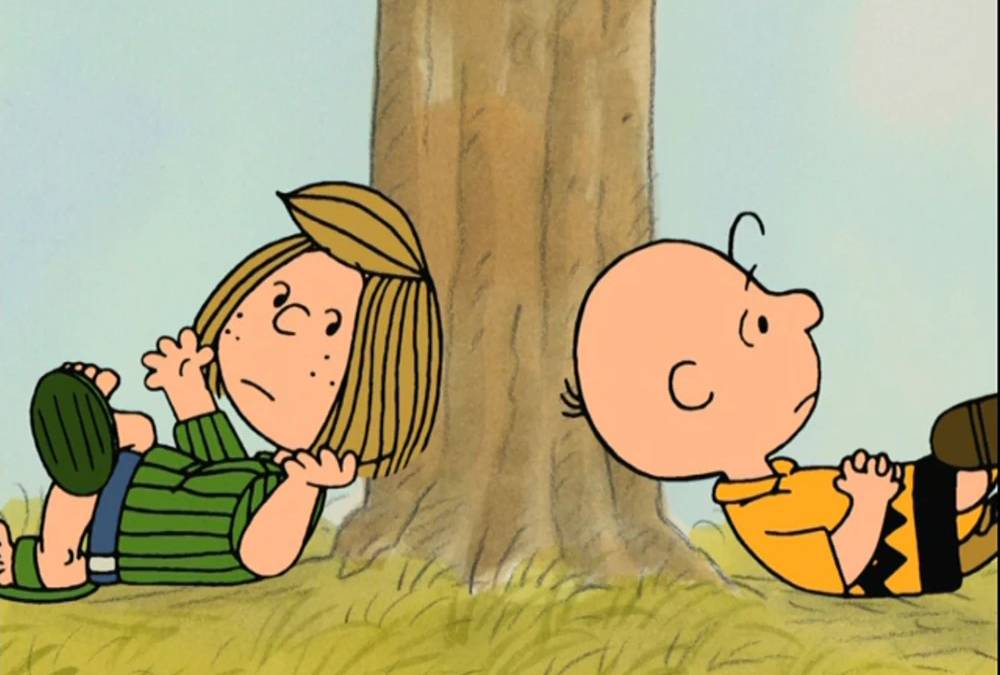
When Patty appears in the panels of Peanuts, her narrative role often revolves around her academic underachievement, her struggles with staying awake at her desk, or her participation in neighborhood sports teams. But just as frequently, her appearances center on her unrequited, often poorly expressed crush on Charlie Brown. He, of course, remains entirely oblivious to her romantic intentions. As far as the frequently distracted and perpetually overwhelmed eight-year-old can tell, Patty is simply a remarkably energetic person who addresses him by his familiar nickname, "Chuck," and behaves with a level of enthusiastic familiarity that leaves him bewildered.
However, if you read enough of Peanuts in a continuous run, especially once the strip hits the 1970s and beyond, you start to get a distinct impression that the core cast of children mostly drive each other crazy. They are all distinct eccentrics in their own childlike ways. While Charlie Brown has dependable buddies like Linus and Franklin to lean on, the core mechanical drive of Peanuts—which frequently keeps Charlie Brown trapped in a state of mild, relatable misery—means he is more often sharing panel time with aggressive frenemies like Lucy van Pelt. Even his beagle, Snoopy, maintains a strangely adversarial, psychologically complex relationship with Charlie Brown that often leans further into indifference or mild mockery than a traditional pet dynamic would suggest.
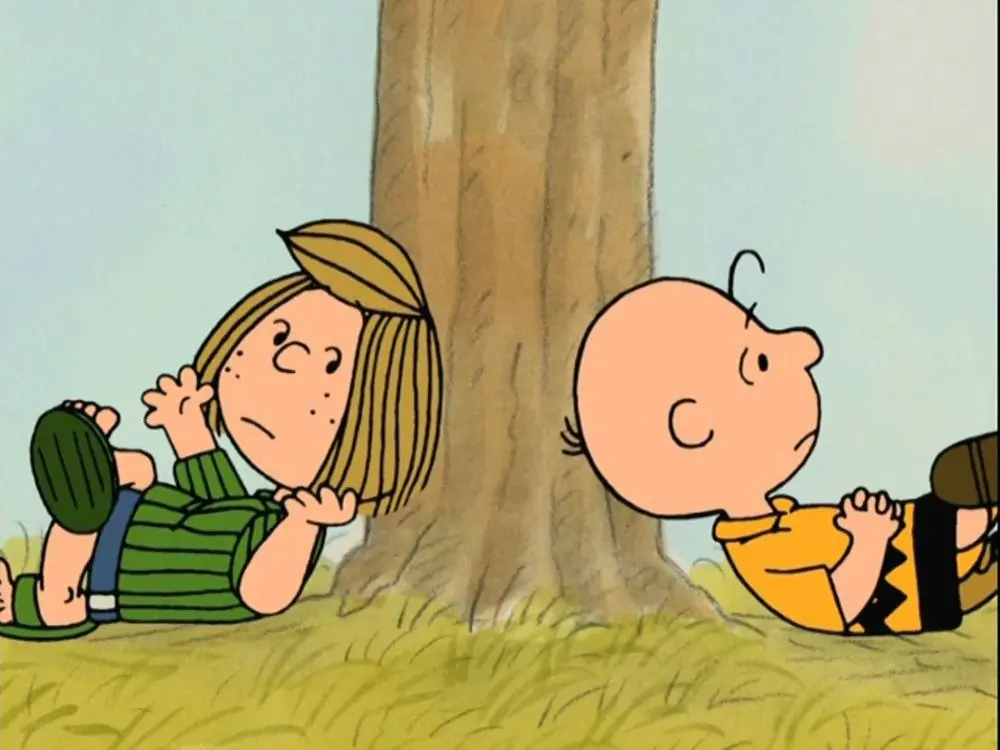
Peppermint Patty, on the other hand, consistently has "Chuck’s" back like a jacket whenever she is around. She is certainly as eccentric as any other member of the core Peanuts cast, but her specific brand of eccentricity is rarely deployed to make Charlie Brown’s life intentionally difficult. Most of the time, her unique quirks manifest as unwavering support for her favorite round-headed friend, setting her apart from a neighborhood dynamic otherwise built on sarcasm, football-pulling tricks, and psychiatric booth diagnostic fees.

A Month-Long Hospital Stint Highlights True Loyalty
A brilliant example of this dynamic comes from a memorable month-long storyline in the summer of 1979, wherein Charlie Brown unexpectedly finds himself admitted to the hospital. The narrative never explicitly establishes the exact nature of his ailment—aside from the fact that he is genuinely sick—but much of what makes the storyline remarkable is how it ripples out to affect Charlie Brown’s diverse circle of friends and family. During this arc, even Lucy van Pelt admits to herself that she actually considers him a friend, though she naturally keeps that revelation to herself rather than offering any comforting words to his face. Meanwhile, Snoopy belatedly gets around to wondering where the round-headed kid went, perfectly capturing the beagle’s tendency to remain thoroughly trapped inside his own imaginative inner world.
Most crucially, both Peppermint Patty and her loyal sidekick, Marcie, make the deliberate trip across town to visit Charlie Brown at the hospital, demonstrating a level of proactive care that stands out starkly against the backdrop of typical neighborhood indifference.
In another certified "where the hell are these kids’ parents?" moment characteristic of classic comic strips, Patty and Marcie are informed upon arrival that they cannot personally visit Charlie Brown inside his hospital room because they are too young to enter the ward. Undeterred by administrative rules or the physical barrier of the building, they opt instead to sit outside the hospital on a park bench, patiently watching what they assume to be his room’s window until the light finally goes out for the night.
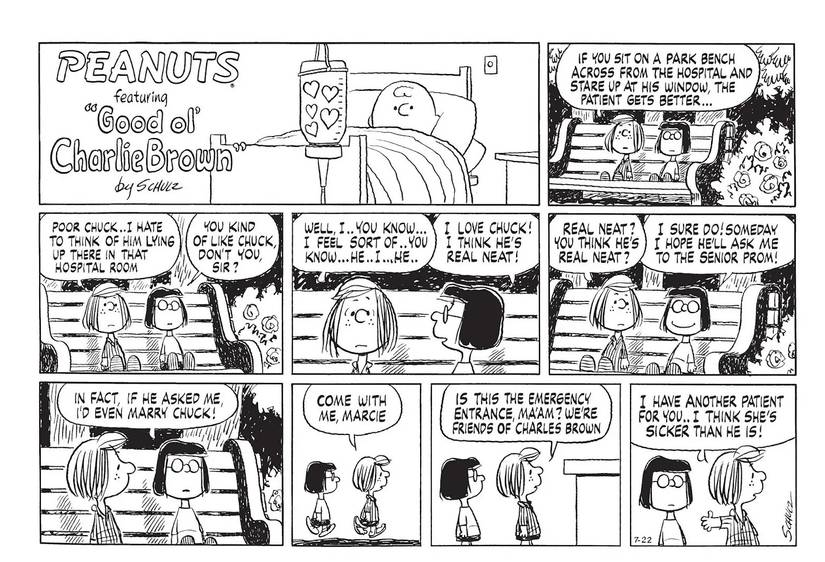
"It’s a well-known fact, Marcie, that a patient will recover faster if he knows a friend is staring up at his room," Patty declares with absolute, unshakeable conviction.
While Patty and Marcie’s appearances in the hospital arc certainly fit comfortably within one of Patty’s established comedic shticks—where she instantly locks onto some random, arbitrary decision and commits to it with unwavering stubbornness no matter how absurd it might be—the moment carries significant emotional weight during a long, unbroken read of the series. This sequence stands out quietly as one of the nicest, most genuinely selfless things anyone does for Charlie Brown across the entire multi-decade run of the Peanuts canon. Patty and Marcie are not there to cause neighborhood problems, orchestrate a practical joke, or score cheap gags at Chuck’s expense. They are simply there to support their friend, full stop.
For a comic strip like Peanuts that has built its global reputation on a delicate balance of melancholy and wholesomeness, actual overtly wholesome moments within the narrative canon are surprisingly few and far between. That kind of sentimental sweetness was usually reserved for licensed merchandise like T-shirts, greeting cards, decorative posters, or the beloved animated television specials. As a result, when something genuinely touching and sincere does happen within the daily panels of Peanuts, it still manages to pack a distinct emotional punch. That is a crucial lesson about pacing and sentimentality that Charles Schulz understood inherently, even if many of his comic strip imitators over the years ultimately failed to grasp it.
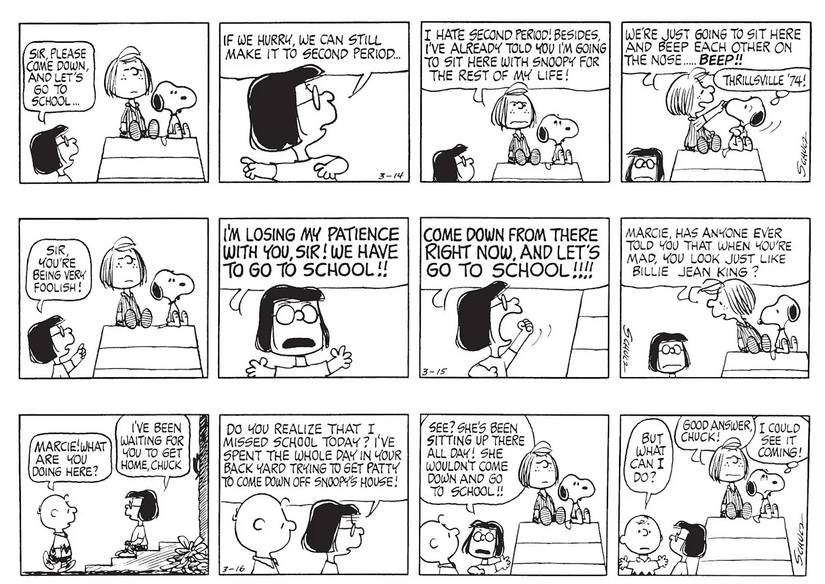
If a reader wanted to extract a definitive thesis statement about the true nature of friendship from the expansive run of Peanuts, they could certainly do a lot worse than examining this specific 1979 hospital arc. Peppermint Patty certainly possesses her fair share of incidental strangenesses and endearing blind spots, much like any other child wandering through the suburban landscape of Peanuts, but the overarching narrative suggests that everyone could benefit from having a friend who is willing to sit on a park bench in the dark just to stare up at a hospital window.