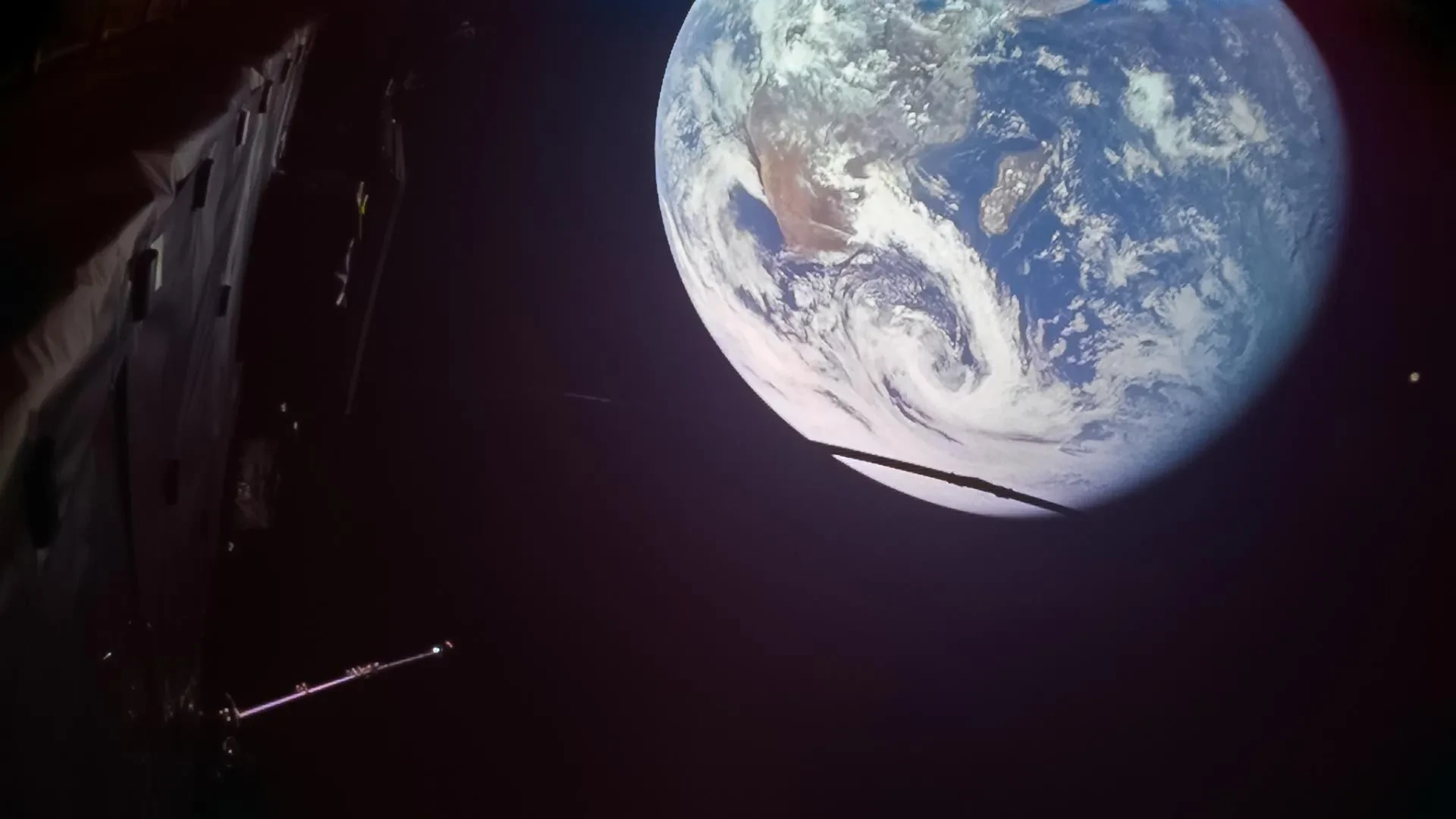
On September 28, the European Space Agency’s (ESA) Jupiter Icy Moons Explorer—famously known as Juice—completed a pivotal maneuver in its long-distance journey to the outer Solar System. Skimming the outer reaches of Earth’s atmosphere, the spacecraft successfully leveraged the planet’s gravity to reshape its trajectory toward Jupiter. This high-stakes "gravity assist" was executed with remarkable efficiency, allowing the probe to change its heading and velocity while consuming only a minimal fraction of its precious fuel reserves.
The gravity assist was the result of months of meticulous planning and real-time navigation. By passing just 8,640 kilometers above the Indian Ocean at 13:45 CEST (11:45 UTC), Juice’s path was altered by 20 degrees relative to its previous trajectory, while simultaneously receiving a velocity boost of 3.5 km/s. This maneuver acts as a cosmic slingshot, essential for redirecting the massive spacecraft toward the Jovian system without requiring a massive, fuel-heavy engine burn.
A Masterclass in Precision Navigation
The success of the flyby was not a matter of chance, but the culmination of an intensive period of monitoring. Mission controllers at ESA began observing Juice with heightened scrutiny starting on August 17, a surveillance period that is slated to continue through October 10. During the four weeks leading up to the encounter, the flight dynamics team had identified six specific opportunities to perform course corrections to refine the spacecraft’s approach. Remarkably, only one small adjustment was required to place Juice on the exact vector needed to harness Earth’s gravitational pull.
"The flyby required ultra-precise navigation in real time," says Angela Dietz, Juice’s Spacecraft Operations Manager. "Thanks to our very careful planning, we used only a small amount of the propellant reserved for this flyby. This gives us more to use at Jupiter to carry out observations of the planet’s icy moons."
Preserving propellant is a mission-critical objective. Because Juice’s scientific campaign around Jupiter and its complex system of moons will span years, every kilogram of fuel saved during the cruise phase is a resource that can later be repurposed to ensure the spacecraft remains operational, maintains its orbit, and performs the necessary maneuvers to study Ganymede, Callisto, and Europa.
Earth as a High-Stakes Testing Ground
While the primary goal of the September 28 encounter was orbital refinement, the event also provided a rare and valuable opportunity to stress-test Juice’s sophisticated suite of scientific instruments. The spacecraft carries 10 distinct instruments designed to probe the Jovian system, and calibrating these tools in the harsh environment of space is a complex undertaking.
This flyby marked the third major opportunity for such calibration during the mission, following the 2024 lunar-Earth gravity assist and the 2025 observations of Comet 3I/ATLAS. Coordinating the operation required a massive collaborative effort between ESA’s spacecraft operations, science operations, and various technical centers, all working in tandem with the diverse scientific teams responsible for each of the 10 instruments.
"Juice’s journey to Jupiter provides only a few opportunities to calibrate and validate the instruments under well-understood environmental conditions," explains Claire Vallat, the Juice project scientist who led the coordination effort.
During the flyby, instrument operation was carefully prioritized. The mission team had to account for operational constraints, such as when Juice passed through Earth’s shadow and was forced to rely exclusively on battery power. Decisions on which instruments to activate were based on their relevance to future Jupiter operations and whether the opportunity provided unique data that could not be captured later. By testing the instruments against the familiar backdrop of Earth, scientists can better understand how the hardware behaves in the vacuum of space, refining the analytical tools that will eventually be used to process data from the Jovian system.
Preparing for the Jovian Frontier
The Earth encounter, while complex, serves as a rehearsal for the far more rigorous challenges that await Juice at its destination. Once the spacecraft reaches Jupiter, it is scheduled to perform 35 flybys of the planet’s large icy moons. These encounters are scientifically demanding, requiring the spacecraft to function at peak performance to capture high-resolution data during the narrow windows when it is in close proximity to its targets.
Planning for these future encounters is an exercise in long-term vision. Discussions regarding the instrument configurations for the Europa flybys, for example, began approximately 10 years ago and will continue until the spacecraft finally passes the moon in the early 2030s. Each flyby of Earth is an essential step in maturing the mission team’s operational capabilities, ensuring that when Juice arrives at Jupiter, the transition to active scientific observation is seamless and effective.
Exploring the Magnetotail
In addition to the orbital mechanics and instrument testing, the flyby offered a unique scientific window into Earth’s own environment. For several days, Juice traveled through the magnetotail—a vast, comet-like extension of Earth’s magnetic field that stretches far away from the Sun. This allowed the spacecraft to collect measurements of magnetic fields and charged particles in a region of space rarely sampled with such high-fidelity instrumentation.
Simultaneously, the European-Chinese Smile (Solar wind Magnetosphere Ionosphere Link Explorer) mission was observing the aurorae and measuring magnetic fields much closer to the planet. By combining data from both Juice and Smile, scientists hope to establish a rare, comprehensive link between activity occurring deep in the magnetotail and the events unfolding in Earth’s polar regions.
In the coming weeks, as the data from the flyby reaches ground stations and is processed, researchers expect to release initial results, including spectra and high-resolution imagery captured by JANUS, Juice’s primary scientific camera. These images of Earth and the Moon will serve as a triumphant preview of the spacecraft’s imaging capabilities.
Looking Toward the Final Approach
Juice’s dance with Earth is not yet complete. The mission architecture dictates one more visit to our home planet in January 2029. This third and final flyby will serve as the definitive maneuver to lock the spacecraft into its final trajectory, positioning it for its long-awaited arrival at Jupiter in 2031.
Launched in April 2023 aboard an Ariane 5 rocket from Europe’s Spaceport in Kourou, French Guiana, Juice represents one of the most ambitious undertakings in the history of planetary exploration. Over an eight-year cruise, the spacecraft utilizes a series of gravity assists—including those involving Earth and Venus—to navigate the vast distances of the inner Solar System.
Once it reaches the Jupiter system, the mission will enter a new, highly active phase. Juice will perform detailed observations of Jupiter, a gas giant that serves as an archetype for planetary systems across the universe, while simultaneously conducting 35 flybys of Ganymede, Callisto, and Europa. By utilizing a powerful suite of remote sensing, geophysical, and in situ instruments, the mission aims to characterize these moons, investigating their internal structures and their potential to harbor conditions suitable for life. As it maneuvers through the complex magnetic, radiation, and plasma environment of the Jovian system, Juice will eventually transition to a dedicated orbit around Ganymede, concluding its journey by focusing on the largest moon in the Solar System.
For now, the spacecraft continues its steady, measured trek through the dark, having successfully leveraged the gravity of its home world to reach a little closer to its ultimate destination.